
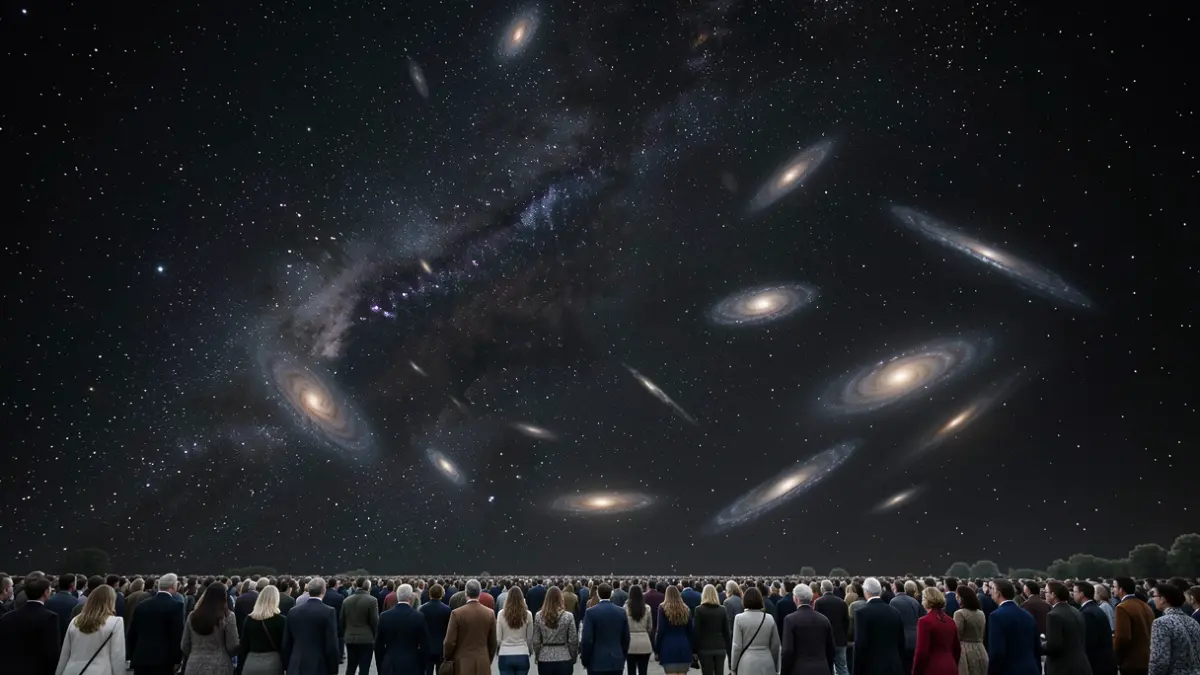
During the first hundreds of millions of years of its history, the universe was a very different place from what we know today. Galaxies as we observe them did not yet exist, and space was populated mainly by a gas of hydrogen and helium. As the first stars formed, their radiation began to transform that environment. Hydrogen, which until then was mostly neutral, started to lose its electrons. Much later, a new generation of luminous sources caused a similar transformation in helium.
Reconstructing how these changes occurred, how long they lasted, and what objects drove them is one of cosmology's great challenges. Now, the Lumina project offers a new tool to tackle these questions. Its developers have created a simulation that jointly tracks the evolution of galaxies, black holes, and the gas filling intergalactic space. The result allows for the study of two major episodes in cosmic history: the reionization of hydrogen and that of helium.
After the Big Bang, matter was in an extremely hot and dense state. Electrons could not remain bound to atomic nuclei, so matter formed a plasma. With cosmic expansion, the temperature decreased until, about 380,000 years after the beginning, electrons could combine with nuclei and form atoms, mainly hydrogen and helium.
From then on, light could travel through space with much greater freedom. However, the stars and galaxies that would eventually illuminate the universe were still missing. For a long period, known as the cosmic dark ages, matter gradually clumped together under gravity to form the first structures capable of producing light.
Young stars emitted abundant ultraviolet radiation. When this radiation reached the surrounding gas, it could strip electrons from hydrogen atoms. This process is called ionization: the atom loses its electrical neutrality. Reionization was the large-scale transformation by which intergalactic gas became dominated by ionized hydrogen. It did not happen all at once. Around the first luminous sources, ionized regions appeared that grew and merged, like expanding bubbles in an initially more opaque medium.
Helium also underwent a significant transformation, although its timing and responsible agents were different. In particular, the reionization of helium studied by Lumina involves stripping the second electron from helium atoms that had already lost their first. This requires more energetic radiation than that needed to ionize hydrogen. Stars can produce photons capable of ionizing hydrogen, but their usual radiation is not sufficient to efficiently explain the large-scale reionization of helium.
This is where active galactic nuclei come into play – the central regions of some galaxies whose enormous luminosity is largely due to matter falling towards a supermassive black hole. When that material heats up and emits high-energy radiation, it can modify the properties of gas at enormous distances. These objects, including quasars, play a fundamental role in the second phase studied by Lumina.
Lumina's main advance is methodological. It doesn't just calculate where galaxies are or estimate radiation output separately. It combines the evolution of matter, gas movement, star and black hole formation, and the transport of radiation emitted by these objects. To do this, the team simulated a cubic volume of 500 megaparsecs on a side in comoving distances.
One of the main results is that the reionization of hydrogen was a late and prolonged process, driven primarily by stars. According to Lumina, the median region of the analyzed subdivisions of the simulation becomes completely ionized around a redshift of 5.2. The simulation preserves small regions of neutral hydrogen until a redshift of approximately 4.75.
The results also indicate that active galactic nuclei contribute to hydrogen ionization, although their contribution is secondary to that of stars. Towards the end of the process, about 15% of the ionizing radiation budget comes from these active sources, according to the model. Stars bear the main weight of the first transformation, while black holes gain more prominence in the second.
Helium reionization begins, according to Lumina, around a redshift of 6. Its midpoint is approximately at 4, and the process is practically complete when the universe reaches a redshift of 3. In this case, the energetic radiation from active galactic nuclei is the protagonist. By ionizing helium, that radiation also deposits energy into the intergalactic gas and raises its temperature.
Lumina obtains a thermal evolution of the gas that is broadly compatible with available observations and reproduces additional heating associated with helium reionization. It also calculates a global measure of the interaction between free electrons and the cosmic microwave background radiation that aligns very well with constraints from the European Space Agency's Planck mission.
Lumina does not definitively resolve the origin and evolution of reionization. Its results depend on the hypotheses incorporated into models of star formation, black hole growth, and radiation propagation. However, it can help interpret future observations of distant galaxies and quasar light absorption to reconstruct the distribution of ionized and neutral gas more precisely.