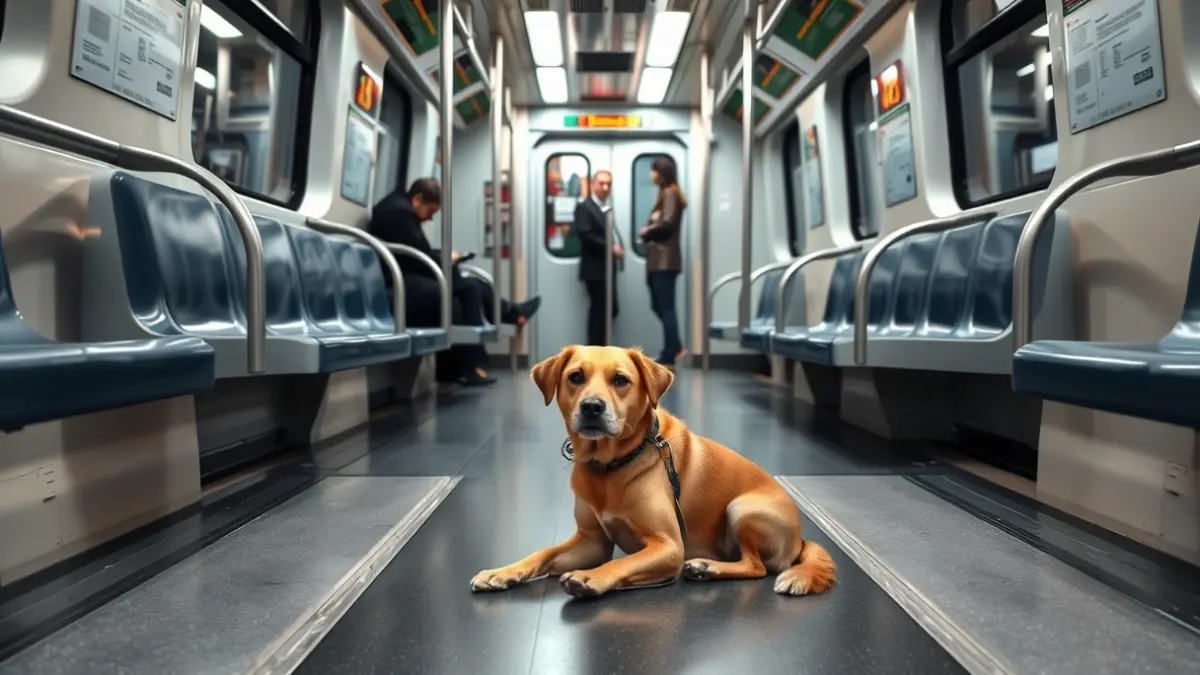
The general deputy of Bizkaia, acting as president of the Bizkaia Transport Consortium, has put forward a proposal to Metro Bilbao to amend its current regulations. The aim is to permit dogs weighing more than eight kilograms, which is the current maximum allowed, to travel on the subway. She believes that the debate surrounding their access is now settled, and the focus should shift to establishing appropriate conditions, such as designating specific carriages or requiring muzzles.
Last year, pet owners launched a campaign that garnered approximately 8,000 endorsements on change.org, advocating for larger dogs to be allowed on subway lines 1 and 2, which currently enforce some of the most restrictive regulations in Spain. In contrast, line 3, operated by Euskotren, Renfe commuter trains, and subway systems in cities like Lisbon, Porto, Brussels, Vienna, Paris, Berlin, and Rome, already permit access for larger dogs.
“"Society is changing, and nowadays it is common for dogs to accompany their owners in indoor spaces like shops. We all see it as normal."
Consequently, she has urged Metro Bilbao to revise its current regulations to facilitate the entry of these pets into the subway. She emphasized that “the important thing is to determine the rules that make everyone's rights compatible”.
Furthermore, the general deputy announced her expectation that the tender for new subway cars and signaling systems could be launched before summer. This project represents an investment of nearly 800 million euros, making it “the most significant public investment to be made in Bizkaia in recent years,” underscoring the subway's crucial role in citizens' daily mobility.
Currently, the fleet operating on lines 1 and 2 comprises 46 convoys; half of these have been in service since the subway's inauguration, each accumulating three million kilometers. The remaining units include 14 in operation since 2001, with 2.5 million kilometers, and the latest nine, running since 2009, with 1.5 million kilometers. The introduction of this “new generation” of units and signaling systems will not only increase the capacity of the convoys, all of which will consist of five cars, but also enable a higher service frequency.