At Bilbao Airport, in Loiu, 14 aircraft are based almost all year round, and more in the summer. They return to the nest each night to rest, even if only for a few hours, after a frantic day of bringing passengers back and forth. It's time to undergo maintenance by mechanics. The aircraft take to the air very early, almost always at dawn. But before the first light, the flight attendants and pilots arrive, giving a human face to these metal birds. More than 400 professionals, mostly from Biscay, work tirelessly, always against the clock, so that Bilbao can enjoy fast and efficient air connections with major European cities. This report covers a day in the life of one of the aircraft based in Loiu and its crew.
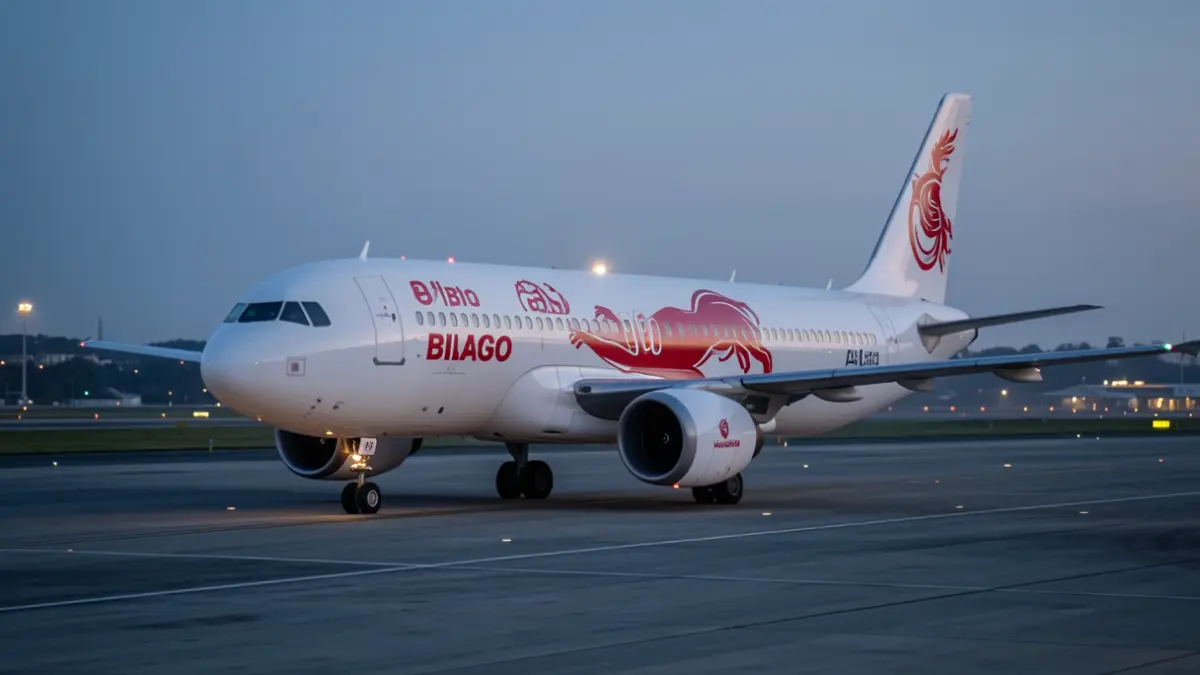
It is registered as EC-LUO and belongs to Vueling. It's an Airbus 320 with a capacity for 180 passengers and is perhaps the most 'Bilbao' of the planes that spend the night in Loiu. For a special reason: the red and white vinyl covering its aluminum skin. It's ten past six in the morning at 'La Paloma', and the darkness still prevents the Athletic crest from being distinguished. The aircraft occasionally transports the footballers, but on other days it's just another regular line aircraft. 'With this design, we attract a lot of attention at most airports,' explains Dani Sánchez Alea. This 47-year-old Asturian, residing in Erandio, will be our commander.
Dani meets with his team for the day. Enrique Iglesias, originally from A Coruña, will serve as co-pilot. Leire Uribarri, from Mungia, will be the purser. The crew is completed by flight attendants (known in aviation jargon as TCPs) Gaizkane Puente, Andrea Marín, and Aida Pérez.
The six gather for the welcome briefing. They have ground support from Cristina, who ensures the human team is complete. 'If someone gets sick or is delayed for any reason, we always have a substitute on standby within 60 minutes of Loiu,' she explains. The goal is for the aircraft to remain grounded for the shortest possible time. Because an aircraft grounded is a disaster. The airline loses thousands of euros for every hour wasted. An Airbus 320 can cost up to 100 million euros. There's a lot of investment to amortize. And then there are the compensation issues. If the flight is delayed more than two hours due to the company's fault, 250 euros must be paid to each traveler. If you do the math, that's nearly 50,000 per takeoff.
'Are we all well, in good spirits, and fit to fly?' This is the first question a pilot always asks. 'It's important because we have a lot of responsibility up there and we need to be 100%.' The next step is to explain the day's flight plan. Today, this crew will make four hops. 'We'll go to Lisbon and back. Then to Alicante and return,' announces Dani. But the plane won't stop there. There will be a crew change in the afternoon in Loiu, and the Athletic's 'Airbus' will head to Milan. After landing in the Italian city, it will finally return home to rest. It will have been almost 4,000 kilometers. Just a few hours of rest, before everything starts again. This happens 365 days a year. 'This never stops. A plane only stops when it undergoes a special inspection. And, in that case, they send us another aircraft.'
The briefing also includes a review of the weather. 'Today there will be no south wind in Loiu.' The crew expresses relief. 'I don't mind flying on those days. It's complicated, but we're used to it, although I understand it's uncomfortable for passengers,' the commander values. The final instruction concerns the keyword that grants access to the aircraft's cockpit. It's a security safeguard, implemented since the Twin Towers attack.
The meeting ends, and it's time for checks. The cabin crew review the safety equipment. They check the trolleys and catering. They also check the mobile devices that support the payment terminals. They deploy incredible energy. They move with ease through every narrow corner of the plane. In the minds of Leire, Gaizkane, Aida, and Andrea, a list they know by heart is repeated.
Dani puts on a reflective vest and goes down to the tarmac. It's time for a visual inspection of the aircraft. Dawn has just broken. He puts his head into the 320's giant turbine. He looks for possible cracks or signs that the engine is not in good condition. Then he looks at the ground. 'You mainly check that there are no oil or other liquid leaks and that no cable or hose is still connected.' Everything is correct.
There's no time for more. The first passengers for Lisbon board the plane. Boarding takes almost half an hour, even though it's done very orderly. The flight attendants ensure that no passenger blocks the aisle because they can't, for example, place their luggage in the overhead compartments. A single person can create an unbearable bottleneck for the other 179. 'The great secret of a plane that makes constant rotations, like today's, is to try to be on time for each hop,' explains Leire. 'If you start accumulating delays on the first takeoff, things can pile up and worsen throughout the day. That's why it's important to be on time from the first minute.'
The first mission of the day goes very well. We take off at 07:42. That's 7 minutes later than scheduled, but Dani and Enrique make up the time in flight. We arrive at our destination 19 minutes ahead of schedule. Time to breathe. The crew eats some sweets brought by Leire. They congratulate her. Today is her 39th birthday. The team smiles. They look happy. 'I love my job. I'm coming back today after 10 days off and was eager to get back to work,' says the pilot.
'What we do is very vocational,' argues Gaizkane. This professional, who lives in Leioa, recounts her best memory during her career. 'A man choked on a sandwich and started turning blue. He wasn't breathing. Between another colleague and me, we managed to lift him and perform the Heimlich maneuver until he spat out the food. We possibly prevented him from drowning. I felt very good.'
At breakneck speed, the attendants clean the seats. The first passengers for the Lisbon-Bilbao flight begin to board. The ritual is repeated: demonstration of safety measures, seatbelts fastened, and off we go. We depart 13 minutes late. But we beat the clock again in the sky. We land in Loiu 8 minutes ahead of schedule.
Things are going well. And yet, something special happens on every flight. On the first hop of the morning, some passengers were a bit rowdy because the model Jon Kortajarena and his baby were traveling. And on the hop that now takes us to Alicante, there's a giant guide dog that draws a lot of attention. Leire is particularly attentive to these circumstances. 'It's part of our job, to reassure passengers and offer them assistance.'
New takeoff. This time towards the Levantine coast. Time passes very quickly in the air. Enrique tries to eat something while Dani is at the controls. Pilots always have a different meal at different times. 'It's to prevent possible intoxication.' Soon they glimpse the Mediterranean light. 'There are very beautiful routes and airports, like the approach to Lisbon we just did, or the one to Barcelona.' Back in Loiu (also on time), the crew declares their duty finished. But the Athletic's 'Airbus' doesn't stop. A new crew will take it to Milan, finally returning to Bilbao at 22:13. It's already dark. It has been 6 hops, 3,847 kilometers covered, and 1,052 passengers transported. Tomorrow awaits a new day and another eight hops (two visits to Seville, Porto, and Barcelona).