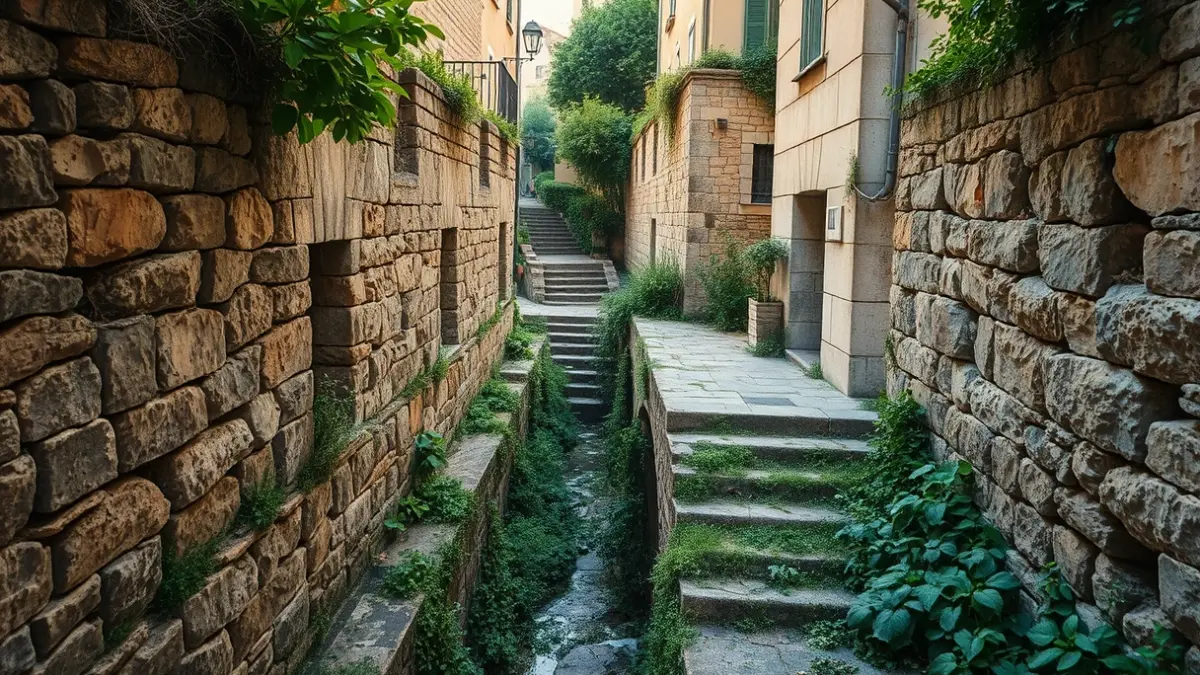
Although they often go unnoticed today, the Caños are urban spaces of medieval origin whose primary function was to serve as drainage, into which dirty water from hillside homes was discharged. Scattered throughout various points of Gasteiz's Medieval Quarter, their name comes from the ravine-like shape of the terrain through which the waters flowed.
During the spring and summer months, it is possible to discover them by taking a guided tour. Currently, they are public spaces of restricted use and municipal property, located within the residential blocks of the Medieval Quarter of the Alavese capital. They serve as spaces for ventilation and lighting of homes. However, in various house rehabilitation processes, the channeling of dirty water has been modified towards new underground pipes in the main streets, although some areas of the Quarter still retain the Caños' original function.
Like any other element belonging to our historical heritage, the Caños of Gasteiz's Medieval Quarter also have their history. For centuries, the channeling of these waters was open-air, which was a constant source of disease. After the cholera epidemic that Gasteiz suffered in 1878, a series of regulations were approved to keep the city clean. Among these, the sanitation of the Caños was included as one of the main foci of diseases, to prevent their proliferation and improve the general health conditions of the population. It was then decided to channel the waters and pave the ground, giving rise to what today seem to be eternally forgotten spaces.
Their specific location within residential blocks and their limited visibility have meant that, over time, they have become trapped in modern urban planning, resulting in them being considered mere residual urban spaces.
Aware of this situation and the need to improve them, the GAIA Ecologist Group initiated an intervention project years ago, aiming to recover them as intrinsic elements of the medieval city, preserve them from interventions that alter their original morphology, and revalue them as a sign of identity and a reference point for historical and cultural heritage. Another objective is to gradually transform them into small botanical gardens, replacing the dirt and bad odors of some of them with a green area that allows residents to enjoy a space that provides freshness and elegance.