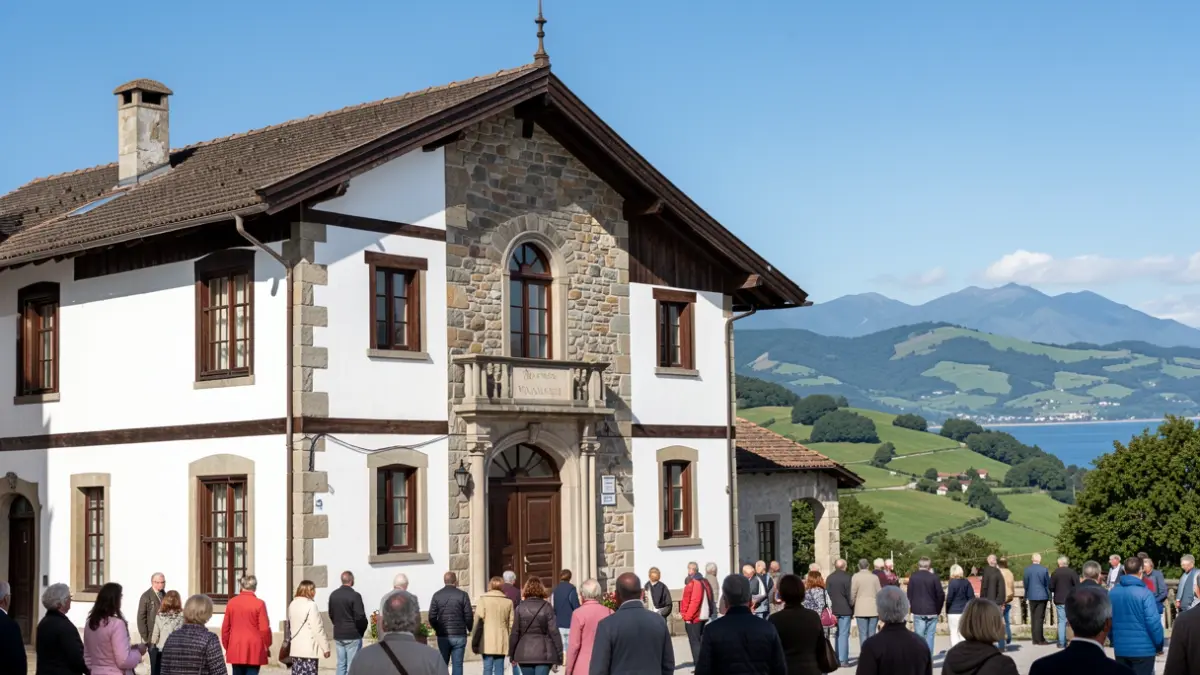
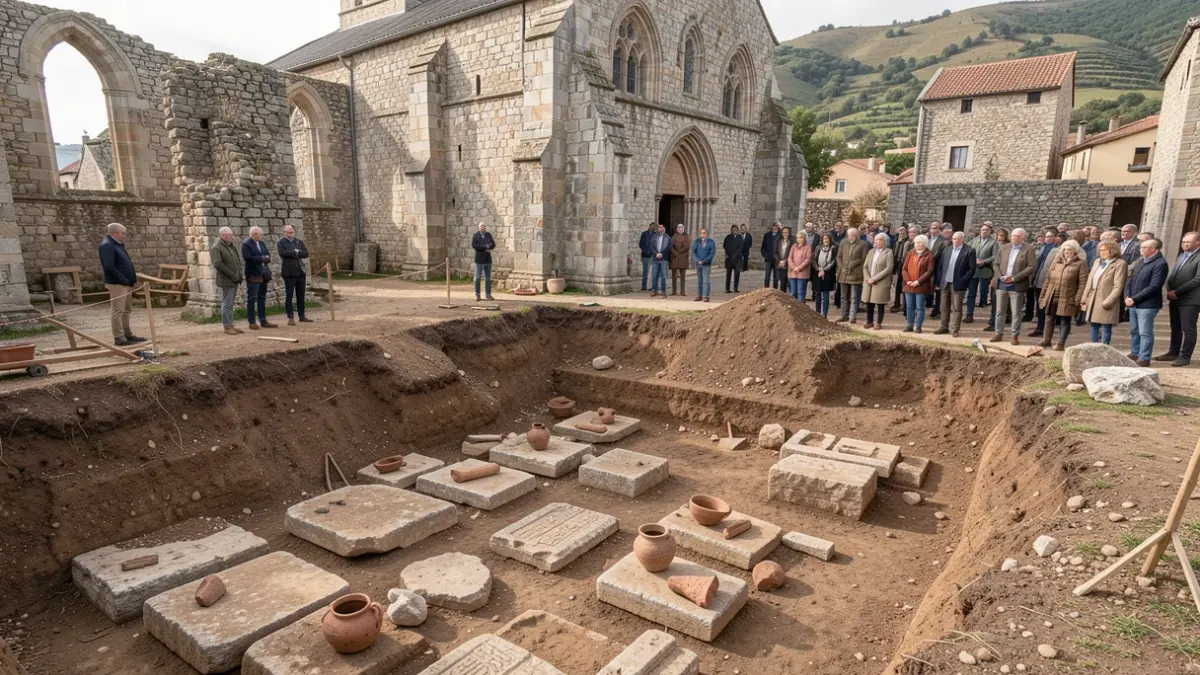
Archaeological excavations at the San Jorge church in Santurtzi have uncovered a medieval burial, possible remains of an ancient domestic space, and structures of the late Gothic church, expanding knowledge of the municipality's history. Key findings include a stone slab medieval burial, remnants of an ancient domestic space, and structures from the late Gothic church that preceded the current Baroque temple.
The work began in 2025 as part of activities organized by the council in collaboration with the Provincial Council of Bizkaia for Santurtzi's 950th anniversary, and continued through 2026, documenting various historical stages of this site.
Among the oldest findings are a slab burial, bone remains, ceramics, fauna, and other organic materials, potentially dating between the 9th and 12th centuries. Post holes have also been identified, possibly corresponding to an ancient domestic space predating documented temples, though their function and age are yet to be determined.
Two large stone structures have been located, potentially representing the bases of columns from the former late Gothic church, built approximately between 1470 and 1530. Their arrangement supports the hypothesis of a Latin cross plan, pending confirmation through further excavations.
So far, no physical remains of pre-Romanesque or Romanesque temples have been found in the excavated areas, although it is not ruled out that they may be preserved in uninvestigated areas or that some materials were reused in later constructions.
The excavations have also documented different funerary practices. Alongside human remains from various periods, ceramics, clothing, footwear, coins, and rosaries have been recovered, providing information on the daily life and customs of the population. Two stone tombs have also been found near the altar steps, possibly containing burials of individuals linked to the priesthood.
The findings help reconstruct the evolution of the religious space, from early medieval vestiges to the current Baroque church, whose main works were completed in the early 18th century. They also shed light on the history of the surrounding area, which included an external cemetery between the current Plaza Juan José Mendizábal and the Town Hall facade.
Human remains recovered in 2025 have undergone anthropological study, providing information on ages, sexes, and physical characteristics, which will be complemented by findings from the 2026 campaign.
The excavations are promoted by the Town Hall of Santurtzi, with the collaboration of the Diocese of Bilbao, the San Jorge church, and the Las Encartaciones Museum, and were carried out by Ondare Babesa S.L.
The research results will contribute to expanding knowledge about the municipality's history and will be included in future publications linked to the proceedings of the Congress for Santurtzi's 950th anniversary.
Once the work is completed, the Town Hall of Santurtzi will organize guided tours to showcase the main findings of the archaeological excavations and bring the history of the San Jorge church and its surroundings closer to the public.
This will be an opportunity to discover the discovered vestiges firsthand and better understand the historical evolution of one of the municipality's most emblematic sites.
These tours will be led by art history expert Jesús Muñiz Petralanda during November, on the 10th, 12th, and 13th at 6:00 PM, the 14th at 10:00 AM in Basque and 11:00 AM, and finally on Sunday the 15th with two more sessions at 10:00 AM and 11:00 AM. The visits are free and reservations must be made through the municipality's tourist office at 944839494 or via email: turismo@santurtzi.eus.