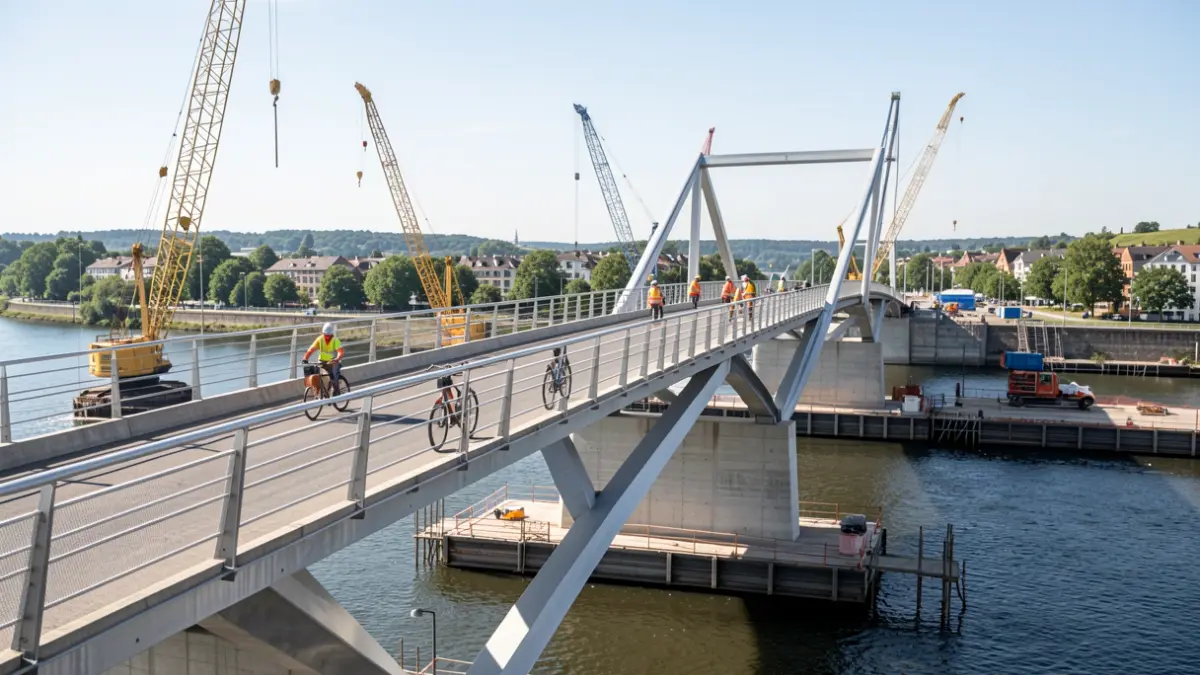
The construction of the future footbridge over the River, connecting Barakaldo and Erandio, enters a decisive new phase. Next Wednesday, May 27th, the first metal section of the structure will be placed, a visible milestone for a project aiming to become one of the most emblematic infrastructures for sustainable mobility in Bizkaia.
The footbridge is part of the Bizkaia Territorial Sector Plan for Cycle Paths and is designed to connect both sides of the river via a safe and accessible route for pedestrians and cyclists. The project costs around 29 million euros (VAT included) following a contractual modification that expanded the scope of work and extended execution deadlines. Initially, the opening was projected for the summer of 2026, but technical managers are now avoiding setting a firm date. "The plan foresees manufacturing and installing approximately one section per month, meaning the complete execution could take a year or more," explained Alejandro Godoy, an engineer specializing in bridges and structures.
The footbridge will be 352.2 meters long and six meters wide, with three meters designated for cyclists, three for pedestrians, and a central 0.50-meter strip with lighting and urban furniture. Additionally, it will feature a 60.2-meter movable central span to allow the passage of large vessels. Its curved geometry, both in plan and elevation, along with its mobile system, demands millimeter precision, which the project manager, Gorka Marchán, describes as "watchmaking" work. The section to be installed on Wednesday is number 10, in Erandio, one of only two sections assembled from land, alongside the one on the Barakaldo side. It measures 32 meters in length, eight meters in width, and weighs approximately 60 tons, although it has been divided into two pieces for transport.
“"The plan foresees manufacturing and installing approximately one section per month, meaning the complete execution could take a year or more"
The transport will depart at night from Vitoria and will be coordinated by the Ertzaintza (Basque Police). The convoy will pass through La Avanzada, the University exit, and Astrabudua, where signage and other urban elements will need to be dismantled to reach the assembly area. The lifting operation will begin early Wednesday morning and will require two large cranes for several hours, with millimeter adjustments for the piece's fit. The remaining sections will be transported by pontoons to Zorroza for subsequent assembly and transport via the river.
How does the system work? The footbridge consists of ten large sections made of S355 steel with special protection for a marine environment, as corten steel has poorer performance against salinity. Each piece is manufactured through high-precision cutting, machining, assembly, and welding processes. One of the most unique elements will be the central span opening system, which will rotate 90 degrees clockwise to clear the navigation channel.
The mechanism will operate via a rotating ring on the main piers powered by three electric motors, with dual electrical supply and a backup system with a generator set. The opening, planned once or twice a month for the passage of large vessels, will last about five minutes and will be communicated to the public 20 minutes in advance via public address and luminous signaling. The interior of the deck will integrate electrical conduits, control systems, communications, and lighting. The project also includes two conical masts of about nine meters, manufactured in Italy, and a counterweight system to balance the mobile sections, especially during the closing phase. Before final assembly, functional tests will be carried out to ensure the millimeter fit of the entire structure.