
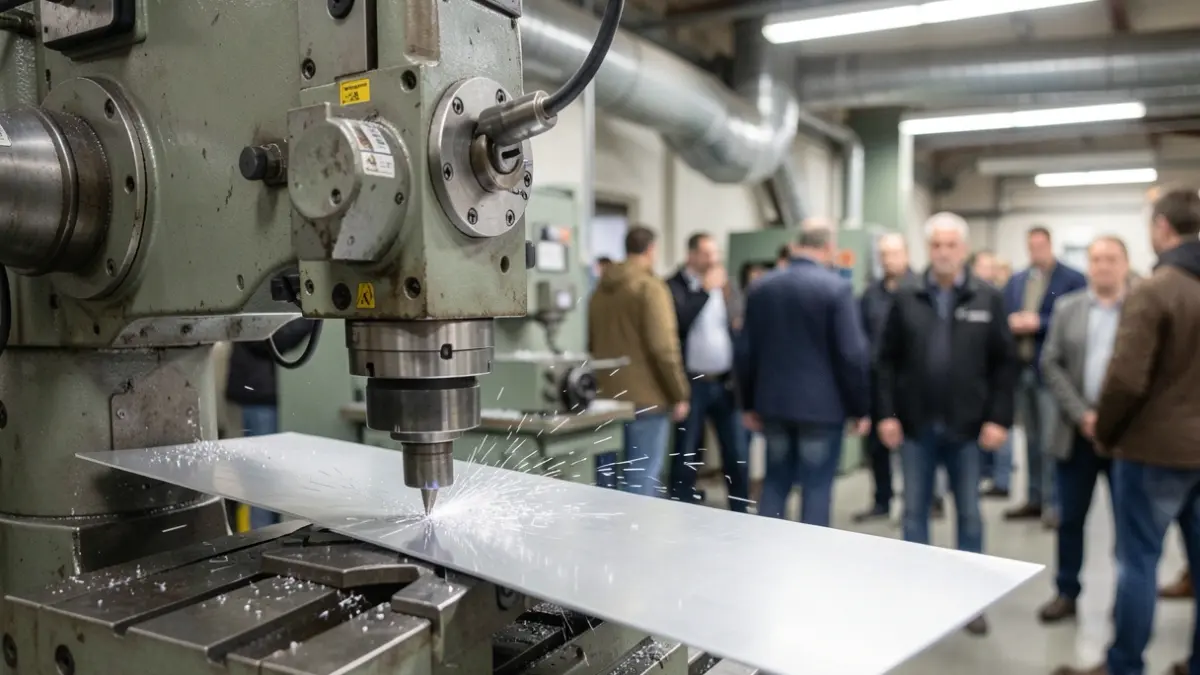
More than 16,000 workers are currently employed in the aeronautical sector of the Basque Country, and the number is increasing year by year. One of the main challenges in this sector is the manufacturing of fuselages, which are the parts that will form the skin of aircraft. The primary technology for manufacturing these parts is mechanical machining, where material is removed through chip formation to give the part the desired shape and dimensions. For example, starting from steel sheets, machining reduces the thickness to just a few millimeters.
The reduced thickness of fuselages lowers the overall weight of the aircraft and, consequently, its energy consumption, impacting its entire lifecycle. Furthermore, for aerodynamic and safety reasons, strict manufacturing tolerances are imposed on these parts. However, this minimal thickness creates rigidity issues; the deformation and vibration of the part can be facilitated under the action of machining forces, leading to defects or causing the part to fall outside tolerances. The continuous loss of material alters the vibration, and overcoming this is the main challenge, both economically and ecologically, focusing on material and energy savings.
To prevent vibrations and deformations, two main techniques have been proposed: the use of appropriate tooling and mathematical analysis of the process. Tooling, in addition to its function of holding and positioning parts, must increase the rigidity of the substrate and dampen vibrations. Large tables composed of adjustable vacuum cups are used, but this leaves a significant portion of the substrate surface unsupported, with insufficient rigidity for the precision machining required in the aeronautical sector.
On the other hand, mathematical analysis of the machining process is useful for calculating and employing suitable cutting conditions. Used individually, these techniques do not achieve complete success, but when combined and with an appropriate procedure, they do. Vibration does not occur everywhere or at all times, but only in areas of lower rigidity. Therefore, stable machining zones can be delineated within the tooling, by conducting tests and determining the most stable machining conditions.
In conclusion, achieving precise, defect-free thin aluminum fuselages is a critical operation in current manufacturing, with a significant economic and ecological objective. Unfortunately, their low and variable rigidity causes deformations and vibrations. To prevent these, it is necessary to simultaneously employ appropriate tooling and perform a mathematical analysis of the process.