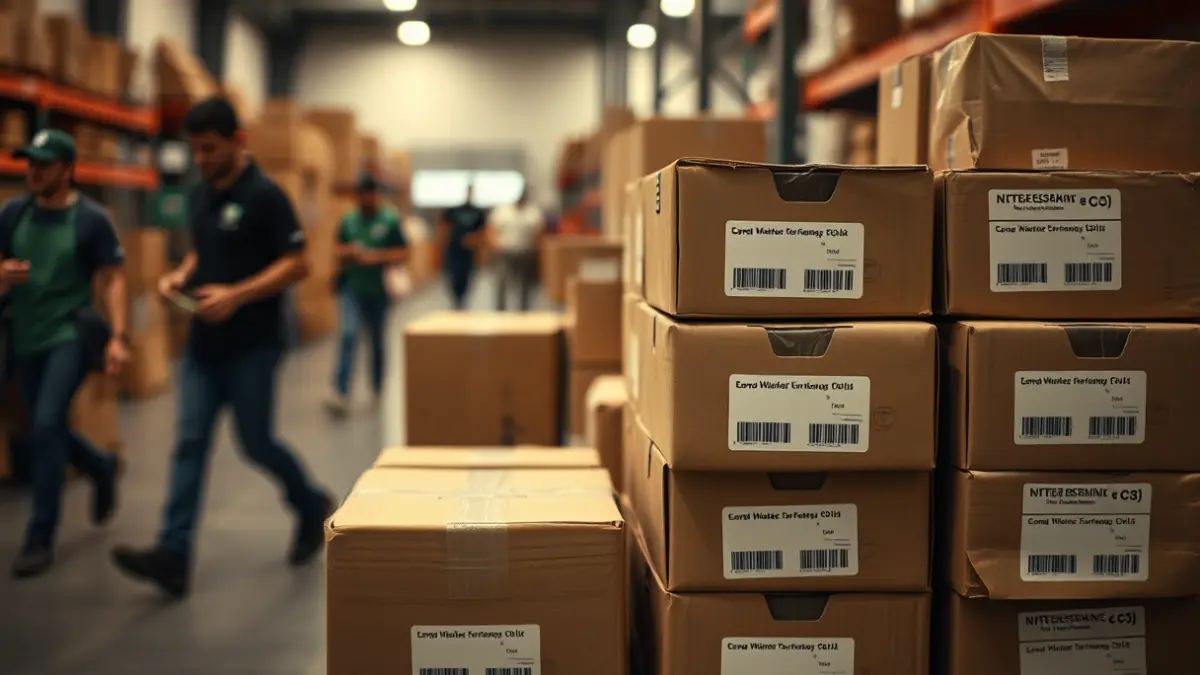
Before eight in the morning, in the Basauri industrial estate where the Food Bank of Bizkaia has its warehouse, there was already significant activity. Vans were coming and going, boxes were piling up, and volunteers were rushing past each other. “Now we work against the clock,” one of them summarized. The new law against food waste has altered the rhythm of an organization that had been operating for three decades and was facing a new challenge: managing more food in less time.
The organization carries out a food collection route through various points in Bilbao, such as San Mamés, Deusto, Moyua, and Rekalde. At the supermarkets, products are already prepared, and in just fifteen or twenty minutes, the van is back on the road. A volunteer noted that “now what they give us most is meat and cooked food.”
Law 1/2025 against food waste has brought about a major shift. The obligation to donate surpluses to avoid penalties—which can reach 500,000 euros—has boosted the arrival of food, but has also complicated its management. “Cooked food is given to you for the same day. You have to go as soon as possible to distribute it,” explained a volunteer.
At the Food Bank, no one is paid, not even the president. Everything functions thanks to a network of more than 170 volunteers, mostly retirees, with an average age close to 70 years. However, this structure is starting to fall short. “There is more work than before,” insisted a volunteer. “Right now, we can’t cope. We are not collecting from schools or hotels, for example.” The reason is simple: there aren't enough hands. And wheels. “They will have to buy another van,” he added. They have eight vans, and two of them can no longer enter Bilbao due to environmental restrictions.
“"Now what they give us most is meat and cooked food. Cooked food is given to you for the same day. You have to go as soon as possible to distribute it."
After 11:30 AM, back at the warehouse, activity did not stop. The space is divided into two pavilions of about 700 square meters. In one, non-perishable products are stored, organized according to the needs of each entity. In the other, the “last-minute” pavilion, everything happens faster. This is where foods with immediate expiration dates arrive and are sorted for immediate distribution.
Another volunteer explained while checking boxes: “We prioritize what expires today or tomorrow. We always give notice.” Trays of prepared food were piled on a table. “Now what we are receiving most is bread, quite a few sweets, and, above all, cooked food. This Wednesday, for example, more than 300 kilograms had arrived. Sometimes we are not even able to distribute what we have,” he noted. A figure unthinkable just a few months ago.
To balance products, food banks also coordinate with each other. They exchange merchandise depending on what each territory has. “From Álava, they send us a lot of potatoes, other frozen goods, or fruit. This way we ensure variety and that the same things don’t always accumulate,” they explained.
The increase in volume is evident. “It’s more work, but it’s good. The objective is twofold: that food is not thrown away and that people receive it.” Still, not everything is simple. One of the challenges was to avoid unnecessary intermediate steps. “We have already done tests with canteens and schools, but it’s complicated. We try to get the food to go directly from the school to the association, without passing through here. Otherwise, it’s a loss for everyone.” “Ideally, associations would have refrigerated vans, but it’s difficult,” explained the president. “Traceability is fundamental. If something arrives in poor condition, the responsibility is ours.” Maintaining that chain intact is, therefore, one of the main challenges.
The day ended around noon. It was just over three hours of route, several supermarkets, and dozens of boxes. In total, the Food Bank covers more than 200,000 kilometers a year with its eight vans. Behind each journey is an invisible network that sustains the system. The new law has put this mechanism to the test, multiplying opportunities—more food, more variety—but also demands. Now, each collection is a race against the clock. And each volunteer, an essential piece.