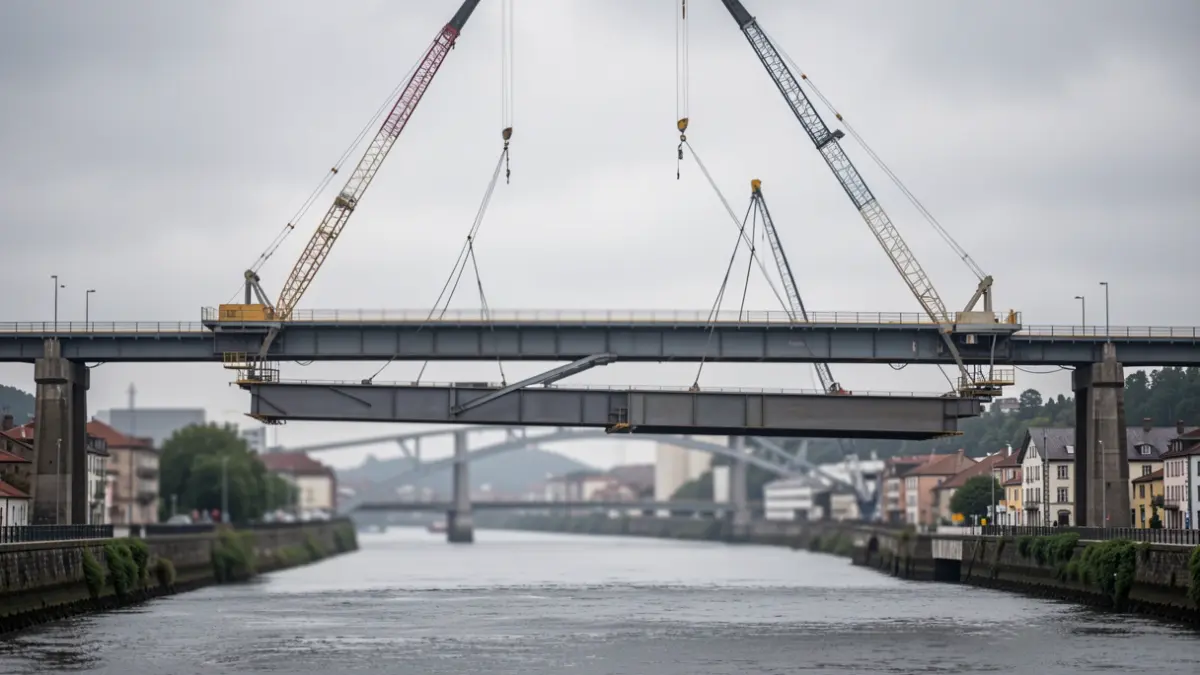
The 'All Iron' footbridge, a major initiative by the Diputación Foral de Bizkaia to link Barakaldo and Erandio for pedestrians and cyclists, is beginning to take shape over the River. This infrastructure project, with an investment of 37 million euros, marked a highly visible milestone this Tuesday with the installation of the first deck section.
The section, which arrived from Vitoria overnight via special transport coordinated by the Ertzaintza, was lifted into place by two large cranes. The operation, observed by technicians and media from a boat, highlighted the technical complexity of the work in a busy port environment. A 15-ton lateral cantilever and the main 50-ton structural box, both 32 meters long, were positioned with millimeter precision.
“"The assembly of the footbridge is probably one of the most spectacular phases of the process. We are talking about a very demanding infrastructure from a technical point of view."
The footbridge will have a total length of 352 meters and a width of six meters, accommodating a cycle path and a pedestrian walkway. Its most distinctive feature will be a 60-meter movable central span, designed to rotate and allow large vessels to pass through the navigable channel of the river.
Working over water, mud, and tides presents significant challenges. Engineers explained that tides greatly affect operations, necessitating pumping water to improve visibility for divers involved in underwater tasks.
The construction must be continuously coordinated with port activities and maritime traffic. The structure has been divided into ten main sections to facilitate manufacturing and transport, with the installation of approximately one section per month. The assembly work is projected to be completed by the summer of 2027.
Upon completion, the footbridge will directly connect the cycle networks on both banks, enhancing pedestrian and bicycle travel between Barakaldo and Erandio, and also linking with the metro and rail services. Beyond its practical function, its two large mobile sails are intended to become a new recognizable symbol of the river landscape.