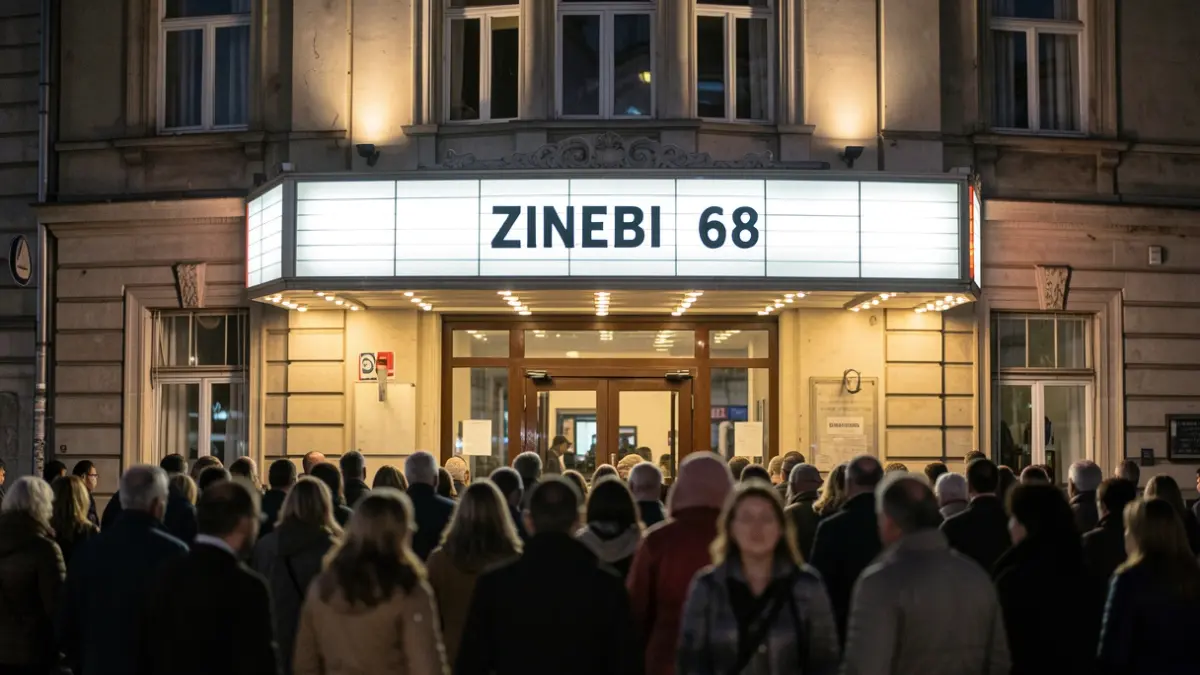
The Bilbao International Festival of Documentary and Short Film – ZINEBI will celebrate its 68th edition from November 20 to 27, focusing on contemporary short films and documentaries. The International Competition will feature 49 works of fiction, animation, and documentary, selected from over 3,300 submissions. The Essential Docs section will highlight figures such as Laura Poitras, Barbara Kopple, James Benning, and Albert Serra. Additionally, the Spain Shorts section will promote Spanish short films.
The festival reinforces its commitment to talent development: several titles from Essential Docs, including "La noche de la infancia", "La Pietà", and "Taranta", previously participated in ZINEBI Networking. The GazteDoku initiative, developed with SGAE and EHU, has received 25 projects this year and expands the connection between training, creation, and the Professional Documentary Film Forum.
To complete the program, the Bilbao actor, director, and playwright Ramón Barea and the Hungarian filmmaker István Szabó will receive the Mikeldi de Honor awards for 2026. The Bertoko Begiradak section will expand its program to four sessions, and a panorama of Basque short films will be offered, along with activities for various generations. Memory, migration, identity, social relations, and territorial transformations will also be central themes in the selected works.
Joseba Lopezortega, Festival Director, and Cristina Ezquerra, acting General Secretary, presented the full program for the 68th edition of ZINEBI at the Bilbao City Hall.
OFFICIAL SECTION: 49 SHORT FILMS OF FICTION, ANIMATION, AND DOCUMENTARY
The Official Section – International Short Film Competition will bring together 49 works selected from over 3,300 submissions. Divided into eight programs, it will showcase diverse ways of telling stories through fiction, documentary, and animation. The selection committee views this cinema as capable of surprising, questioning certainties, and proposing new aesthetic, cultural, and political perspectives, in contrast to dominant audiovisual consumption formulas.
The Official Section – International Short Film Competition will bring together 49 works selected from over 3,300 submissions. Divided into eight programs, it will showcase diverse ways of telling stories through fiction, documentary, and animation. The selection committee views this cinema as capable of surprising, questioning certainties, and proposing new aesthetic, cultural, and political perspectives, in contrast to dominant audiovisual consumption formulas.
All these films will have their Spanish premiere in Bilbao and will be screened in the eight competition sessions taking place at the Teatro Arriaga between November 21 and 26. Among the competing titles are "The Revolution Against Death" by American Joshua L. Oppenheimer; "Masao Adachi Takes a Passport Photo" by Palestinian filmmaker Kamal Aljafari; "The Spoon" by Nele Wohlatz; "Raftsmen and Canoeists" by Brazilian artist Jonathas de Andrade; and "Electric Birds" by Ulu Braun. Works such as "Please" by Anna Mantzaris; "Cartoon Physics" by Ru Kuwahata and Max Porter; "Ploo" by Jon Frickey; and "Algo en la casa" by Carla Pereira, demonstrating the diversity of contemporary animation languages, will also be shown.
The competition includes titles that address contemporary displacements, connections, and conflicts from heterogeneous perspectives: "A Tenderness" by Sabrine Khoury; "Patronymic" by Mariia Ponomarova; "El león" by Diana Bustamante; "Memories of a Window" by Mehraneh Salimian and Amin Pakparvar; or "Forgotten Spaceman" by Elham Ehsas. The fiction selection features "Nervios de acero" by Beatriz Navas Valdés; "Los andares" by Isa Luengo and Sofía Esteve; and "En este día tampoco se encontró nada" by Irene Visa.
Basque creation will have a prominent presence in this Official Section with "Guretako eztia" by Violette Bellet and Maia Iribarne; "Neska bat desagertu da" by Mikele Landa; "Bitartean, gero" by Raúl Barreras; "Onena ura da" by Sonia Estévez; "High River" by Daniel Alegrete; and "Siurana" by Esther Escudero.
ESSENTIAL DOCS: MASTERS OF DOCUMENTARY AND INTERNATIONAL AWARDS
The 68th edition of ZINEBI presents a notable selection of international documentary cinema in Essential Docs, formerly known as Beautiful Docs. This section brings together the latest works from some of the genre's most influential filmmakers alongside emerging talents making waves on the international circuit. The program includes films premiered or recognized at festivals such as Venice, Berlin, Locarno, Toronto, Visions du Réel, Shanghai, or Thessaloniki, as well as projects linked to Cannes Docs. This selection positions Bilbao as a meeting point for contemporary documentary, featuring works that explore historical memory, political and social conflicts, identity, transformations in the world of work, and the expressive possibilities of non-fiction cinema.
The 68th edition of ZINEBI presents a notable selection of international documentary cinema in Essential Docs, formerly known as Beautiful Docs. This section brings together the latest works from some of the genre's most influential filmmakers alongside emerging talents making waves on the international circuit. The program includes films premiered or recognized at festivals such as Venice, Berlin, Locarno, Toronto, Visions du Réel, Shanghai, or Thessaloniki, as well as projects linked to Cannes Docs. This selection positions Bilbao as a meeting point for contemporary documentary, featuring works that explore historical memory, political and social conflicts, identity, transformations in the world of work, and the expressive possibilities of non-fiction cinema.
Among the prominent names in Essential Docs is Laura Poitras, Oscar winner for "Citizenfour" and Golden Lion winner at Venice for "All the Beauty and the Bloodshed," as well as a ZINEBI Mikeldi de Honor recipient in 2024. She returns to the Festival with "They’re Here" (2026), co-directed with Rachel Lauren Mueller and premiered in Venice, documenting ICE immigration raids in Minneapolis. Also featured are "Going Home" (2026) by Palestinian Kamal Aljafari and "Sawyer Avenue, Sunday Afternoon" (2026) by American Bill Morrison.
Another significant presence is Barbara Kopple, ZINEBI's Mikeldi de Honor in 2001 and a two-time Oscar winner for Best Documentary. She presents "Union Town" (2026), premiered at Venice and selected for Toronto, focusing on the working conditions and union organization of delivery platform workers. The film revisits the social commitment of "Harlan County, U.S.A." (1976), celebrating its fiftieth anniversary, and "American Dream" (1990), both Oscar winners.
The section also includes James Benning, a benchmark in experimental cinema and ZINEBI jury president in 2006, with "Eight Bridges" (2026), premiered at Berlinale; and Albert Serra, winner of the Golden Leopard in Locarno and the Golden Shell in San Sebastián, who presents "Sixteen Moments of My Life" (2026), world-premiered at Locarno.
Of particular note is "La noche de la infancia" (2026) by Xisi Sofia Ye Chen, the first Spanish production to win the Grand Jury Prize at Visions du Réel in over half a century. The project participated in ZINEBI Networking two years prior. "La Pietà" (2026) by Rafael Molés and Pepe Andreu, selected for the Spain Showcase at Cannes Docs and premiered in Thessaloniki, also passed through this Forum. Joining them is "Taranta" (2026) by Samuel Nacar, winner of the ZINEBI Networking Prize 2025 and world-premiered in Seville. Their presence in Essential Docs highlights the continuity between project development in Bilbao and their subsequent festival runs internationally.
Contemporary conflicts are central to "Citizen Osama" (2026) by Palestinian Ahmad Hassouna, premiered in Venice, which depicts the life of a photographer and his family during the bombings in Gaza; and "Meanwhile in Namibia" (2026) by Jonas Spriestersbach, presented at Visions du Réel and arriving in Bilbao in a shared premiere with the Gijón Festival.
The Spanish representation includes "Benigno" (2026) by David Baute, Goya winner for "Mariposas negras", premiered in Shanghai with cinematography by the also award-winning Mauro Herce. Completing the selection are "Irailak" (2026) by Izaskun Arandia, premiered in San Sebastián; "Atlas de la desaparición" (2026) by Manuel Correa, presented at CPH:DOX; and "Crías" (2026) by Xiana do Teixeiro, premiered in Málaga. These works delve into historical and personal memory, silenced narratives, and intergenerational experiences.
Essential Docs thus consolidates ZINEBI as an international documentary meeting point, bringing together major figures of the genre, films recognized at leading festivals, and new voices finding a platform for projection in Bilbao.
BERTOKO BEGIRADAK: FOUR SESSIONS OF BASQUE SHORT FILMS
ZINEBI strengthens its support for Basque production with Bertoko Begiradak – Miradas desde Euskadi, which will host four short film sessions, programmed at the Teatro Arriaga between Monday, November 23, and Thursday, November 26. The section brings together fiction, animation, documentary, and hybrid forms, with films exploring themes of identity, desire, memory, care, and the transformations of landscapes and communities.
ZINEBI strengthens its support for Basque production with Bertoko Begiradak – Miradas desde Euskadi, which will host four short film sessions, programmed at the Teatro Arriaga between Monday, November 23, and Thursday, November 26. The section brings together fiction, animation, documentary, and hybrid forms, with films exploring themes of identity, desire, memory, care, and the transformations of landscapes and communities.
Selected works include "Zisne beltzak" by Iban del Campo; "Abata" by Aner Etxebarria and Pablo Vidal; "El otro lado" by Pablo Esteo, June San Sebastián, Leyre Fernández, Antton Gorroño, Leire Martínez, Irune Agirreazaldegui, and Javier Martínez; "Si los pájaros cantan" by Beatriz Larragueta; and "Hemen gaude" by Sébastien Boulard. The program continues with "Joare tte" by Ekaitz Bertiz; "Itsas epel" by Aroa Fernández Lazkano; "Madame Mademoiselle" by Aitor Elorriaga; "Aho beltza" by Alba Lozano; "La Madame" by Alexander Lemus Gadea; "El santo que vestí" by María Monreal; "Anai" by Imanol G. Gurrutxaga; "Loose Sleep" by Rodrigo Soares Teixeira; "Hambre" by Imanol Ortiz López; and "Los Divulgators" by Pablo Hernando.
These works are joined by titles also present in the International Competition, highlighting the diversity and vitality of Basque short filmmaking.
A BROAD OVERVIEW OF BASQUE DOCUMENTARY FEATURES
The Basque program extends to various venues in Bilbao with a rich selection of feature-length documentaries, exploring intimate and historical memory, cultural portraiture, music, and the recovery of relevant local figures. While sharing a common origin, the proposals differ in their approach: including observational documentaries, biographical explorations, and works that blur the lines between reality and representation.
The Basque program extends to various venues in Bilbao with a rich selection of feature-length documentaries, exploring intimate and historical memory, cultural portraiture, music, and the recovery of relevant local figures. While sharing a common origin, the proposals differ in their approach: including observational documentaries, biographical explorations, and works that blur the lines between reality and representation.
Audiences can discover "Aresti eta abesti" and "El arte sencillo" at the Museo Guggenheim Bilbao; "La maleta de Álex", "Pedro Arrupe. Yo viví la bomba atómica", and "Simulacro" at Sala BBK; and "Mari Puri Herrero, de lo real a lo fantástico" and "Gaulana" at the Museo Bellas Artes de Bilbao.
Music will also have a special presence with "Gatibu: Agur esan barik" and "ETS – Itzal argitan". The latter documentary is set for its world premiere at Sala BBK on Wednesday, November 25, while "Gatibu: Agur esan barik" is scheduled for Golem Alhóndiga on Tuesday, November 24.
SPAIN SHORTS: A WINDOW INTO SPANISH SHORT FILMS
Spain Shorts is a new section designed to showcase a selection of the best recent Spanish short films, including works whose quality and trajectory merit a screening in Bilbao beyond the necessarily limited International Competition. It offers a panorama of the format's vitality, its aesthetic explorations, and the plurality of voices in Spanish cinema.
Spain Shorts is a new section designed to showcase a selection of the best recent Spanish short films, including works whose quality and trajectory merit a screening in Bilbao beyond the necessarily limited International Competition. It offers a panorama of the format's vitality, its aesthetic explorations, and the plurality of voices in Spanish cinema.
The selection features "Bobs" by Júlia Marcó, recognized at the Málaga Festival; "Gamberra" by Marine Auclair March, awarded in Huesca; "La fábula de la punki adolescente" by Juan Vicente Castillejo; "Crónica del cansancio" by Natalia Marín, which has screened at FIDMarseille and Toronto; "OAO" by Rocío Mesa; and "Like Moths to Light" by Gala Hernández López, programmed at festivals like Rotterdam and Punto de Vista. Also included are "Que me alimente" by Olga Navalón and Bea Hohenleiter; "Mi tía Pura" by Álvaro Fenech and Noa Fito; "A Hole in the Ground" by Harper Madrigal; and "Garabato" by Alicia Úbeda.
The short films in Spain Shorts are eligible for the Caimán Cuadernos de Cine – ZINEBI Critics' Award, endowed with 2,000 euros and granted by a jury of five critics. This collaboration with the specialized magazine introduces a new avenue for recognition and exposure for the selected works.
GAZTEDOKU AND ZINEBI NETWORKING: FROM LEARNING TO PROFESSIONAL DEVELOPMENT
GazteDoku, developed in collaboration with SGAE and EHU, has received 25 projects and opens a space for learning and work in documentary filmmaking. This initiative aligns with the Festival's commitment to supporting new voices and bridging the gap between early creative processes and the professional sphere. Its connection with the ZINEBI Networking Professional Documentary Forum allows for the presentation of training and project development as integral parts of a unified support ecosystem for documentary cinema.
GazteDoku, developed in collaboration with SGAE and EHU, has received 25 projects and opens a space for learning and work in documentary filmmaking. This initiative aligns with the Festival's commitment to supporting new voices and bridging the gap between early creative processes and the professional sphere. Its connection with the ZINEBI Networking Professional Documentary Forum allows for the presentation of training and project development as integral parts of a unified support ecosystem for documentary cinema.
The Professional Documentary Forum, in its 20th edition, will feature public presentations of documentaries in development and nearing completion, one-on-one meetings with professionals, encounters with television networks and platforms, and sessions dedicated to labs and residencies. It connects filmmakers and producers with programmers and agents who can contribute to the future of their films.
ZINEBI Animation Lab will hold its second edition from November 25 to 27, with the participation of animation projects in development. The lab will offer training activities, mentorship, and meetings with industry professionals, and will award two grants of 3,000 euros each: one for a Basque project and another for a project from the rest of Spain. Through this initiative, ZINEBI expands its support for cinematic creation into the specific field of animation.
ZINEBI Express will also invite emerging creators to experiment with cinema. Its presentation is scheduled for November 5 at the TUMO Bilbao-Bizkaia center, featuring Basque presenter Ugaitz Alegría, filmmaker Lara Izagirre, and Festival Director Joseba Lopezortega, in an event particularly aimed at film school students.
ZINEBI Networking also hosts the Aukera program, developed by the (H)emen Association and focused on the development of projects created by women.
Mikeldi de Honor: RAMÓN BAREA AND ISTVÁN SZABÓ
ZINEBI will honor Ramón Barea and István Szabó with its Mikeldi de Honor awards, recognizing two cinematic careers of significant projection, linked to different traditions and generations. These accolades emphasize interpretation, creation, and the memory of European cinema.
ZINEBI will honor Ramón Barea and István Szabó with its Mikeldi de Honor awards, recognizing two cinematic careers of significant projection, linked to different traditions and generations. These accolades emphasize interpretation, creation, and the memory of European cinema.
Ramón Barea, a Bilbao-born actor, director, and playwright, has had an extensive career spanning theater, film, and television. His name is synonymous with Bilbao's cultural life and his consistent work in favor of the performing and audiovisual arts. The Mikeldi de Honor acknowledges a career marked by his interpretive versatility, commitment to creation, and connection with multiple generations of audiences and professionals.
Hungarian filmmaker István Szabó is one of the great references of European cinema in recent decades. Winner of an Oscar in 1982 for his work "Mefisto", his filmography explores the relationships between individuals, power, and history, with a particular focus on the moral and political dilemmas of the 20th century.
Ramón Barea will receive the award at the ZINEBI opening gala on November 20, starting at 7:30 PM at the Teatro Arriaga. István Szabó will receive the recognition at the Festival's closing ceremony on November 27, also at 7:30 PM at the Teatro Arriaga.
ZINEBISKOPIO: CINEMA, COMMUNITY, AND CONVERSATION
The sessions combine screenings and conversations centered on shared realities, inclusion processes, and intergenerational relationships. The program includes a Colombian concert and a selection of short films, alongside works such as "Prejuicios", "Headscarf", "Empoderío", and "El regalo". Also noteworthy is the presence of "Crías" and an intergenerational workshop on unproductive writing based on Xiana do Teixeiro's film, bridging cinematic experience, literature, and the memory of different generations.
The sessions combine screenings and conversations centered on shared realities, inclusion processes, and intergenerational relationships. The program includes a Colombian concert and a selection of short films, alongside works such as "Prejuicios", "Headscarf", "Empoderío", and "El regalo". Also noteworthy is the presence of "Crías" and an intergenerational workshop on unproductive writing based on Xiana do Teixeiro's film, bridging cinematic experience, literature, and the memory of different generations.
ZINEBITXIKI: DISCOVERING CINEMA FROM CHILDHOOD
Young audiences will have their own space with ZINEBItxiki, which invites them to discover how short films can tell stories in many different ways. The selection fosters curiosity and the pleasure of exploring cinematic forms beyond those typically seen on everyday screens.
Young audiences will have their own space with ZINEBItxiki, which invites them to discover how short films can tell stories in many different ways. The selection fosters curiosity and the pleasure of exploring cinematic forms beyond those typically seen on everyday screens.
The sessions will take place at the Teatro Arriaga on November 23, 24, and 26, allowing children to experience cinema in a historic venue. The program includes "The Sky Was Candy", "El otro lado", "Into the Forest", "A Day in the West", "Shorts from the Box: Wild Things", and "A Little Death".
DEPÓSITO ZINEBI: ANIMATION, EXILE, AND MEMORY
The Festival continues to recover its film heritage through Depósito ZINEBI, a research project developed with Elías Querejeta Zine Eskola and the Basque Film Archive. This year, it focuses on Grupo Cine Sur, a collective of Argentine creators exiled after the 1976 coup d'état, who used animation as a tool for political expression and pedagogy from Mexico.
The Festival continues to recover its film heritage through Depósito ZINEBI, a research project developed with Elías Querejeta Zine Eskola and the Basque Film Archive. This year, it focuses on Grupo Cine Sur, a collective of Argentine creators exiled after the 1976 coup d'état, who used animation as a tool for political expression and pedagogy from Mexico.
The session will screen "La persecución de Pancho Villa" (1978), along with "El compa Clodomiro y el capitalismo" (1981) and "El compa Clodomiro y la explotación" (1981). These films, previously shown in Bilbao, return decades later accompanied by the results of research conducted in 2025 and 2026 through interviews with collective members in Argentina, Mexico, France, and the Dominican Republic. This initiative allows for the recovery not only of titles but also of the political and human circumstances that marked their production and circulation.
The program also reserves space for special sessions, including "La amiga" and "Vida en los teleclubs". The archive thus becomes a living resource for revisiting film history and the ways collective history has been told.
THE IMAGE OF ZINEBI 68: A HOMAGE TO ARRIAGA AND BILBAO
Artist Jesús Mari Lazkano (Bergara, 1960) is the creator of this edition's poster, a cinematic reinterpretation of the Monument to Arriaga, by Francisco Durrio. The ZINEBI 2026 image links two events in Bilbao's cultural life: the opening of the expanded Museo de Bellas Artes de Bilbao, where the sculpture occupies a central place in its new atrium, and the second centenary of the death of composer Juan Crisóstomo de Arriaga, to whom the work is dedicated.
Artist Jesús Mari Lazkano (Bergara, 1960) is the creator of this edition's poster, a cinematic reinterpretation of the Monument to Arriaga, by Francisco Durrio. The ZINEBI 2026 image links two events in Bilbao's cultural life: the opening of the expanded Museo de Bellas Artes de Bilbao, where the sculpture occupies a central place in its new atrium, and the second centenary of the death of composer Juan Crisóstomo de Arriaga, to whom the work is dedicated.
The poster's protagonist is Euterpe, the muse of music, depicted as a golden silhouette against a dark background. Instead of the lyre held in the original sculpture, Lazkano has placed a 16mm film reel. This gesture transforms the musical homage into a cinematic statement, evoking both the power of creation and the work's exposure and vulnerability to public view.
A graduate and doctor in Fine Arts from the University of the Basque Country, Lazkano has developed his career focusing on the relationships between architecture, landscape, and nature. His work has been exhibited in Europe, America, and Asia, and he maintains a close connection with Bilbao, with exhibitions at the Guggenheim Museum and the Museum of Fine Arts, and interventions in spaces like the Euskalduna Palace and Metro Bilbao. In 2025, he also participated in the first edition of ZINEBI Animation Lab.
TICKETS AND VENUES
The Teatro Arriaga will once again host the opening and closing galas and regains its role as the Festival's central venue after the renovation of its technical projection and sound resources. In addition to allowing audiences to link sessions throughout the day, it will feature work and attention areas for professionals and journalists.
The Teatro Arriaga will once again host the opening and closing galas and regains its role as the Festival's central venue after the renovation of its technical projection and sound resources. In addition to allowing audiences to link sessions throughout the day, it will feature work and attention areas for professionals and journalists.
The Museum of Fine Arts also rejoins as a venue for the Festival's programming. Likewise, other cultural facilities in the city are added, such as the Gólem Alhóndiga cinemas, Sala BBK, Bilborock, the Guggenheim Museum Bilbao, Azkuna Zentroa-Alhóndiga Bilbao, and numerous other collaborating venues.
The sale of tickets and passes (for the general public and various groups) is scheduled to begin tomorrow, October 28. Final prices and conditions will be communicated through the official ZINEBI channels.
Audiovisual material for the media is available at this link.
SOCIAL MEDIA:
zinebi.eus
zinebi.eus