The region will have the opportunity to observe a total solar eclipse on August 12, starting at 19:37 and concluding at 21:24. This astronomical phenomenon will reach its peak at 20:32, with the moment of maximum darkness occurring at 20:27. At the summit of Aketegi, the highest point in Goierri, the maximum eclipse moment will be at 20:28:01.
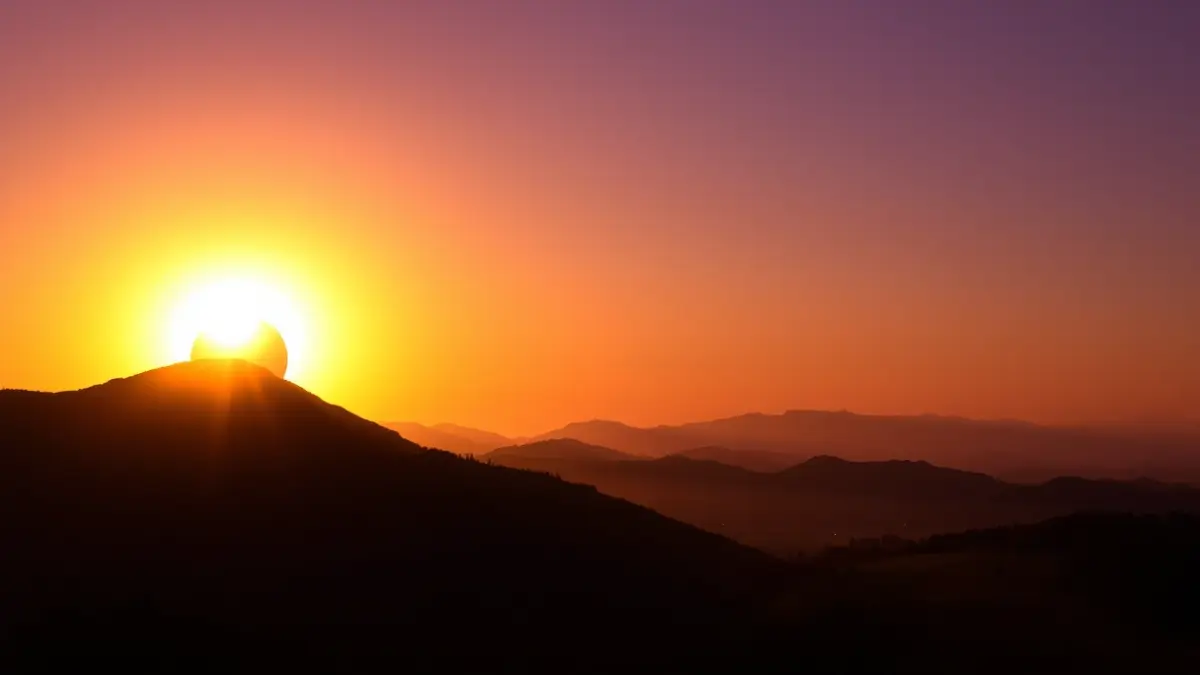
The eclipse will coincide with the sunset, making it best visible from locations with a wide view to the west. Furthermore, the night of August 12 will be ideal for observing the Perseids meteor shower, also known as the tears of Saint Lawrence, as the new moon will allow for better visibility of celestial light phenomena with less ambient light.
The period of total darkness will last just under two minutes (1:50 minutes) in areas where the shadow is densest. Goierri will be on the edge of the shadow zone, which will extend southward. For this reason, the observation of the total eclipse will be shorter in Goierri than in other regions of the Basque Country. For instance, members of the Lemniskata Goierriko science association will travel to Lerín (Navarre), where the total solar obscuration will last twice as long.
Within Goierri itself, there will also be a noticeable difference in duration between the north and south. The total eclipse will be visible in the areas of Legazpi, Zegama, Idiazabal, and Ataun; in other towns, it will be partial. The sun will follow a northwest to southeast trajectory, with the band of darkness covering the northern edge of the Iberian Peninsula from A Coruña to Bilbao.
An event of this magnitude has not occurred in this part of the world since 1912. After the event on August 12, there will not be such a long wait for the next total solar eclipse: it will be one year later, on August 2, 2027; and an annular eclipse on January 26, 2028.
To find the best viewing spot for the eclipse, a trial run can be conducted next Thursday or Friday, paying attention to the sun's path at dusk and looking westward. The Earth's inclination between the summer solstice and August 12 can be determined by counting backward from the solstice. Thus, the Earth will have the same inclination on April 30 or May 1 as on August 12, meaning the same position relative to the sun.