The Department of Mobility, Tourism, and Territorial Planning of the Gipuzkoa Provincial Council will renew the Tourism Observatory to "go beyond data and generate its own rigorous and contrasted knowledge." For the first time, it will include data to measure seasonality and de-localization.
This was announced by the provincial deputy Azahara Dominguez during a conference on tourism competitiveness held at the interpretation center of Antoño in Zumárraga. The event gathered stakeholders from Gipuzkoa's tourism industry, with the mayor of Zumárraga, Mikel Serrano, and the president of the Urola Garaia Mancomunidad and mayor of Urretxu, Jon Luqui, acting as hosts.
Dominguez highlighted the progress of the Tourism Observatory, established in 2024 to add value to the tourism industry and provide information for decision-making. She stated that the Observatory has now "taken a decisive step, moving from collecting data to generating knowledge," by adding two measurement indices on the "strategic challenges of de-seasonality and de-localization." This aims to create "more stable, higher-quality employment opportunities throughout the year, across all of Gipuzkoa".
To deepen this knowledge, the Department will integrate a tourism competitiveness panel into the Observatory, offering an "updated snapshot" of Gipuzkoa's tourism evolution compared to the same period last year.
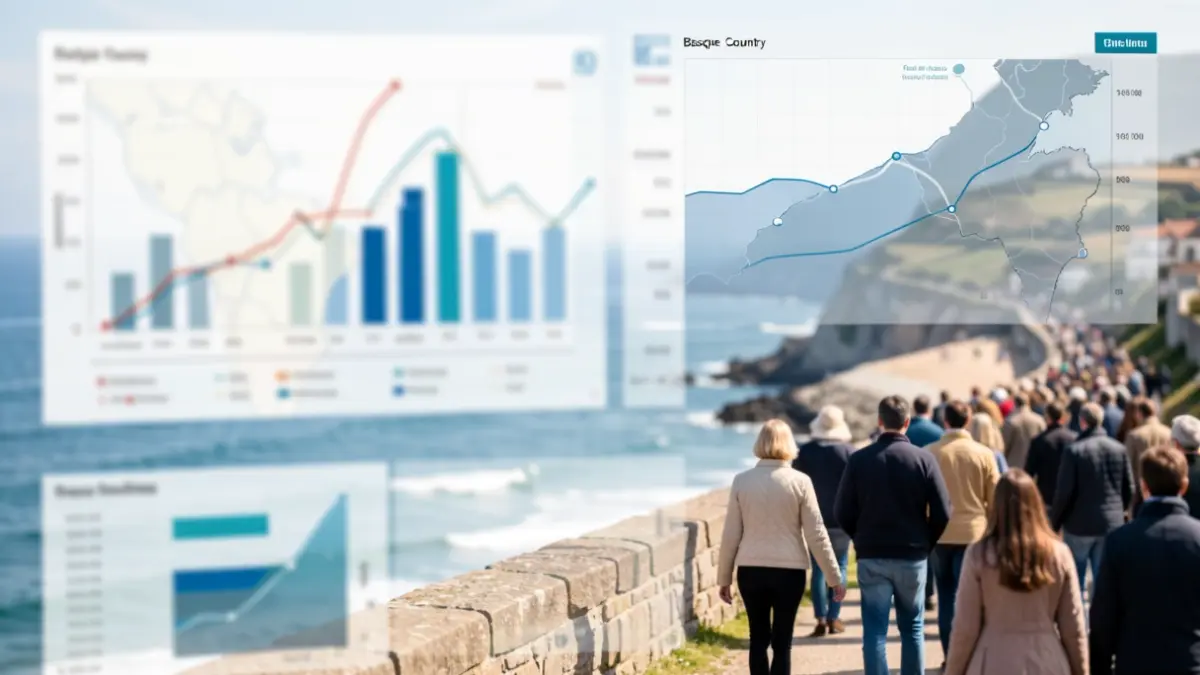
According to the latest data, tourism is a "strategic sector" in Gipuzkoa, accounting for 8.7% of GDP and employing over 40,300 people (11.8% of total employment) across 7,295 companies. Visitors spend €2.843 billion annually, and despite a slight decrease in accommodation offerings (-1.8%), employment has risen by 3.47%.
The newly introduced indices for de-seasonality and de-localization of tourist flows indicate that 33.48% of revenue is generated outside Donostia, and nearly 60% of tourists visit outside the summer months. This reduces pressure during peak season and fosters more stable year-round employment.
Finally, the first qualitative report from the Observatory was presented, an active listening study analyzing over 60,000 online opinions about Gipuzkoa as a tourist destination during 2025. "This allows us to better understand the sector's evolution, detect trends, identify signals of change, and enrich our analyses," Dominguez concluded.