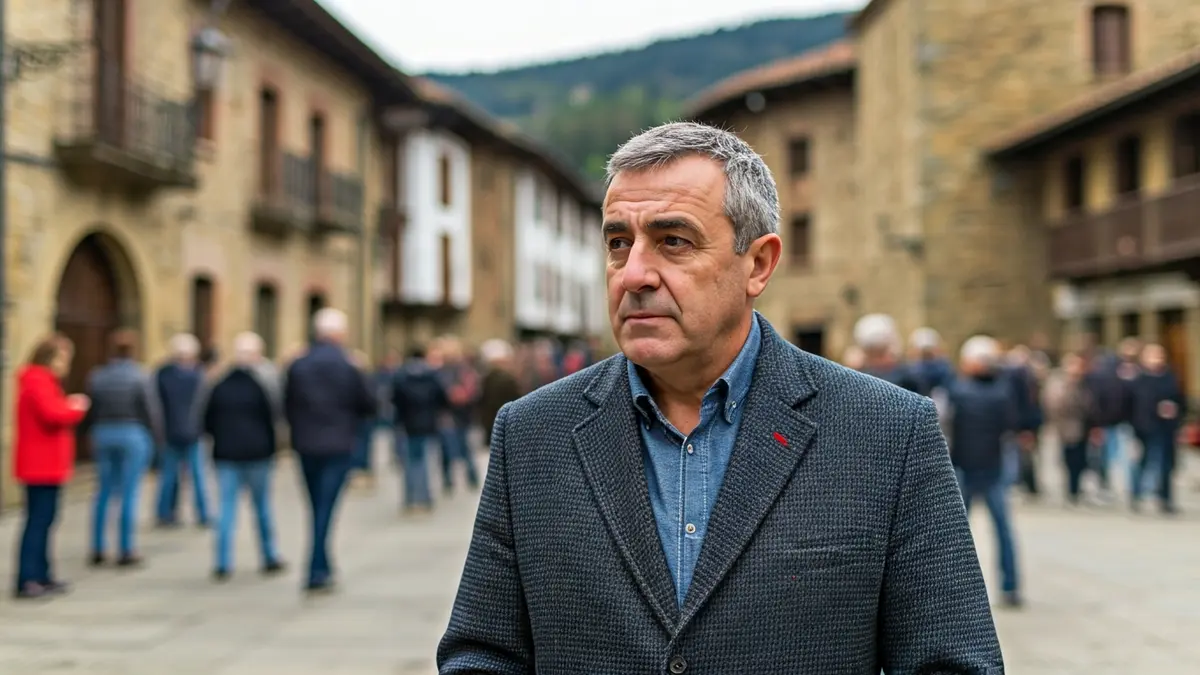
Dirk Morenweiser, born in Kiel (Germany) in 1964, began visiting Euskal Herria in the late 1980s as a tourist, drawn by political and cultural interests. In the early 90s, he decided to stay, and has lived in Arrasate since 1994. His hometown, Kiel, is a port city of about 250,000 inhabitants, which was almost completely destroyed during World War II, leading to a rapid reconstruction where aesthetics were not a priority.
Morenweiser discovered Euskal Herria thanks to some young people from Eibar he met in Berlin, who invited him to visit the region. After several years returning for holidays, in 1992 he decided to settle there. He initially lived in Vitoria-Gasteiz, then in Donostia in 1993 as a German teacher, and finally in Arrasate in 1994, when he learned that a local company needed a German teacher. He expressed a preference for inland Gipuzkoa, considering it more “authentic” than Donostia, where he felt the Basque character was less reflected.
“"I believe that a person who migrates must be sure about taking the step."
Morenweiser's integration was marked by his surprise at the “zirimiri” (drizzle), the abundance of festivals (such as Lekeitio's Goose Day, Sanfermines, and Maritxu Kajoi), and the presence of the Basque language. Sociologically, he highlighted the importance of social groups (cuadrillas) and people's enthusiasm for organizing activities, contrasting with the greater individualism observed in other parts of Europe. Adaptation was easy at first, as a tourist, but learning Basque has been a significant challenge. Although he manages in Spanish, he acknowledges that mastering Basque would open more doors for him.
According to Morenweiser, in the 90s he was one of the few foreigners, and initially felt a kind of positive discrimination. Today, Arrasate is his home, and emotionally he does not feel like a foreigner, although objectively he is. Regarding learning Basque, he plans to resume it when he retires, as his current job as a language teacher prompts him to dedicate his free time to other hobbies. He considers Basque to be “another league” and more difficult to understand compared to other Romance languages.