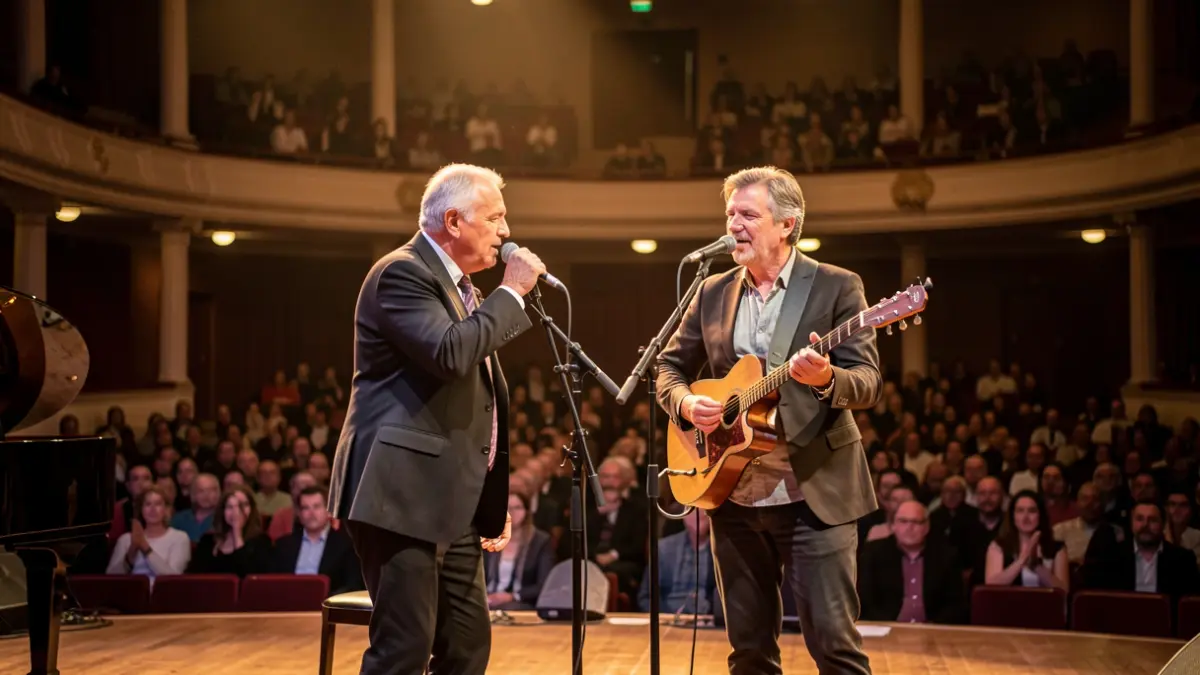
Pantxoa Karrere (Azkaine, Lapurdi, 1948) and Peio Ospital (Ezpeleta, Lapurdi, 1948) will conclude their musical journey with a series of farewell concerts at Barakaldo's BEC in January 2027. After their last performance in 2011, they have decided to give a dignified end to their career of over 40 years as a token of gratitude to their fans. "It will truly be a beautiful and moving moment," they stated. Only a few tickets remain for the 9th.
Additionally, they will receive the Adarra Award 2026, presented by the Donostia City Council and Donostia Kultura, tomorrow, June 21st, on European Music Day, at the Victoria Eugenia Theatre. The jury recognizes their significant work in reviving and transmitting traditional songs from Northern Basque Country that express the identity, sentiment, and collective memory of Euskal Herria.
The musical duo had been inactive on stage for fifteen years. Peio Ospital explained that the warm reception from the audience and public demand, after being invited to sing together in Peio Reparaz's show Mitoaroa II, motivated them to undertake this tour. Pantxoa Karrere admitted he was initially hesitant but realized it "had to be done" given the public's response.
The rapid sell-out of tickets for the BEC concerts demonstrates the public's eagerness to see them. "It's a special challenge," says Karrere, "nervousness is normal before any concert, but there will be many emotions on stage." They have chosen several significant locations for their final tour, including Santutxu, Lesaka, Bergara, and Baiona. The concert in Santutxu is particularly poignant, as it takes place at the same location where police attacked the audience 50 years ago.
Ospital stated that the final concerts will be "a narrative of a journey," celebrating a story of love with the Basque people. "I want to express my gratitude to the people for this love story that life has given me," he said. Karrere added that their songs have been successful because they "resonate with the issues of this land," and that people "see their lives reflected in these songs."
Initially, concerts were not common in Ipar Euskal Herria (Northern Basque Country), and performing on stage in a repressed language was "something new." Over the years, with the release of records and cassettes, their music entered homes, and local festival committees began to book them. They mentioned Mixel Labegurie as a pioneer. Pantxoa and Peio learned their traditional repertoire at home, which served as their "conservatory."
Karrere emphasized that they were clear about "what they wanted to sing about" and that they would not change. Ospital recalled that in the 1960s, a Basque consciousness began to emerge in Northern Basque Country, leading to a "renaissance." Looking back, they particularly remembered Manex Pagola and Telesforo Monzon for singing their songs.
Regarding the status of the Basque language, Ospital tells his grandson that his generation's struggle was to make Basque a language of education, while the next generation's fight is to "make Basque a language of the street." Karrere believes Basque music is alive and that young musicians are increasingly skilled, expressing hope. Ospital is surprised by the public's desire to gather in large numbers, as seen at the BEC.
The final tour is titled "Looking at the history of Pantxoa and Peio." Ospital says they have been more interpreters than composers, and that it "has been worthwhile" if people started learning Basque by listening to their songs or if they served as a connection to their homeland for those abroad. The phrase "Because we were, they will be" encapsulates everything, according to him.