
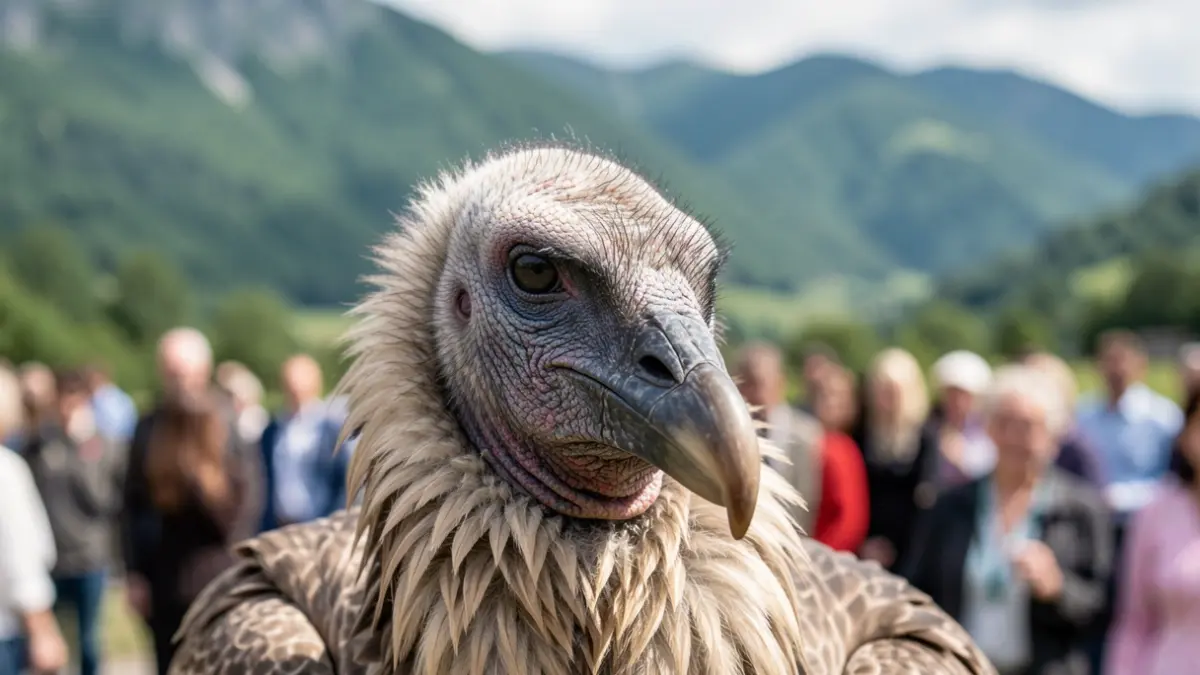
Research involving UPV/EHU researcher Jon Morant emphasizes the importance of vulture conservation and proposes measures to enhance their protection. In a letter published in the journal Conservation Biology, the authors warn of the risks that avian flu poses to vulture populations, as well as the problems that the decline of vultures can cause in ecosystems and human well-being.
To address this situation, they propose five lines of action: monitoring populations, organizing vaccination campaigns, managing carrion, establishing protocols for handling vultures, and promoting local action plans. Globally, vultures are among the most threatened bird groups; at least sixteen of the twenty-three species are in a worrying conservation status, largely due to poisoning and other threats caused by human activity.
“"They provide us with one of the most important ecosystem services for human well-being: they consume carrion, which contains pathogens. It is proven that scavenger animals contribute to preventing or reducing the spread of pathogens. That is, they prevent the microorganisms that cause diseases from continuing to spread,” explains Jon Morant, a researcher at the UPV/EHU."
The avian flu virus (H5N1), the cause of panzootics (the animal equivalent of a pandemic), is highly contagious and can cause the collapse of vulture populations, which are already in decline. Indeed, it has been confirmed that the virus has spread widely in certain parts of the world essential for vultures and has had severe consequences, such as the death of thousands of American black vultures and turkey vultures in the United States and South America. It has also caused significant damage to bearded vultures in Europe and to California condors and Andean condors in America. Notably, California condors are critically endangered, and approximately 6% of their wild population was lost in six weeks.
To alert about this risk and establish lines of action, Jon Morant, a researcher from the Department of Zoology and Animal Cell Biology at the UPV/EHU, has published a letter in Conservation Biology along with several researchers from the Mediterranean Institute for Advanced Studies (IMEDEA, Mallorca) and the Institute for Biodiversity and Environment Research (INIBIOMA, Argentina). “We wanted to send an alert to those responsible for conservation and to the research community to promote coordinated actions,” explains Morant.
In general, “vultures are social animals and gather at feeding sites, places where there is a high risk of contagion. Furthermore, by feeding on infected carrion, they can become infected with the H5N1 virus. Vultures are prepared to withstand many bacteria and pathogens due to their scavenger nature, but that is not enough to cope with the H5N1 virus,” explains Morant. The virus has a high mortality rate in both domestic and wild animals. Avian flu does not only affect birds: it is documented that more than 48 mammal species have been infected worldwide. “The more infected carrion there is, the greater the risk of contagion for vultures. As these same carcasses can become sources of infection, a paradox arises: as more vultures die, the capacity to eliminate carrion decreases, pathogens spread, and contagion increases,” explains the researcher.