The Basque Government has reinforced its commitment to sustainable transport with the new Topo railway variant between Altza and Galtzaraborda. This new two-kilometer double track, which eliminates the current ‘dead end’ in Altza, will reduce the service frequency between Pasaia and Amara to every 7.5 minutes on weekdays.
Lehendakari Imanol Pradales and the Minister of Sustainable Mobility, Susana García Chueca, led the inaugural journey today, prior to the service's launch this Saturday. Institutional representatives from Gipuzkoa, civil society members, and construction sector professionals attended the event.
These works, fully financed by the Basque Government and executed by the public entity Euskal Trenbide Sarea (ETS), include the construction of a new underground station in Pasai Antxo. This will allow for the upcoming demolition of the 1912 viaduct that crosses Pasaia, just meters from some homes, freeing up 3,500 m2 of space for citizens.
Pradales emphasized that mobility must guarantee territorial cohesion, equality, and balance, placing "people at the center, including future generations". He recalled that the Topo registers over 12 million annual journeys and that it "will enable Gipuzkoa to be a pioneer in completing a first-class commuter rail network".
García Chueca indicated that the Government works for a "sustainable and efficient public transport that unites us", and described the variant as "the most significant work in Pasai Antxo". She added that, along with the underground through-line in San Sebastián, "we are preparing the Topo for the 21st century".
Among those attending the institutional event were the Deputy General of Gipuzkoa, Eider Mendoza, the Mayor of San Sebastián, Jon Insausti, his counterpart in Pasaia, Teo Alberro, and the Vice-Minister of Infrastructure and Sustainable Mobility, Miguel Ángel Páez.
The general directors of ETS and Euskotren, Antonio López and Javier Seoane respectively, as well as the former Minister of Transport, Iñaki Arriola, also participated in the journey.
The new route starts from Altza and proceeds in a tunnel to Eskalantegi street, marking the border between Donostia and Pasaia. Subsequently, it crosses Pasaia in a cut-and-cover tunnel and continues in a tunnel to the municipality of Errenteria.
In Errenteria, ETS is close to concluding the design for covering the railway as it passes through Galtzaraborda, which will include a new terminal and the removal of the current railway trench.
For the construction of the station in Pasaia, the temporary diversion of the Molin o stream was necessary. The construction method allowed for the rapid recovery of the Gure Zumardia square. Currently, work is focused on the final urbanization, including green spaces, a children's park, and rest areas.
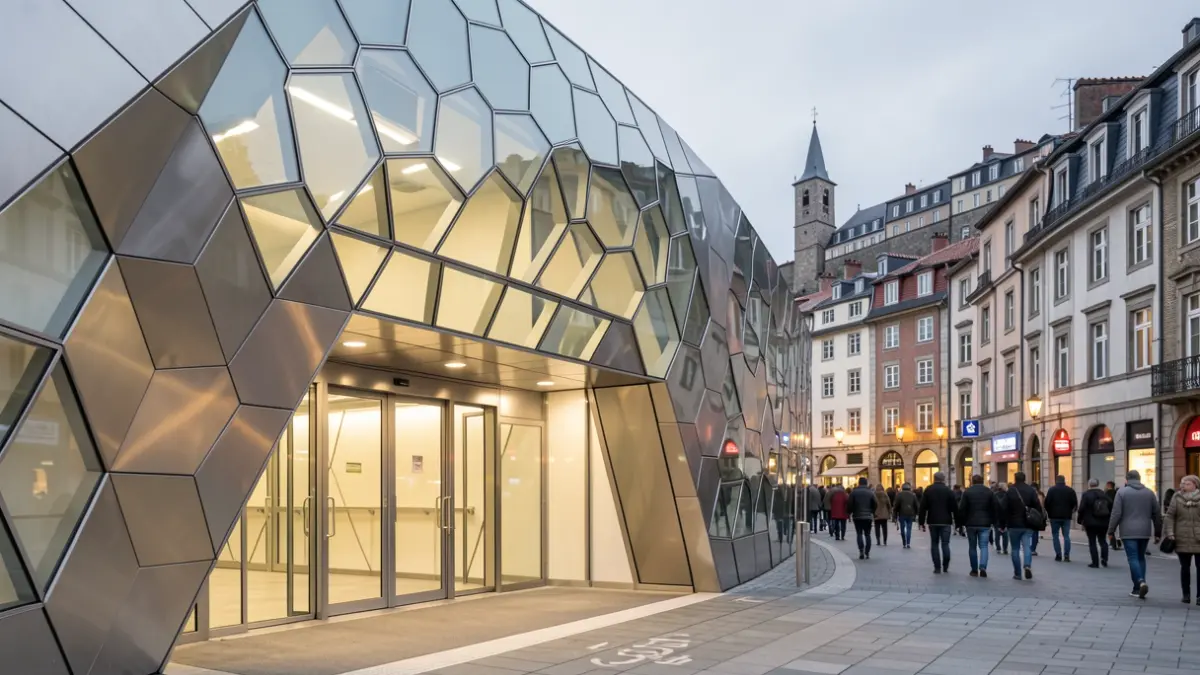
Access to the station from the square is via stairs or an elevator protected from the weather by a cover designed by the Norwegian studio Snøhetta. This structure, made of stainless steel and glass, is called ‘Vamos’.
The elimination of the Altza railway junction creates a continuous line and improves frequencies in Altza and Pasaia. The frequency will change from the current 15 minutes to 7.5 minutes on weekdays and weekend afternoons. Weekend mornings will be every 15 minutes (previously 30), and Saturday nights every 30 minutes (previously hourly).
This means doubling the services in both stations, from 136 to 274 on weekdays. To operate the service, Euskotren has trained over 150 driving agents on the new variant in recent weeks.