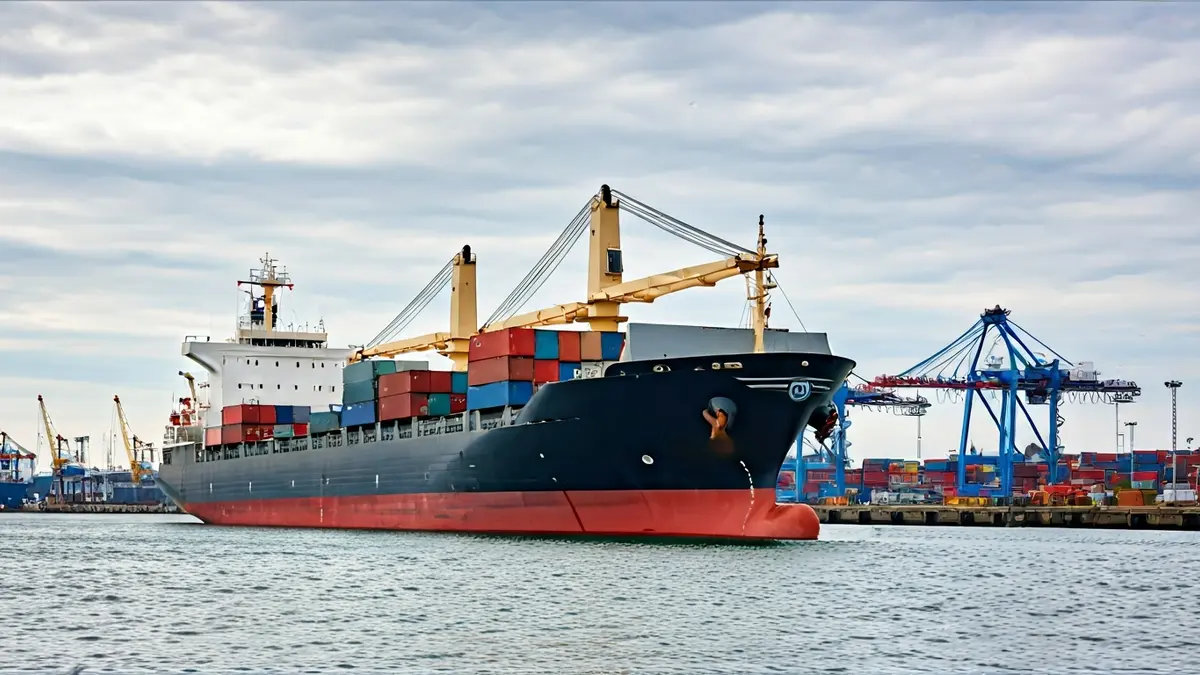
Following arduous negotiations with the Spanish Government regarding the management of regional airports, the next political battle to advance the fulfillment of the Gernika Statute focuses on the port of Pasaia. The Basque Government aspires to an integral transfer of its management, believing it possible to agree on its removal from the state's general interest catalog. This issue has created divisions between the coalition government partners, the PNV and the PSE.
Eneko Andueza, the socialist leader, has proposed an alternative that would maintain state ownership of the port but expand Basque management capacity. Meanwhile, José Antonio Santano, Secretary of State for Transport and former socialist mayor of Irun, suggested on Radio Euskadi that if the PNV insists on removing the port from the general interest catalog, “perhaps” the law would need to be changed. These statements are intended to have a clear deterrent effect, as subjecting the transfer to a vote in the Congress of Deputies could complicate its approval, facing potential opposition from parties like Vox and the PP, and the possibility that other partners of Pedro Sánchez might use the vote to push their own demands.
“"Pasaia only meets one condition: that it handles international merchandise. Therefore, the current state law allows this port to be removed from the list."
However, for Councillor Maria Ubarretxena, this legal reform is unnecessary. In an interview with Grupo Noticias in November, she had already warned that the Spanish Executive was trying to condition some transfers on legal changes that, at this stage of negotiations, “are not acceptable.” Although she did not specify if she was referring to Pasaia, she argued that Article 4 of the Ports and Merchant Marine Law establishes the parameters for a port to be classified as of general interest, and Pasaia “only meets one: that it handles international merchandise.” This, according to her, means the current law allows its removal from the catalog.
“"It has international, inter-autonomous, and strategic sector traffic due to automobiles. We are awaiting the offer from the Basque Government, but we must legally analyze this declassification very carefully, because it fully affects the criteria set by the Ports Law."
This is where the discrepancy with Santano lies, as he claims Pasaia meets three conditions. Santano acknowledged that Pasaia is not “as” strategic as Bilbao for Europe, admitting status differences between the two ports. Both the port of Bilbao and Pasaia are part of the European TEN-T network, but only Bilbao appears in the strategic Core Network, while Pasaia is in a lower subcategory. For this reason, the Basque Government seeks a shared management formula for Bilbao and full ownership for Pasaia.
Article 4 of the Ports Law states that those included in the list must meet “any” of its conditions: engaging in international maritime activities, having a commercial influence zone that “significantly” affects more than one autonomous community, serving industries of strategic importance for the “national economy,” having an annual volume essential for state economic activity, and affecting traffic safety. For a classification change, a royal decree from the Spanish Government is required, following prior consultation with the autonomous community and the corresponding city council. The removal from the catalog “will entail the change of its ownership in favor of the autonomous community,” provided it has “assumed the necessary competencies.” Ubarretxena advocates for the transfer to elevate the port to the top 10.
On another note, Santano, who has a history of confrontations with the PNV in Irun, denied being an obstacle in this negotiation or the airport agreement. He stated that in Madrid, they call him “the peripheral.” He defended the bilateral body for Loiu, Foronda, and Hondarribia as a tool for “reinforced cooperation” and consensus-building, even if the final decision rests with the Council of Ministers. He justified the absence of a total transfer by arguing that the system is solidarity-based, and small ports are maintained by the system as a whole. The PNV's questioning of his will “hurt him personally,” and he believes they were referring to another Secretary of State when they mentioned that some officials wield more power than ministers.
Santano reiterated his intention to complete the high-speed train surveys this spring, bypassing Aralar, “in line with the approach taken by the Basque Government in 2018.” He is confident that this year it will be decided whether the connection with Nafarroa will be via Ezkio or Gasteiz, regretting that this decision will leave “winners and losers.” To argue that “we all win,” he pointed out that connections between Donostia, Irun, and Iruñea will represent barely 5%, while those between the three capitals of the CAV will be 50%, with the rest directed towards Madrid and Barcelona.