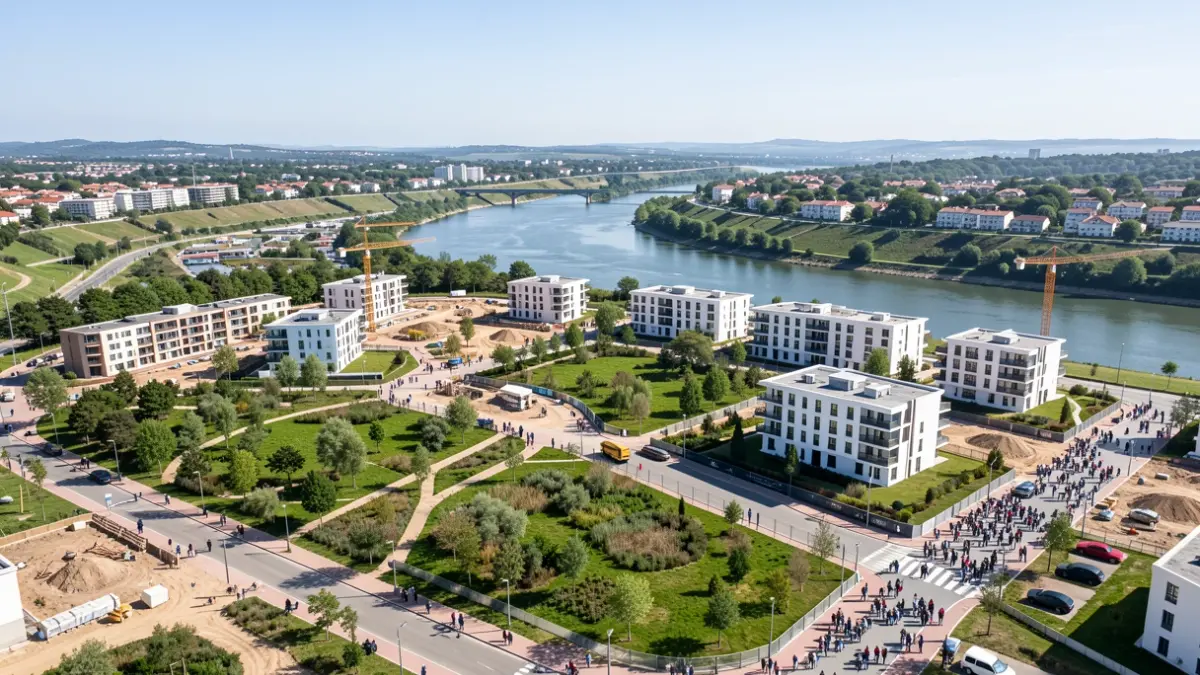
The Antondegi area, located in the Martutene neighborhood of Donostia-San Sebastián, will soon attract the attention of international architects and urban planners. The Department of Housing and Urban Agenda of the Basque Government has proposed it as a site for the 19th edition of Europan, with the clear objective of designing a future eco-neighborhood capable of accommodating approximately 3,000 homes. This process aims to gather international proposals within about a year.
The announcement was made in Vienna, where a delegation led by counselor Denis Itxaso is engaged in institutional collaborations on public and affordable housing. In the Austrian capital, successful projects developed through Europan competitions were visited, such as Wildgarten, a garden city of 1,100 homes resulting from the 10th edition.
Should Europan accept the site, presumably in November, architecture teams will receive all information about Antondegi. The area is located south of Donostia, bordering Astigarraga, and has a rural character with farmhouses and some residences. It also includes a significant ecological zone that is part of Gipuzkoa's green infrastructure network.
The current General Urban Planning Plan, approved in 2010, anticipates a high percentage of public housing in this zone. In total, there is a residential development area of 283,000 square meters, allowing for the construction of approximately 3,000 homes.
The Basque Government, through Visesa, owns 30% of the land, amounting to 286,850 m². This participation enables the Basque Government to promote protected housing in the future planning. The development of 1,110 protected homes is anticipated: 789 VPO (Official Protected Housing) and 321 regulated-price homes.
The theme of the 19th Europan edition, ‘The Reborn City / Living Together’, aligns with the area's challenges: imagining 21st-century urbanism that integrates the site's natural values while responding to the needs of a city with high housing pressure.
The Department intends for this international reflection to advance the urban planning definition of the area. Antondegi is already included in the General Urban Planning Plan of Donostia. Once a winning project is selected and agreed upon with the City Council of Donostia, the Basque Government aims to process its detailed planning efficiently, possibly through a priority action project.
The competition is not limited to designing a new residential neighborhood; it will also explore ways to modernize and revitalize the economic activity of the San Sebastián 27 industrial estate and its immediate surroundings.
The Basque Government and the City Council of Donostia will collaborate on the Antondegi project, as has been done in other areas like Playa de Vías. Counselor Denis Itxaso emphasized: "We have a housing emergency and little land; we cannot afford to lose an area like Antondegi".
The counselor pointed out the necessity of planning Antondegi's future in advance to prevent project delays, as has occurred in other areas like Auditz Akular, which has remained undesi gned for 15 years.
The Europan competition will allow the winning project to be known by late 2027. The process includes several phases: site approvals on November 5, 6, and 7, 2026; the call for entries on March 1 with a submission deadline of June 27. Evaluation will begin in June 2027, with jury meetings in July and September/October.
Europan, a European network of architecture, urbanism, and landscape competitions established in 1988 for professionals under 40, has seen the execution of winning projects. The Basque Government has collaborated with Europan since the 1990s, realizing protected housing projects in Basauri, Bilbao (Mina del Morro), Lasarte-Oria, Beizama, Eibar, and Vitoria-Gasteiz.
The Antondegi project represents a leap in scale, marking the first time the Basque Government proposes an urban design competition for an entire neighborhood to Europan. "Europan guarantees that Antondegi will have the best possible architectural and urbanistic project," stated the counselor, adding, "we want Europe's best young teams to think about what a 21st-century neighborhood should be: with affordable housing, integrated with nature, and connected to the city."