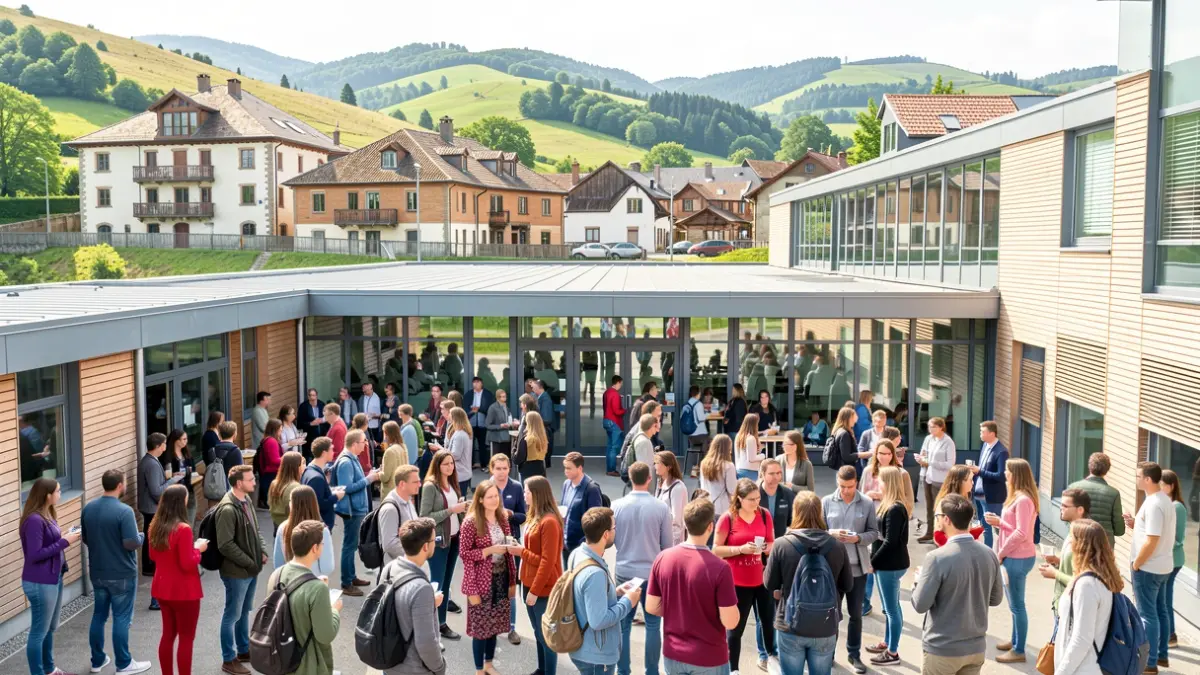
Continuing the dynamic of recent years, the Zaraobe Institute in Amurrio has built bridges with European countries through the Erasmus+ program. This year, dozens of students from Secondary Education (ESO), Baccalaureate, and Vocational Training have had the valuable opportunity to pursue their studies abroad.
This year, 53 ESO and Baccalaureate students and 8 teachers have joined the mobility programs, focusing on historical memory. In different groups, they have already visited the Italian city of Bassano del Grappa and the French city of Lezignan. The Amurrio school also hosted students from these two countries for a week, who were welcomed "with open arms" by the Zaraobe educational community. During their stay, they visited Gernika, Gaztelugatxe, Bilbao, and Donostia, gaining insight into the bombing of Gernika, Spain's democratic transition, and events of the democratic era.
Following these international exchanges, the next destination for Zaraobe students is Poland. They will travel there on June 14th for a week-long stay with students from the institute in Katowice. They will visit Auschwitz and Krakow, which teachers describe as "a visit they will never forget."
In addition to student exchanges, two ESO teachers have visited Brno in the Czech Republic thanks to the Erasmus+ program, "with the aim of learning about the local education system and improving that of Zaraobe."
Students in Vocational Training have also had the chance to benefit from these mobility programs. In recent years, 16 students have traveled to various European countries for internships, "combining training, work experience, and personal growth." Italy, Portugal, Denmark, Finland, Germany, the Netherlands, Bulgaria, Ireland, and Poland are among the destinations explored by Zaraobe students.
This academic year, for instance, students from the Higher Level Vocational Training Cycle for Care of Dependent Persons completed their first-year internships on the Danish island of Fanø. Beyond higher-level cycle students, learners from other Vocational Training cycles have also participated in international stays, with destinations including Finland, Bulgaria, Italy, Denmark, and Portugal.
Students who completed internships in Lisbon highly praised the experience: "Professionally, we had the opportunity to apply and consolidate the knowledge gained in our academic studies. Personally, this experience was a great challenge that allowed us to mature. Lisbon will always be in our hearts: it gifted us unforgettable moments, new friends, and maturity."
Students from the Social Integration Cycle at Zaraobe Institute, who undertook their work training in Finland, also described the experience as "incredible": "We saw how a completely different system works, and the local people made us feel at home. It was an unforgettable experience."
Students from Aiaraldea who completed machining internships in Italy found the learning process "very suitable" for acquiring new manufacturing techniques and better understanding international production processes: "it has been a very enriching experience, allowing us to grow both personally and professionally."
The number of international students hosted by the Amurrio center has also been significant. This academic year, students from Denmark have been at the Zaraobe Institute, undertaking their internships at the Alday elderly residence in Arespalditza.
The institute's work team has advocated that international mobility programs are about "living experiences, growing, gaining self-confidence, and opening up to the world." "In a region like Aiaraldea, where Vocational Training is closely linked to the local industrial and social fabric, programs like Erasmus+ offer students the chance to broaden their future without losing their roots. Young people from Amurrio and the entire region have the opportunity to study here while simultaneously discovering Europe, observing different ways of working, and preparing for an increasingly international job market."