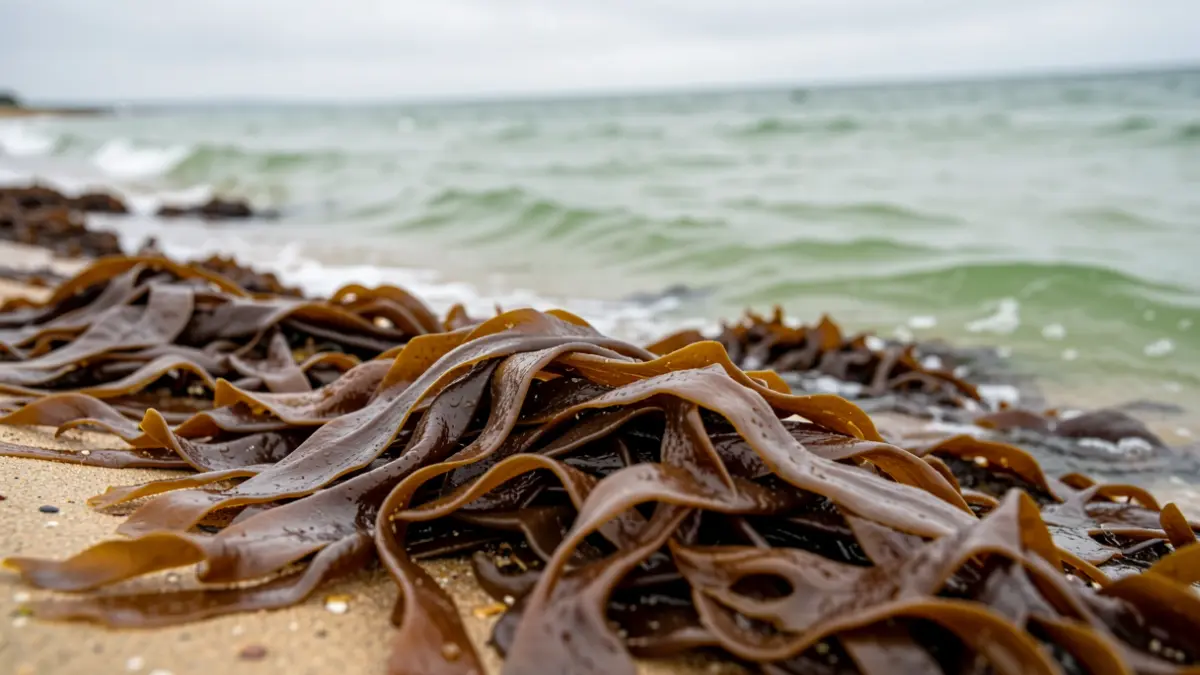
Trengandín beach in Noja has been re-covered by the invasive Japanese seaweed, Rugulopteryx okamurae, whose reproduction accelerates with the warm summer water temperatures. The warming of the sea water boosts the proliferation of this algae, which is then carried by winds and tides to the shore, where it rots and generates a strong stench.
Last summer, the invasion of this seaweed on the beaches of Cantabria forced the removal of 10,000 tons of algae from the sands of Noja and Berria. This weekend, it has flooded Trengandín beach, anticipating another summer plague that will require extra efforts in cleaning the sand.
“"It's rotting and smells awful."
The beach, which hosts numerous activities and tournaments, is affected by this phenomenon. According to a resident, "It just appeared this weekend. It's rotting and smells awful." Another vacationer complains: "As soon as summer starts, Trengandín fills up, and it accumulates more each day. If it's not collected in the heat, it rots, giving off a very bad smell, and crabs and other crustaceans will die from lack of oxygen. We hope that this year Costas and the Government of Cantabria do not wait until the algae are half a meter high to start collecting it."
Estíbaliz Ibarretxe, from the hospitality association of Noja, recalls that historically local seaweeds were collected for industry. She warns that this plague, caused by maritime cargo traffic, "has come to stay," like other exotic invasions. Ibarretxe explains that the algae is more visible in Trengandín, a bay where it accumulates at high tide, unlike other beaches where currents drag it away. Despite this, she assures that "it remains a wonderful beach. But they will have to collect it as they did last year."
Sources from the Department of Environment and Agriculture have indicated that there is no record of its appearance on Biscayan beaches this season so far. A study conducted by fifteen researchers from the universities of Santiago de Compostela and La Coruña, among other institutions, confirmed the presence of this alga in the Cantabrian Sea for the first time, in two locations in Galicia and in the port of Bilbao, after surveying over 90 sites between June 2023 and 2024.
Arantza Atutxa, the Deputy for Environment and Agriculture, explained that in 2025 it also appeared in Sopela and Muskiz, but not "massively." It was subsequently removed and reported to the Plentzia Marine Station. She also assured that there were no forecasts for this season. In 2022, the Government created a national strategy, but eradication is not viable when colonization is advanced. In Bizkaia, it is still recent.
According to the scientists' study, this alga causes drastic changes in ecosystems, eradicating native benthic species. Once the population reaches its full development, the presence of others becomes testimonial. Therefore, experts explain that Rugulopteryx okamurae could have a significant ecological impact. "Beyond the ecological implications, the eventual spread of this aggressive invader could have important socioeconomic consequences," they warned.