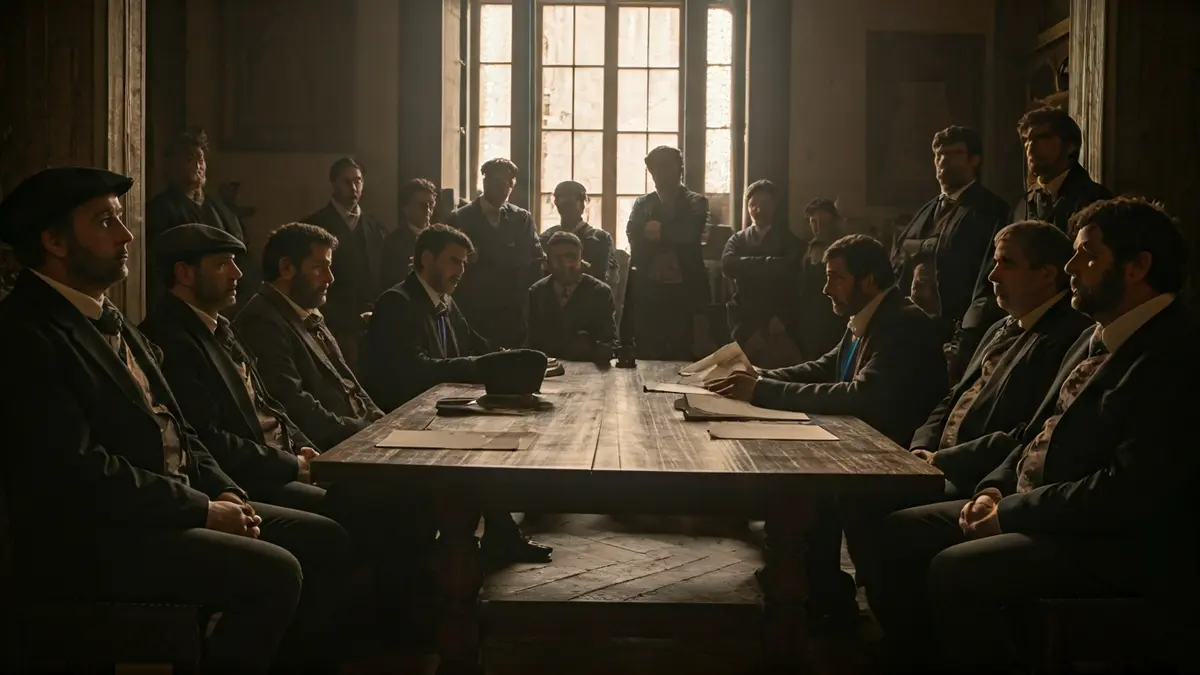
The 19th century was a period of liberal revolutions, and in the Basque Country, in 1800, representatives from the General Assemblies of Álava, Bizkaia, and Gipuzkoa created and structured a shared political foral authority, known as “Irurac bat,” based on the legislation of the time. This public authority strengthened in subsequent decades, with revenues and expenditures quadrupling between 1815 and 1865. However, at the same time, attempts were made to dismantle the political and legal basis of this authority in 1812, 1820, and 1837, leading to its complete abolition in 1877.
During this era, the “Euskaldunak” (Basques) emerged as political subjects, both in literature and politics. An example of this is the formulation of the Foral Constitution as the “Basque Constitution” by P. Egaña and Blas López in 1852. When the Spanish Constitution of 1837 eradicated the foral authorities, the liberal priest Agustín Pascual Iturriaga explained the meaning of the fuero in verse in 1838, amidst the Carlist War:
“"Fueroak esan nahi du / Gure herrietan / Ez zaigula sartuko / Inor ezertan/ Aita ta seme beti / Gure fronteretan / Armatuko gerala / Diraden gerretan / Gainerakoetan / Guk gure Juntetan/ Okasioetan / Aginduko degula / Geure gauzetan."
Based on the 1837 Constitution, a law passed by the Spanish Government abolished the Foral Deputations elected through the General Assemblies. The term “Diputación foral” appeared for the first time in a legal text on September 16, 1837. This further entrenched the issue of restoring foral authorities within the context of the Carlist War and the agreement signed in Bergara on August 31, 1839.
The Spanish Parliament, through the law of October 25, 1839, confirmed the foral authority that had been abolished, but “without prejudice to the constitutional unity of the Monarchy.” Consequently, the General Assemblies were immediately reinstated to elect foral institutions. In Navarre, however, the institutions of the Provincial Deputation assumed full powers. Furthermore, the second article of the new law mandated an adaptation of the fueros to align them with the Spanish Constitution, thus initiating the “Basque question,” or political issue.
Negotiations continued without interruption. It seemed that the project for the adaptation of the fueros presented by Bravo Murillo in 1852 would succeed. Before the negotiating commission, on November 7, 1852, P. Egaña and B. López read a long and profound memoir summarizing the principles of the new foralist doctrine of the Basque representatives, emphasizing, among other things, “Administration del país por el país” and the right of “Pase Foral.” In this context, Iparragirre composed and began singing “Gernikako arbola” in 1852, having recently returned from exile, in Bilbao and Donostia. Following the success of his concerts, Manuel Mazarredo exiled J.M. Iparragirre from the Basque territories, and in 1853, he sang the song of the Tree of Gernika in Madrid, beginning its journey to become the anthem of the Basques.
In 1870, three foralist tendencies emerged: liberal, democratic-republican, and traditionalist-Carlist. Joaquín Jamar, from a democratic perspective and language, published the formulations of liberal democratic foralism.
The law of July 21, 1876, led to the abolition of foral authorities and political self-government. In 1875, in Spain, Martínez Campos and other Spanish army leaders proclaimed and enthroned the new king Alfonso XII (December 29, 1874). After the Carlist War ended in February 1876, Cánovas del Castillo wasted no time, publishing the royal order on April 6, 1876. In the introduction, Cánovas conflated the Fueros, the war, and the Carlists, stating: “The term that without prior pacts or concessions has just taken place in the Basque Provinces in the civil war, (…) the special situation in which the entire old foral regime of said provinces, due to the very events of the war, finds itself; the unequivocal manifestations of public opinion, both inside and outside Spain, pronounced for the immediate and definitive crowning of the great work of national unity.” The General Assemblies were henceforth to be organized in Bilbao, Donostia, and Vitoria. However, Sagarminaga and other Basque liberals pointed out that the fueros were not the origin of the war, as foralism was a liberal policy.
Cánovas sought to seize the opportunity to challenge political and legal self-government, and in 1873, following the path already advanced, legally dismantle public foral authority. Thus, by May 1876, he presented the Basque political representatives with the draft law for the adaptation of the Fueros, stating that it was important to establish a regulated monetary contribution to the Spanish Treasury and the establishment of conscription for military service. The representatives of the three Basque territories did not accept Cánovas's draft law in Madrid, as they considered it the end of foral self-government rather than an adaptation.
Cánovas initiated the legislative process, first in the Spanish Senate. Among the Basque senators, J.M. Aguirre Miramon delivered the most robust political and legal speech on June 20, 1876, defending that the law of October 25, 1839, was a “pacted law.” All Basque representatives voted against it. In the Congress, M.B. Moraza, a parliamentarian from Álava, stood out, asserting that the fueros originated from “their primitive independence” and were not concessions from anyone. In his opinion, the law of October 25, 1839, was “the regulation of the relations of that country with the Central Power.” Finally, we must recall the speech of C. Villabaso, a journalist from Bilbao and director of the newspaper Irurac bat, who argued that the will for self-government should be respected, considering the decision of the General Assemblies, as different legislations and self-government structures were common in European states. The elected representatives from Álava, Bizkaia, and Gipuzkoa in the Spanish Parliament voted against the proposal.
Cánovas succeeded in passing his law, and from then on, the central Government had the option to apply the law as it saw fit. Furthermore, on July 24, 1876, in Bilbao, the military authority prohibited the publication of any article in favor of the fueros: “Published as law the suppression of the fueros, prohibited by the Excmo Sr. Captain general and commander-in-chief of this army all communication in the press contrary to this law and these provinces militarily occupied; I strictly prohibit in this newspaper the publication of any writing favorable to the fueros” (El Noticiero Bilbaíno, July 25, 1876). A state of exception was in effect, with constitutional guarantees suspended in the Basque Country itself.
Fidel Sagarminaga declared that the application of the law through foral institutions was impossible, and the Basque General Assemblies decided to reject the law and disregard it. Nevertheless, by 1877, the Spanish Government, through municipal authorities, began to call young men for military service, but municipal resistance was notable. Finally, the Army enforced it by force. In this context, the last effort or project between Quesada and Olazabal should be placed.
The military leader Quesada aimed to stabilize peace. In his view, it was important to win over the Basque foralist liberals, as they had been completely loyal to the State during the civil war. Therefore, he made special efforts to ensure that the application of the law was as flexible as possible. They agreed to pay the contributions established in the Spanish budgets and, instead of recruiting young men for military service, to pay a substitute sum. The General Assemblies of Gipuzkoa and Álava showed willingness to accept this. F. Sagarminaga, the General Deputy of Bizkaia, however, resigned. In a final effort, the assembly of leaders for the government of Bizkaia, the “regime” (March 26, 1877), was divided into two groups: the 13 members in favor of the flexible option of Álava and Gipuzkoa, and the 16 members who did not accept any collaboration with the central Government. Juan Tellitu, former General Deputy, proposed: “that he be recognized the unquestionable right to form between the Pyrenees and the Ebro, an independent State, in the manner of a small Switzerland” (March 23, 1877).
The General Assemblies of Bizkaia met in Bilbao on April 18, 1877, and a commission prepared a report on the law of July 21, 1876. The majority decided to completely reject the law and not to cooperate. Aware of this, before the commission's report reached the plenary session of the General Assembly, Cánovas ordered the military Governor to dissolve the General Assembly. The order was published on April 26, 1877, and the next day the Deputation protested. Immediately, Cánovas, on May 5, 1877, abolished the Foral Deputation and, therefore, the General Assemblies of Bizkaia. Subsequently, he appointed a Provincial Deputation (May 14, 1877), designating Manuel M. Gortazar as president. When Gipuzkoa and Álava were ready to comply with the orders of the new law of 1876, they protested when the payment of contributions was immediately demanded on November 13, 1877. Subsequently, Cánovas also dissolved the foral administration in Gipuzkoa and Álava and appointed new Provincial Deputations on his own.
As a result, the new Provincial Deputations appointed by Cánovas began to negotiate the amount to be paid to the central Treasury. The amount was fixed, but the collection of money, the origin of taxes, and the contribution remained in the hands of the new Deputations. The decree of February 28, 1878, by Cánovas established the new system and, to adapt it to the common Spanish system, a provisional period of eight years was accepted. In 1887, the term was renewed, leading to the institutionalization of economic-administrative concerts, but without political foral authority, which began to be referred to as “historical rights.” Thus, from a legal point of view, the continuity of the evolution of the Foral Constitution was eliminated, as was the basis of dual nationalism.
F. Pi i Margall, president of the first republic and theorist of federalism, published in 1877 in his well-known book Las nacionalidades: “A poco que se combinen aquí los diversos criterios para la teoría de las nacionalidades, tengo para mí que se habría de estar por la independencia de los vascos. ¿La consentirá España?”. To conclude, the reflection that Juan Ignacio Iztueta published in 1847 in the prologue of his book Gipuzkoako provinciaren kondaira edo historia: “Euskara hil ezkero Fueroak ez dira biziko; bainan Euskara bizi bada, Fueroak biztuko dira. Fueroak nahi dituanak, maite izan behar du Euskara eta Euskara maite dabenak, Euskaldunai Euskaraz behar die hitz egin eta adierazo berai dagozkien gauza guzti guztiak”.