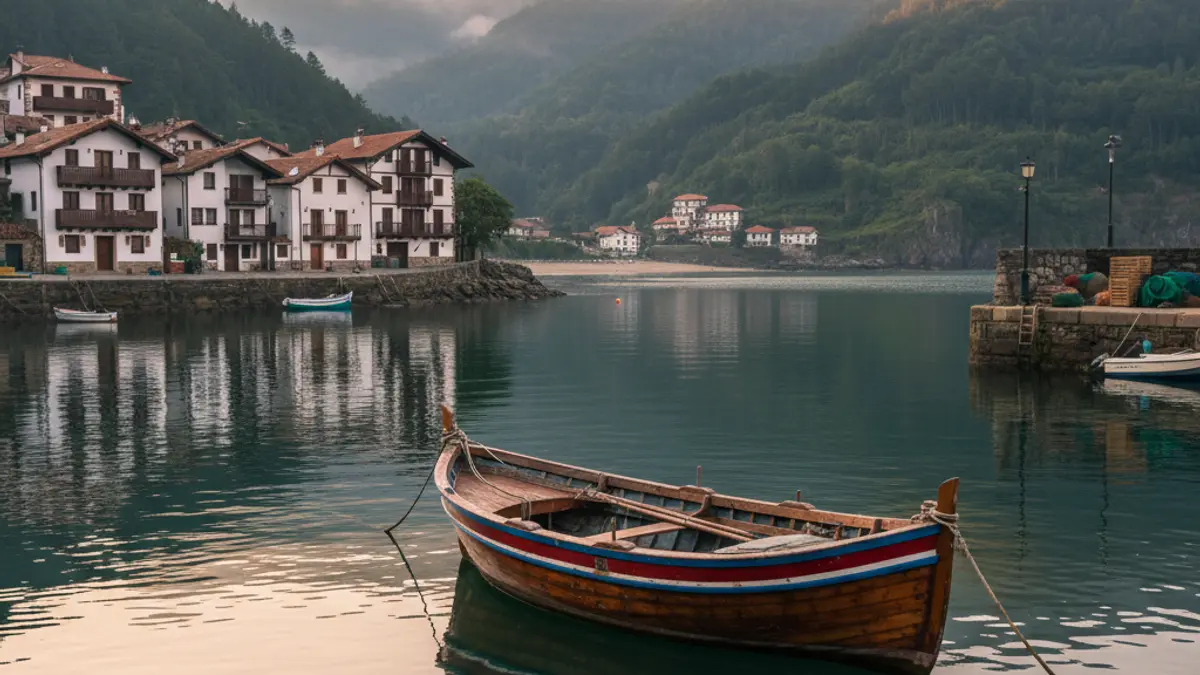
With the aim of preventing the disappearance of Orio's fishing tradition and associated knowledge, two citizens have undertaken extensive research. With the full support of the Orio brotherhood, they have spent two years gathering information and presented part of their findings in a lecture at the Kultur Etxea, as part of Whale Day.
The talk focused on the period of the last whale capture in the Cantabrian Sea, at the beginning of the 20th century, but the research is broader, also covering the preceding and subsequent decades. The title, Sardinatan edo antxoatan ari ziren (They were with sardines or anchovies), was deliberately chosen to emphasize that the whale capture on May 14, 1901, was an isolated event within the context of the true meaning of fishing in Orio. The topic generated great interest, filling the hall with attendees.
During the two-hour lecture, the researchers acknowledged the sources used and previous works. They mentioned several names, such as Spanish navy corporal Benigno Rodriguez and researcher Romana Enparan, as well as Joaquin Arostegi's book. One of the first tasks was to compile a list of steamships, for which they conducted 80 interviews with former fishermen. In this process, they realized that women possessed extensive knowledge about the steamships and that much fishing-related knowledge existed, even outside the vessels.
The research made it clear that studying fishing involved studying the town itself and the way of life of its inhabitants, as well as the environment. In Orio's case, the river and the entrance-exit to the sea, i.e., the sandbar, have been a fundamental element. For centuries, the sandbar has been the main obstacle for fishermen, even causing deaths. Throughout the talk, they explained the attempts made to solve the sandbar problem and the tricks used by fishermen to overcome it, as well as the role of the flagman, who decided whether or not to go out to sea.
Among the specific data, they highlighted the increase in the number of fishermen in the town: from twelve at the end of the 19th century to one hundred at the beginning of the 20th century. They also mentioned the changes that affected fishing, such as technological advances, the arrival of the train in Orio in 1895 and the consequent opening of the market, and political changes. They explained the modernization of vessels, how they transitioned from bateles, potines, and txalupas to steam-powered ships. The steamship San Pedro I arrived in Orio in 1907.
They also addressed the fishing techniques of the time and the importance of the brotherhood. They pointed out that the brotherhood is one of the oldest associations in the town, with mentions dating back to the 16th century. They explained the tasks and problems faced by the brotherhood at the beginning of the 20th century, especially the difficulties in collecting members' fees. They also mentioned that for two decades there were two brotherhoods, although they have not found documentation on the second. They emphasized the importance of the brotherhood and stated that the topic deserves a special lecture.
Of course, they also spoke about the whale capture, the event of May 14, 1901. They analyzed the chronicles of the time and showed how the event was narrated in different ways. They also mentioned the whale verses created by Father Orbegozo and popularized by musician Benito Lertxundi. They gave the names of the five skippers and corrected that Eustakio was Atxega, not Atxaga, as recorded in most notarial acts. They explained that the whale was placed on the slope of Zakilane, and that between 1,500 and 2,000 people from nearby towns came to see it, each paying two reales. They also recounted how, days later, the fishermen who participated in the capture asked the town councilors for money for the profits the event had brought to the town, and the records show that the councilors decided to give the sailors “100 pesetas and a snack”.
They also spoke about fishmongers, malleras (predecessors of netmakers), and pickling factories, highlighting that women were involved in these three trades. They emphasized that women brought a second salary home and the importance of this in Orio's fishing system, as men could not go fishing in winter due to the sandbar problems. For this reason, the inhabitants of Orio have always been fishermen-farmers. They also addressed the harshness of life, noting that fishermen at 40 were “broken,” with respiratory problems and rheumatism, as they started on the boat at 12, barefoot and soaked.
In their research, they have found numerous documents, such as how many businesses, shops, and taverns existed in Orio at the beginning of the 20th century. The researchers stated that they are working voluntarily and are not professionals. They added that there is a large gap in documentation and graphic images, and that women's names barely appear in the records, despite having been “the backbone of the fishing system.” They stated that the work is unfinished and that they will continue researching, as they feel the “obligation to transmit this narrative to future generations.” They promised that all research results will be handed over to the brotherhood, and they called on citizens to contact them if they have additional documents or information.