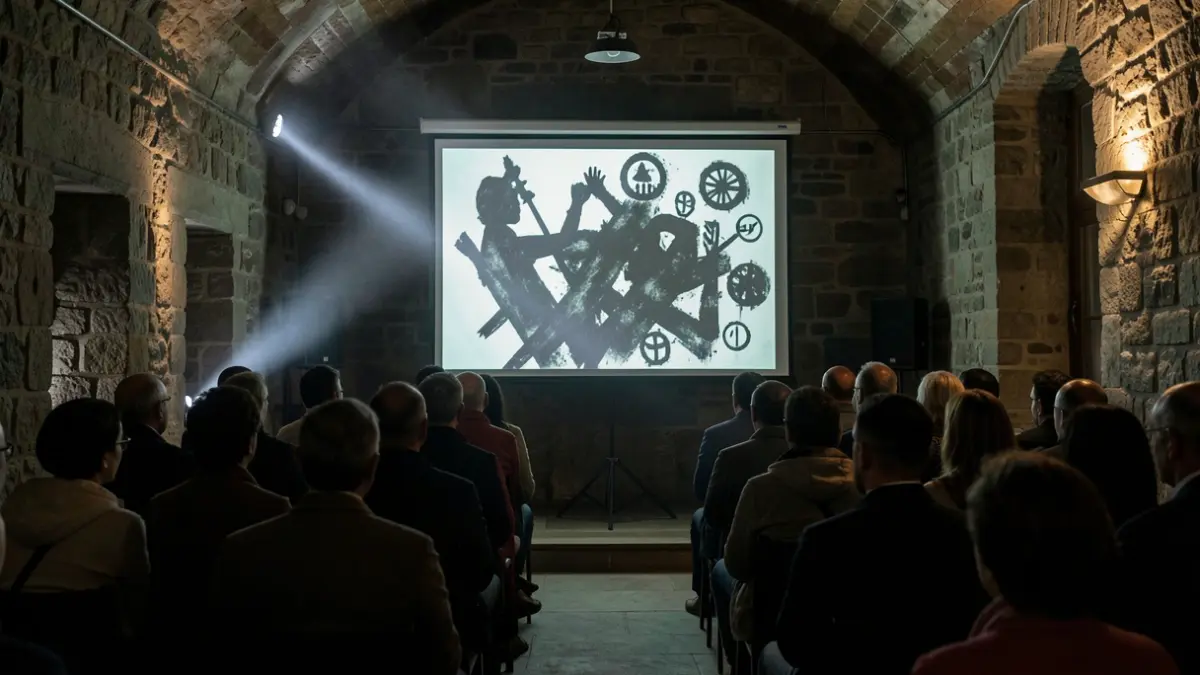
Militants Adam Laamirni (Tolosa, 1996) and Leire Romero (Ibarra, 1999) have participated in the production of the documentary 'Munstroak sortzen direnean'. The audiovisual piece analyzes contemporary fascism and the antifascist struggle, and will be screened on Saturday, May 23rd, at 11:00 AM, at the Tolosa cultural center. Both creators have explained the documentary's content, the production process, and the importance of the topic.
The documentary reviews 20th-century fascism through three main manifestations: far-right parties, street fascism and violence, and the social basis and spread of reactionary ideology. In these sections, parties such as VOX, France's Rassemblement National, and Italy's Fratelli d'Italia are analyzed, concluding that they represent the interests of the international oligarchy and, among other things, accelerate the political and economic offensive against workers and the authoritarian tendencies of states.
Following the same thread, the documentary examines how street fascist groups apply the same agenda through direct violence and fear, and investigates their links with state apparatuses, such as the police or far-right parties. It also analyzes how the fascist discourse spreads and the function it serves in normalizing the fascist movement, concluding that the fight against fascism cannot be effective without the fight against capitalism.
The documentary's title is based on a well-known reflection by the communist militant Antonio Gramsci: 'The old world is dying, the new is struggling to be born; and in this interregnum monsters arise.' The creators believe this reflection is a suitable starting point for explaining the current context and the rise of fascism.
The work, produced by the media outlet Diario Socialista, has taken approximately a year to record and edit. They have highlighted that it is a project carried out in a militant capacity, not driven by economic or personal motivations. The willingness of the interviewees, the artists, and those who hosted them in their homes have made the documentary possible.
The creators emphasize that fascism is an increasingly real threat today, citing examples such as the foreign and domestic policies of states, increased military budgets, social control and authoritarianism, and the restriction of political rights. Furthermore, they point to the expansion of Nazi groups and their attacks, not only in the Spanish State but also in France or Italy, and also in the Basque Country. The rise of reactionary ideology is undeniable, with discourses linking immigration to insecurity and an increase in misogyny becoming more common.
The aim of the work is to understand and analyze what one seeks to confront, demonstrating that fascism is not merely a historical phenomenon of the 20th century. The documentary has been analyzed from an antifascist position, complemented by analyses and experiences of European antifascist militants. In this way, it seeks to contribute to the political line developed by the Socialist Movement in the field of antifascism, serving as a tool for cultural struggle.
The creators acknowledge that they have captured only a small part of a complex reality, demonstrating that fascism, authoritarianism, and war are occurring at high speed, as evidenced by military interventions during Trump's second term, the radical actions of ICE agents, the rise of the far-right in Europe, NATO's increased military budget, cases of police brutality, and the rise in street attacks. Therefore, they stress the urgency for the entire working class to organize and fight against fascism.