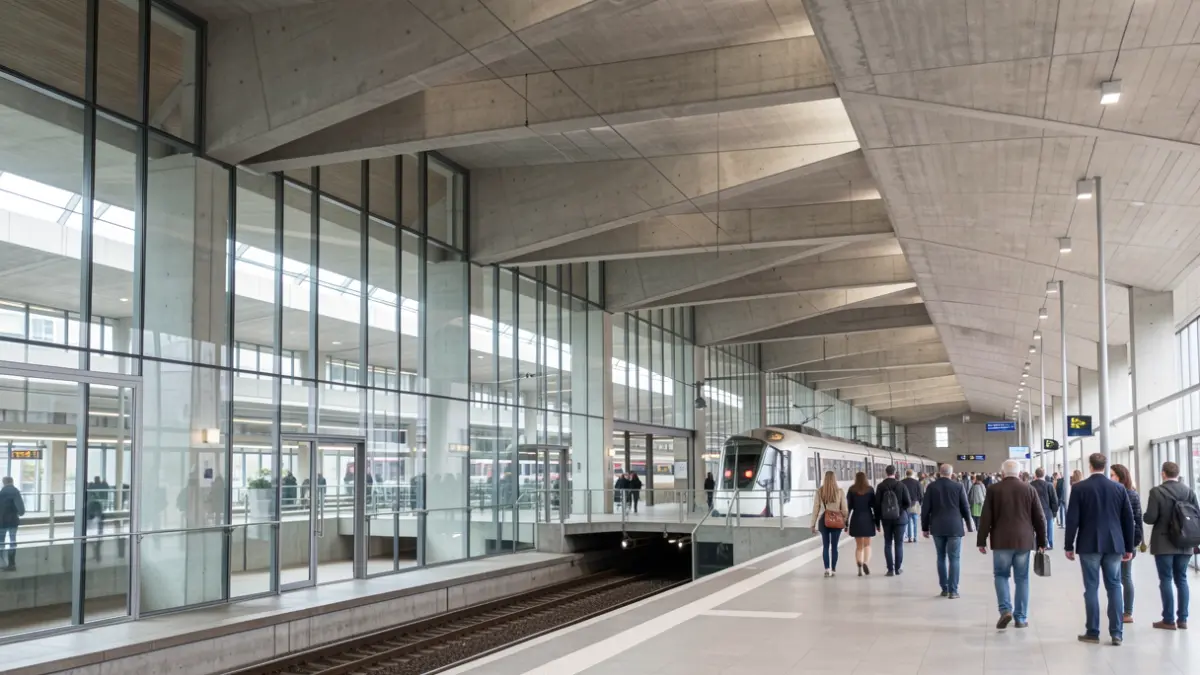
The Minister of Sustainable Mobility, Susana García Chueca, visited the facilities accompanied by the Deputy Minister of Infrastructure and Sustainable Mobility, Miguel Ángel Páez, the Director General of Euskal Trenbide Sarea (ETS), Antonio López, and the Deputy Director General of Euskotren, Yon Pérez. Guided by the project managers, attendees toured the new entrance, where ETS is currently carrying out the final electrical works, and the extended underground platform section.
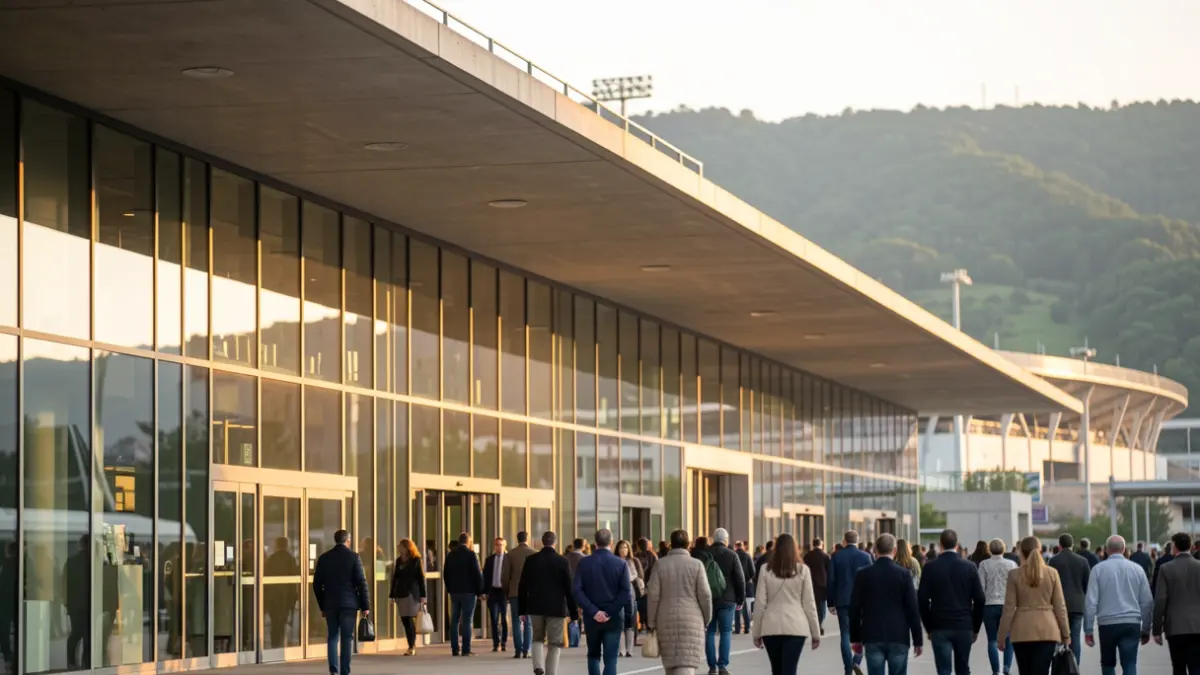
Validation and ticket vending machines are being installed in the new entrance, along with testing of the elevators that, together with the stairs, will provide access to the platforms. The works have been complex as they had to be carried out alongside the regular train service to ensure user mobility. The access entrance features a glass facade and a concrete canopy extending as a cantilever in the entrance area to protect users. The exterior cladding consists of large-format tiles that resemble stone but are made from fully recyclable and anti-vandalism material, responding to the Department of Sustainable Mobility's interest in promoting the circular economy and reducing maintenance costs.
The new and old entrances will be open simultaneously until October 12, inclusive. Starting Tuesday, the old one will be closed for the preliminary and dismantling work necessary for its thorough renovation. During this new phase of works, the old entrance will remain closed, except when the Real Sociedad plays or when events attracting large crowds are organized in the vicinity. In such cases, the old terminal will open two hours before the event and remain open for two hours after its conclusion.
In this context, the Minister of Sustainable Mobility, Susana García Chueca, highlighted that “precisely the main objective of this work is to facilitate the movement of people during matches and events, with improved safety and comfort conditions for citizens visiting Anoeta”. Anoeta is, in fact, the second station with the most Topo users, with nearly 3,000,000 validations last year, “and the new entrance has an area of 400 square meters, in addition to the current 380,” she recalled.
The joint use of both entrances will be implemented on days of major matches and events. Those using the Topo to attend Real Sociedad matches and major events will have a new mode of mobility starting from the match the men's first team will play on October 11. Depending on the direction of the train they wish to take at the end of the match, they will need to consider the following: those wishing to take the Topo towards Hendaia will need to enter the platforms through the new entrance; during match departures, this entrance will be exclusively reserved for those heading east of the territory. Those who wish to access trains to Lasarte-Oria will need to enter the platforms through the main entrance of the old vestíbulo. Users taking units towards Zumaia will have access via the Gasca side. This dynamic will continue unchanged from now on for all match days and when major events, concerts, etc., are held.
Among the works carried out, to compensate for the space occupied by the new accesses on the ground plan, public spaces have been gained from vehicle traffic, taking advantage of the traffic reduction brought about by the launch of the Urumea bypass in the area. As a result, a significant urban regeneration action, common in ETS works, has been carried out in the surroundings, linked to the care of the pedestrian surface in front of the stadium and the promotion of active mobility, in addition to rail mobility. To this end, in the initial phases of the works, the surrounding roads had to be completely reorganized according to the criteria established by the Donostia City Council in traffic matters, including the old Aita Donostia roundabout. After this stage, the affected services were diverted, i.e., the underground electrical, telephone, and water pipes, before the screens (walls) for the new access to the platforms were built. Subsequently, the covering slab was constructed, and the screens of the old tunnel were demolished, without interrupting railway traffic. Once the space was fully adapted, the construction of the stairs to access the platforms and the structure of the building began. The furniture and lighting have also been replaced, to convey greater safety and cleanliness. In addition to the construction of the kiosk, the existing platforms have been extended and equipped with glass protection to prevent falls onto the track.
From a railway perspective, the new infrastructure coincides with the “transport revolution that Gipuzkoa will experience with the recent opening of the Altza-Galtzaraborda section and, on November 21, the opening of the Topo passage in the center of Donostia,” emphasized the minister. “Ultimately, it is about building competitive and efficient infrastructures that encourage citizens to use public transport and leave their cars at home,” she added.