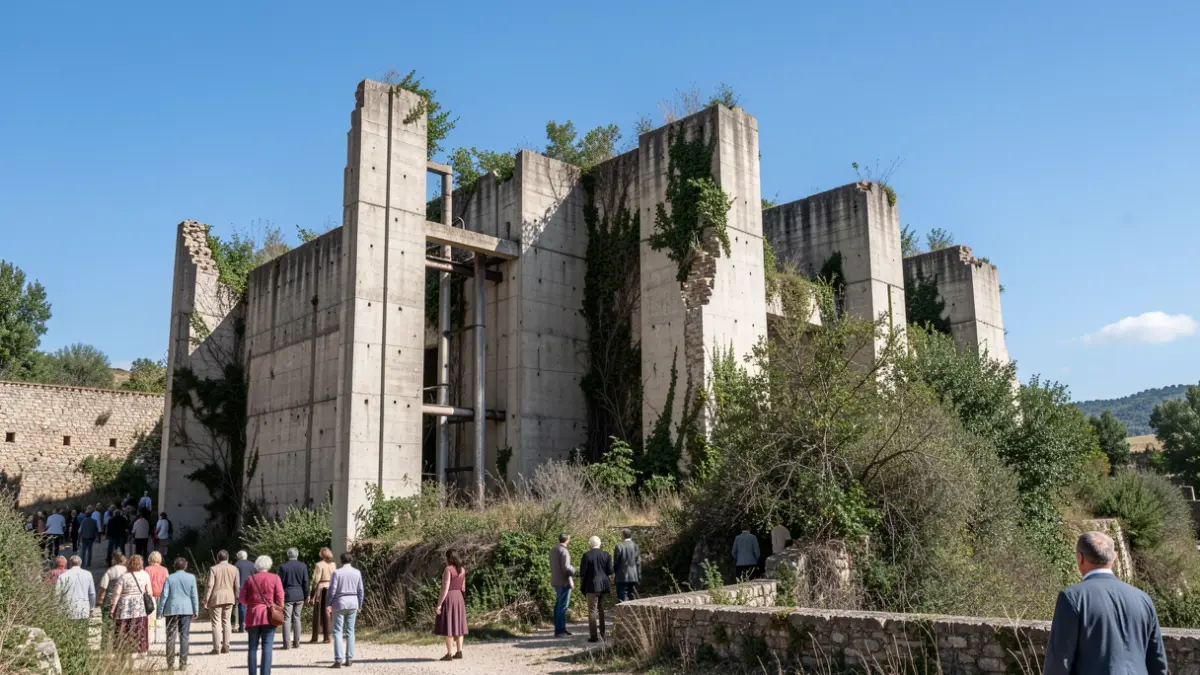
Fundación Vital has kicked off the countdown to give a new life to the ruins of the Bodegas Antion in the Alavesa town of Elciego. With an investment of 12 million euros, the entity will transform an 11,000-square-meter concrete skeleton, abandoned without ever being inaugurated when the 2008 crisis hit, into what it aims to be Europe's largest wine experiential center. The project, which has the unanimous backing of institutions and wineries, seeks to be a catalyst for tourism in Rioja Alavesa and highlight the quality of its wines.
The idea stems from the need to boost a sector facing a complex global scenario and to give visibility to the territory's 205 wineries and wine companies. The search for a location led the Foundation to the old Bodegas Antion, a complex that never operated and had become a hotspot for vandalism, occupations, and insecurity. Its state is desolate, with five meters of water in some areas and the interior completely destroyed.
The designed transformation aims to turn it into "a destination in itself" rather than a traditional museum. The philosophy is to "amuse, entertain, and instruct," offering activities for all ages, from 3 to 90 years old. The goal is for visitors to learn about wine culture in a fun and interactive way, serving as a showcase rather than competition for the wineries.
“"We are not going to compete with anyone, it will not be a winery"
The heart of the project will be a circular building of 6,000 square meters spread over four floors. The exhibition route will take visitors from the surface to the roots, through underground levels, emulating the grapevine cycle. It will include an immersive video space, interpretive tasting rooms, and interactive experiences, such as a virtual grape stomp that mimics the sounds and sensations of reality, with the option to taste the must at the end.
One of the center's pillars is its function as a showcase for all wineries in Rioja Alabesa. It will feature a 'showroom' where each of the 205 wineries will have its own space to display its wines and history. Additionally, a shop will allow customers to purchase any wine from the region and manage worldwide shipping, acting as a logistics and sales hub for all producers.
The complex will also include a wine bar designed to make "opening a bottle of wine an experience in itself," in an "exclusive" atmosphere resembling a "crypt." This will be complemented by an outdoor terrace, event spaces, and the potential creation of a restaurant aiming for a green Michelin star, based on local, zero-kilometer products.
Currently, work is focused on debris removal and cleaning of the facilities. Construction is set to begin after the summer of 2026 and is expected to conclude by the end of 2027. The aim is to inaugurate the center by Easter 2028. The project plans for an initial team of 17 people, although one of the main challenges is the lack of qualified personnel in the area, a problem the center itself hopes to help mitigate. "Many young people are starting to leave for Logroño, due to prices and because there are few opportunities in Rioja Alavesa," laments Urresti.
In parallel, the future of the adjacent hotel, which never operated, is being studied. The idea is to expand it from 12 to 24 rooms to make it attractive to a prestigious hotel chain for management. With this project, which is already in talks with the wine museums of Bordeaux and Porto, Rioja Alavesa is acquiring a reference center that other major appellations already possess.