With housing scarcity as a major concern for Basques, the Minister of Housing and Urban Agenda of the Basque Government, Denis Itxaso, presided over a session in Sopela this Friday to present the Executive's roadmap, supported by a significant construction cluster. The event introduced Eraikihub, an 'accelerator' agent through which the administration seeks to 'industrialize' construction in Euskadi.
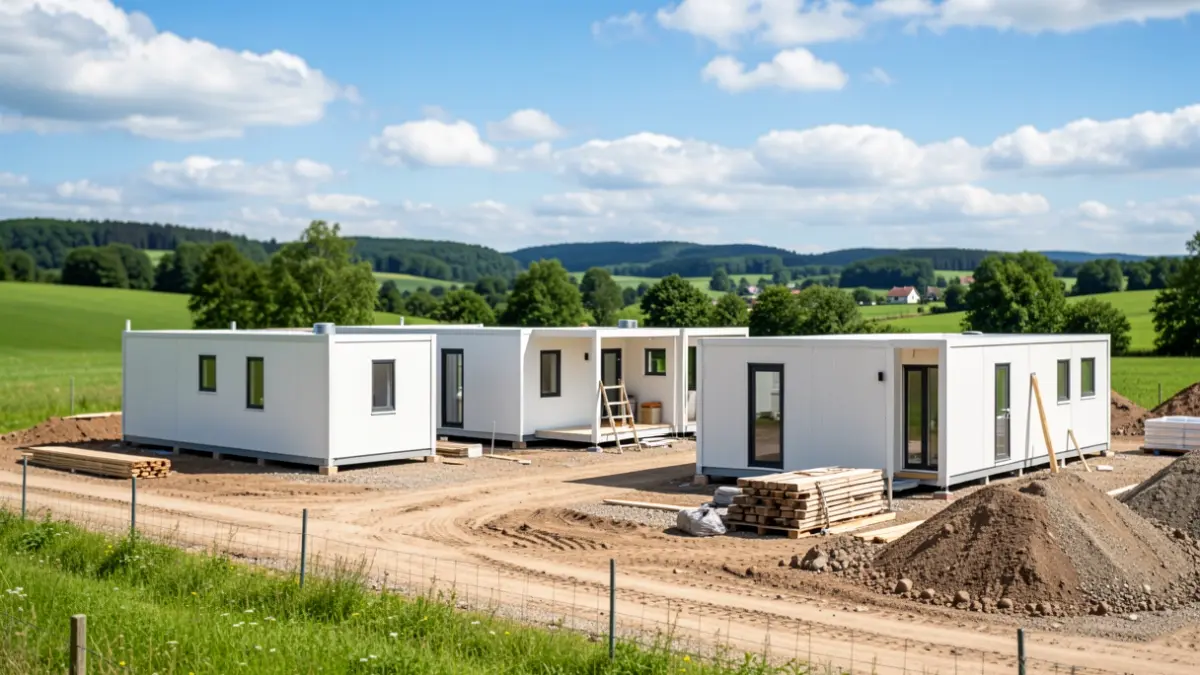
This approach involves shorter processes and factory work, contrasting with traditional on-site construction. The aim is to build faster using large, pre-finished components that only need assembly, and to attract young people to the sector, which is currently facing a 'very complicated' period with an estimated '600,000' unfilled positions.
During the event, Visesa awarded the Eraiki Label certificate to a building of 33 protected homes in Sopela, achieving an industrialization level of 'close to 90%', the highest to date. This is the first such building in Euskadi, but it will be the first of many, as announced by Denis Itxaso. The minister stated that by '2036, 65% of homes' will be built using these new procedures, emphasizing that 'housing is the main problem the country faces' and that this model, already in use in 'many European countries', can provide a solution.
“"Housing is the main problem the country faces"
In the Sopela case, 99 modules, manufactured and nearly completed in the factory, were used, 33 per floor, and later assembled on-site. Nerea Morgado, technical area director at Visesa, noted that while the process took 17 months, 'the learning has been significant,' and she is confident that future timelines will be reduced while maintaining the same quality level.
In the coming years, the Basque Government will implement this new construction paradigm in four specific developments. Denis Itxaso's department aims to provide a rapid response to the housing problem by building new apartments on top of existing protected buildings, thus causing 'less disruption' to current residents. The five pilot projects will be located in Leioa, Mutriku, Arrasate, Vitoria, and Bilbao, totaling nearly 350 new homes. 'The housing problem is a major challenge and requires a lot of imagination,' insisted Aitor Pradovaso, technical director of communities and housing innovation at Alokabide.
Experts have explained that industrialization can be applied to 'facades, floors, interiors...'. In fact, for the Sopela development, even the concrete blocks for the garages arrived compactly and were finished after placement. Buildings adopting this new model will be able to use this technique for 'structure, envelope, installations, and interiors,' as recalled by José Luis Elejalde, director of the Energy, Climate, and Urban Transition Unit at Tecnalia, the entity that will grant the Eraiki Label certificates.
Each development will have a different degree of industrialization, although experts believe that for progress, a global commitment and 'a volume to be competitive' are necessary, stated Elejalde.
Experiences such as 'Kabian' have also been presented, a construction system designed to facilitate access to affordable housing, developed in collaboration with the Peñascal Foundation, which aids in the employment of individuals at risk of social exclusion. 'Being a very tough sector, it can contribute to more favorable conditions and also attract more women because these are safer workspaces,' explained Gorka Rodríguez of Urbanbat. The expert highlighted the 'social' aspect of the sector, both in building 'affordable housing' and in employing and integrating immigrants. His company has conducted a 'mapping' that estimates the potential construction of '1,247' new homes in Bilbao using these new systems.