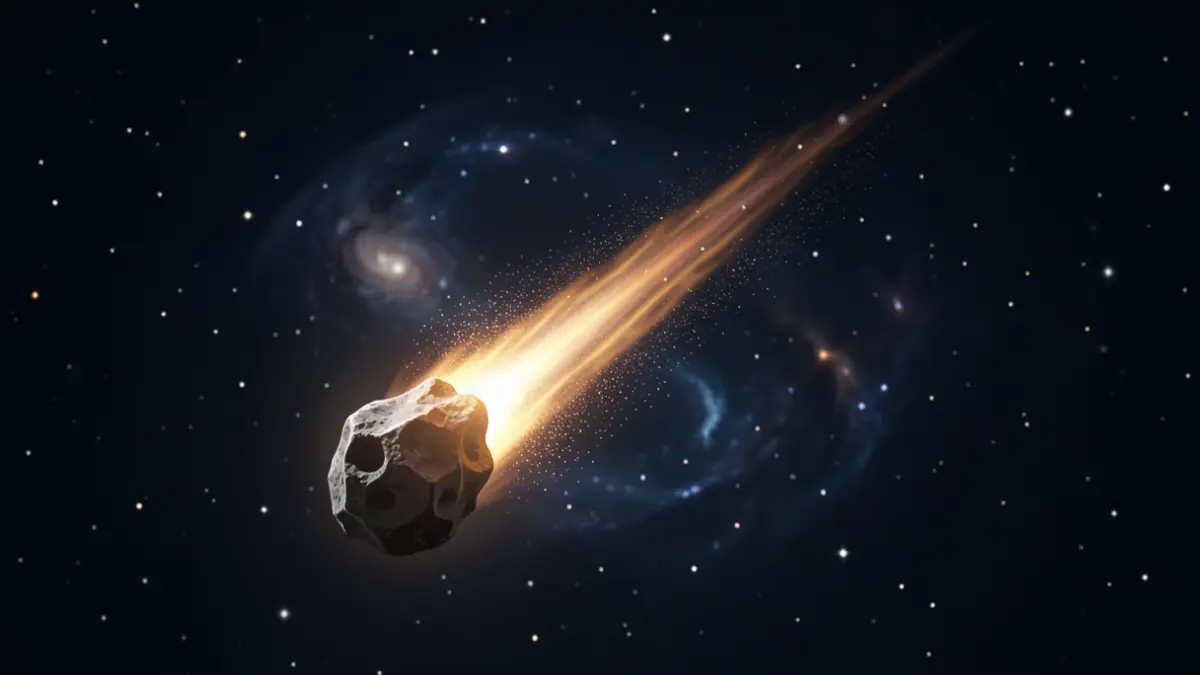
Today, our little hedgehog, Kiñu, will tell us about the journeys it will make from space to Earth, along with meteorites. Additionally, we will learn the names we give to objects made of rock, metal, or ice: meteoroid, asteroid, and comet. These objects are not just rocks from space; they are also traces of the Universe's past.
Most are fragments of asteroids or comets, but some also arrive from the Moon or Mars. Therefore, studying meteorites is very useful for understanding the composition of celestial bodies and better comprehending the history of our planet and the Solar System.
Looking at the sky is enough to find some of the most spectacular traces of meteorites. In August, for instance, we can see the Perseids: when Earth encounters the trail of dust and particles left in space by the comet 109P/Swift-Tuttle, these particles enter the atmosphere at high speed and create streaks of light. These are the so-called shooting stars, although, contrary to their name, they are not falling stars.
Every month, on the last Friday, Kiñu visits the Zientzia Kaiera blog. 'Kiñu's Gaze' will be the segment of our little hedgehog, and through it, he will bring us the most curious facts about a scientific topic published by our authors.
The author, Maddi Astigarraga Bergara, holds a degree in Biomedicine, a master's in Scientific Illustration from the UPV/EHU, and works as an illustrator.