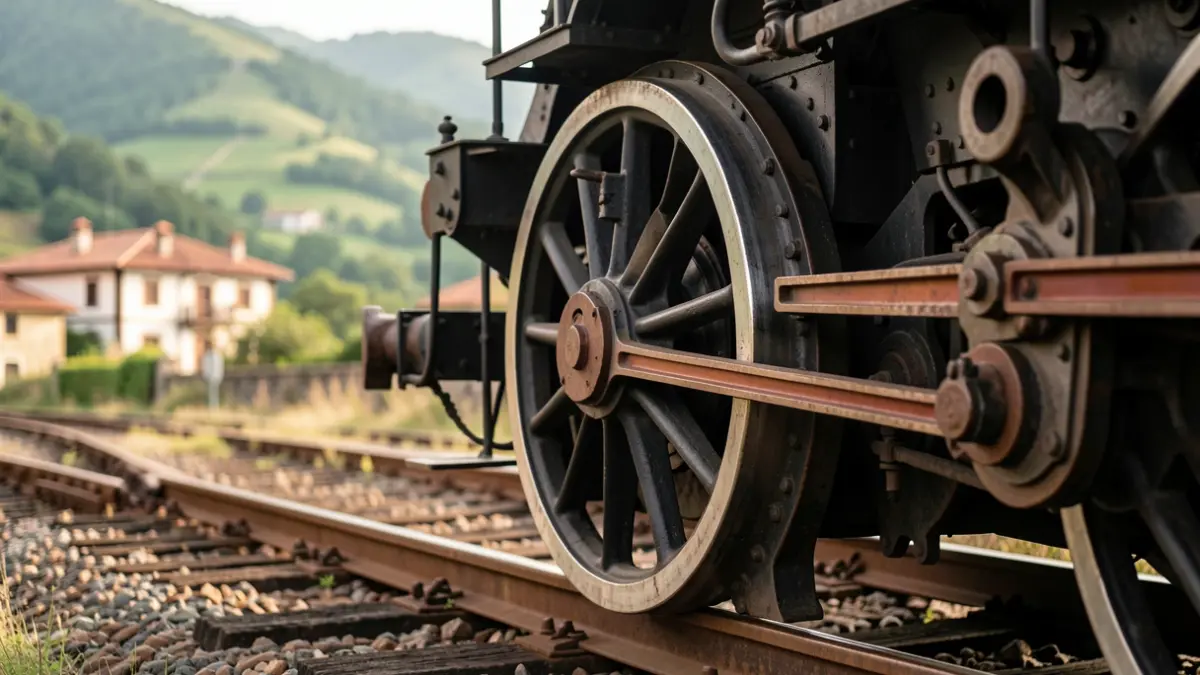
Joan Manuel Estrade, president of the Association of Friends of the Bilbao Railway, has described a significant event on Bizkaia's rail network: the relocation of a 19th-century train. The convoy, comprising an 1892 locomotive and late 19th-century passenger coaches, is heading to the Bizkaia Railway Museum in Lutxana.
This complex technical and logistical operation marks a crucial step in preserving Basque railway heritage. The association successfully saved this historical material from being scrapped after the closure of the former Vasco-Navarro Railway, aiming to exhibit it to the public. Last November, a donation agreement was signed with the Euskotren Foundation for its integration into the new museum.
The convoy has been kept in a "hidden" location in Bilbao to protect it from vandalism it suffered years ago. From its current site, it will travel approximately 12 kilometers to Lutxana, between 1 AM and 3 AM. It will initially run on Adif's metric gauge network to Irauregi (Alonsotegi), before joining Euskotren's line in Lutxana.
As the train cannot move under its own power and lacks operational permits, it will be towed by two diesel locomotives from Continental Rail. Estrade emphasized the need for "especially careful driving, without jerks," as these historical units lack assisted braking systems.
The ensemble, weighing around 38 tons (13 tons for the locomotive), will be handled with extreme caution by the drivers. The route includes 8 kilometers on Adif tracks and 4 kilometers on ETS tracks to Lutxana, with a manual switch change at Irauregi.
The convoy consists of a locomotive built in 1892, a saloon coach, a first-class coach, and a third-class coach manufactured in Manchester in 1887, along with a luggage van built in Bristol in 1902. All of it belonged to the historic Ferrocarril Vasco-Navarro.
The designation of Lutxana as the Bizkaia site for the Basque Railway Museum opens a new chapter. As early as 2000, the Ametzola area in Bilbao was considered for housing these relics, although the project did not proceed.
The Lutxana station holds significant historical value as a key connection point for Bizkaia to the plateau via the La Robla line. Its infrastructure, featuring both Iberian and metric gauges, will allow for the exhibition of vehicles from both systems.
Upon arrival, the convoy will undergo cleaning and restoration, including graffiti removal and routine conservation work. A protective structure is planned to be installed after the summer, preceding the construction of a permanent building for the historical trains.
The arrival of this convoy marks the first major milestone for the new museum, officially established in January. Soon, a locomotive from Altos Hornos de Vizcaya and other historical vehicles linked to Basque industry and railways, such as one from La Orconera, are expected to be added.