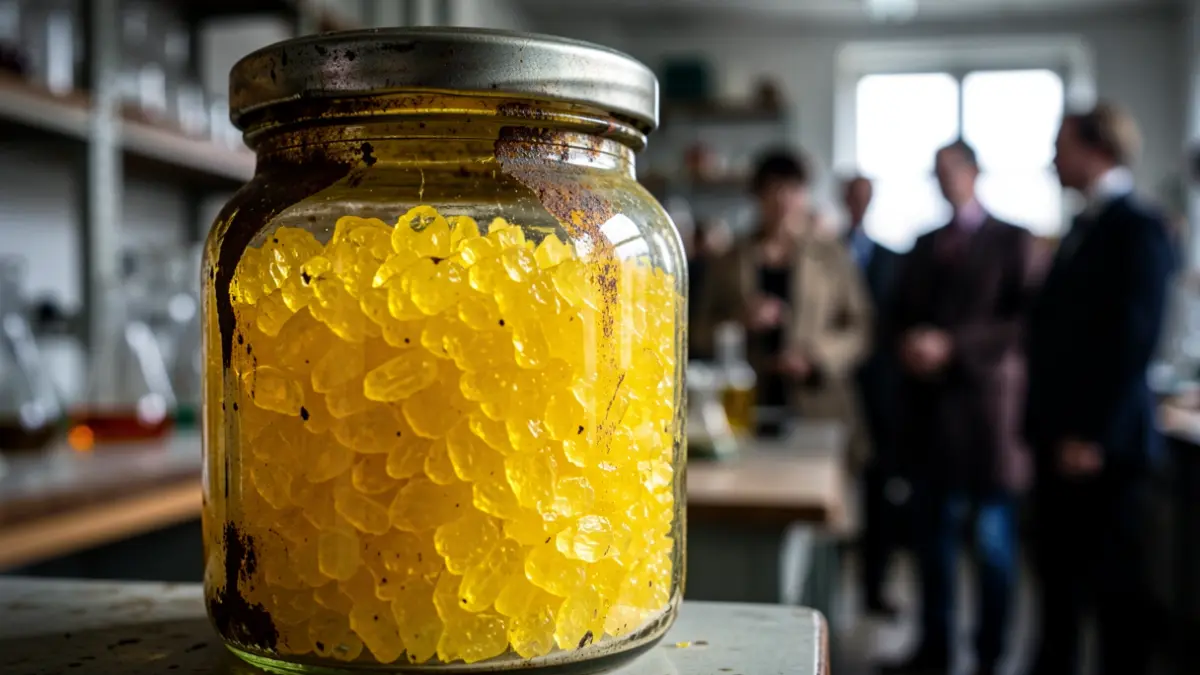
The discovery of picric acid in the laboratories of several educational centers in Euskadi has raised concerns. The Basque Government's Security Department has reported that specialists from the Ertzaintza's Explosives Disposal Unit (UDE) have removed six containers of this substance over three days.
These containers were found at the IES Miguel de Unamuno in Gasteiz, La Salle in Eibar, IES Aixerrota in Getxo, and Zabalburu Ikastetxea in Bilbao. Specialists have begun the process of neutralizing and destroying the substance.
Picric acid, scientifically known as 2,4,6-trinitrophenol (TNP), is a bright yellow crystalline substance. When kept moist, it is relatively stable, but when dry, it becomes highly explosive and sensitive to heat, friction, and impact. It can also react with metals to form picrates, which are even more unstable.
Historically, picric acid was a common reagent in science education, used for histological staining and identifying organic compounds. Containers of this substance, used for decades in school laboratories, had been forgotten in cupboards and storage rooms.
In recent days, a preventive inspection and cleaning campaign has been carried out in educational centers across Euskadi. When it was detected that the substance might be dehydrated or crystallized, the protocol was followed to call emergency services. Ertzaintza's UDE specialists have intervened with special measures, including the removal of containers or, if the risk was high, carrying out controlled detonations.
Picric acid is easily absorbed through the skin, staining it yellow, and can irritate the eyes and mucous membranes. Its side effects include dermatitis, fatigue, stomach problems, and liver and kidney damage. Experts recommend not opening or moving any containers labeled as Picric Acid and immediately notifying the authorities.