Researchers from the departments of Geography, Prehistory and Archaeology and Geology at the UPV/EHU, along with colleagues from the Department of Geology at the USAL, have quantified for the first time the relief difference between the two slopes of the mountain range extending from Castro Valnera (between Burgos and Cantabria) to the Pyrenees. Since the formation of the mountain range, both slopes have eroded differently, causing the crust on the Atlantic slope to rise more than that on the Mediterranean slope.
The Earth's crust rises when it loses the weight of overlying rocks, similar to how a ship floats higher when it loses cargo. While plate tectonics collisions are necessary for mountain formation, the relief continues to rise afterwards. Tectonic plates float on the mantle in the asthenosphere, and when the load on them is reduced, the relief gradually rises to achieve equilibrium. This phenomenon is known as isostatic adjustment and is very noticeable in areas where glaciers disappear.
Understanding isostatic adjustment is crucial for comprehending sea-level changes and the evolution of the terrestrial landscape. The Vasco-Cantabrian Mountains act as a watershed divide for two river systems in the north of the Iberian Peninsula: one flowing into the Cantabrian Sea and another into the Mediterranean Sea. UPV/EHU researchers are analyzing the contrast between these two slopes.
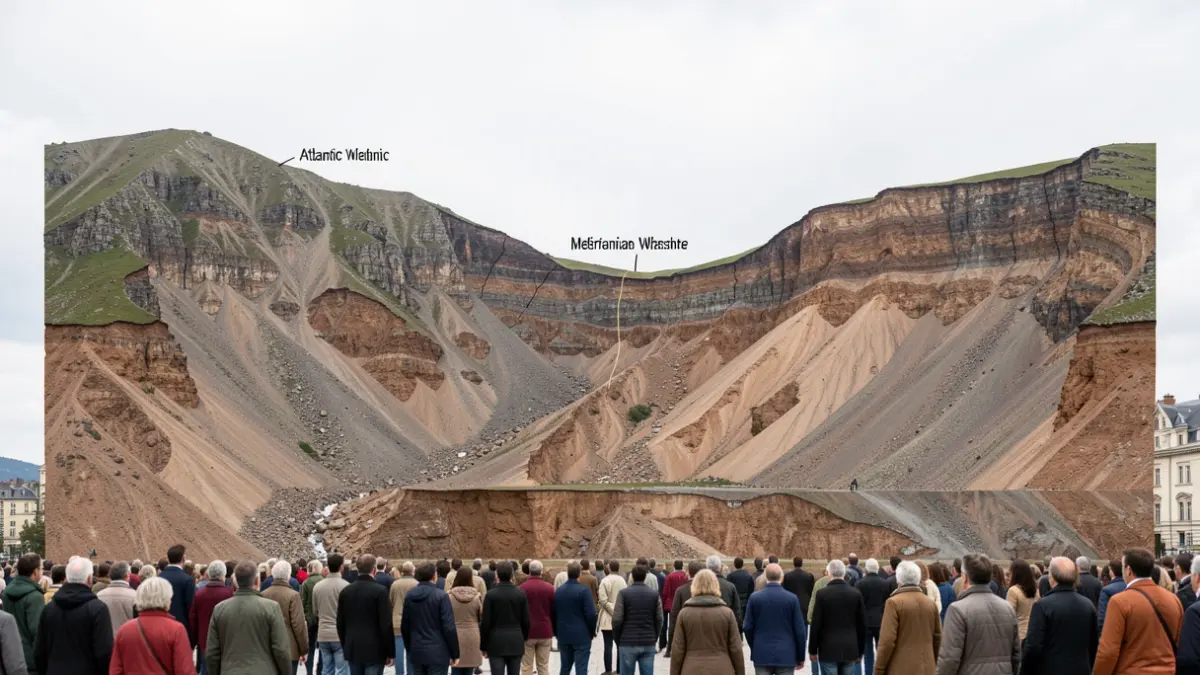
Iván Martín has calculated that, from the formation of the Vasco-Cantabrian Mountains to the present day, 2,019 km³ of rock have eroded on the Atlantic slope and 1,408 km³ on the Mediterranean slope. 'Differential erosion has occurred; the Atlantic slope has eroded more, causing greater isostatic uplift,' states the UPV/EHU researcher. The relief has risen approximately 255 m on the Atlantic slope and 167 m on the Mediterranean slope, resulting in an 88 m difference in uplift between the two slopes.
Rivers from 35 basins on both slopes (13,190 km²) have been analyzed using both classical and modern methodologies. 'To date, few such studies have been conducted globally, primarily in glacial areas. Almost all the isostatic adjustment that has occurred here is due to river erosion, and research related to river-induced erosion is scarce,' he notes.
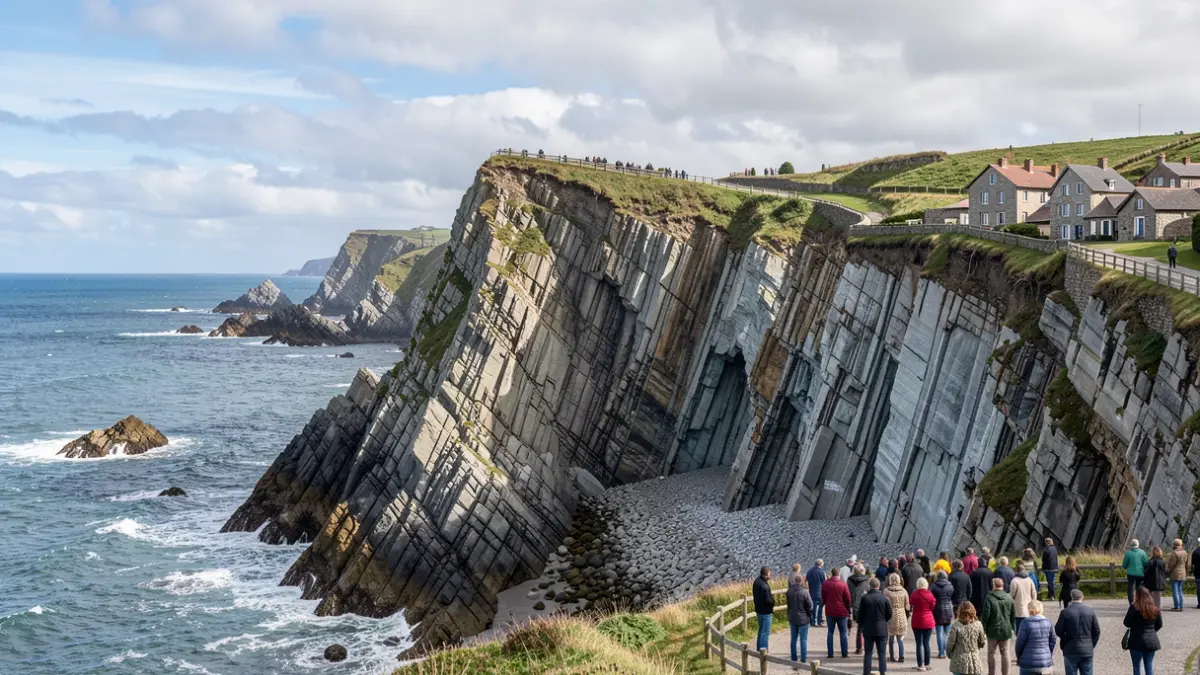
The cliffs of Jaizkibel and Punta Galea, or the Nervión river waterfall, serve as indicators of this evolutionary contrast in a small area, clearly showing the rise of the relief. 'In a very small area, for example, within a distance of 40 or 50 km, there is a huge contrast in the evolution of the topography,' says the UPV/EHU researcher.
This study has calculated for the first time the discharge that has occurred on both slopes and its response. This has allowed for an understanding of the development of rivers on each side, how the relief has changed, the reasons for the differences between the slopes, why the Atlantic rivers are transversal while the Mediterranean ones are longitudinal, and the location of floodplains.
The Vasco-Cantabrian mountain range was formed by the collision of Iberia and Eurasia, composed of folded marine sediments. Rivers are as sensitive as body veins, easily becoming unbalanced, and all changes affecting them leave their mark. The Atlantic river network is more developed, with shorter rivers, steeper gradients, and more rainfall. Furthermore, changes in sea level are significant; when the sea level drops, rivers become unbalanced and erode more. About 6 million years ago, during the drying of the Mediterranean Sea (the Messinian salinity crisis), the sea level dropped by more than a kilometer, causing intense erosion in the Mediterranean rivers.
The researcher also focused on the tilting of the uplift. While there has been an ascent, it has not been entirely vertical but tilted, generally westward. In the central area (encompassing Bilbao and Vitoria-Gasteiz, in the region of the Zadorra and Nervión rivers), the uplift is more horizontal. It has been observed that isostatic uplift increases in small basins, as large rivers are difficult to divert, while small ones change easily and tilt in opposite directions.