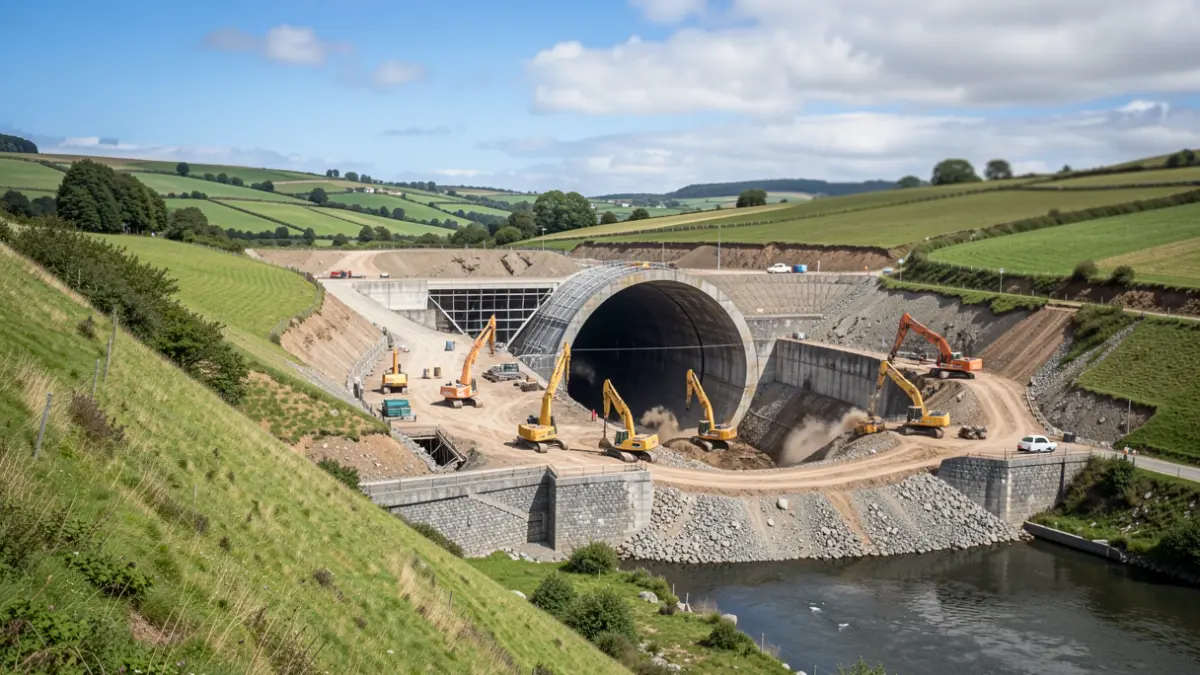
The Provincial Council of Bizkaia has now awarded all project contracts, paving the way for the construction of the under-river tunnel to commence. The new infrastructure will connect Leioa and Getxo with Portugalete and Sestao, with the primary objective of easing congestion on the Rontegi bridge. Work is expected to begin in September.
Last month, contracts for the Artaza tunnel entrance and the gallery leading to the Lamiako roundabout were formalized. This week, the Council awarded the remaining two phases: access roads to the roundabout serving the Ballonti shopping center and the tunnel boring from the border between Sestao and Portugalete. This is Bizkaia's most ambitious project in recent years, aiming to decongest traffic on the Rontegi bridge. With the bulk of bureaucratic procedures completed, machinery will soon start working on site.
The joint venture (UTE) comprising Ferrovial, Mariezcurrena, and Cycasa will be responsible for the section of the project covering the boring of the tunnels from the Ballonti access to Lamiako, with a budget of 129 million euros. Meanwhile, the firms Campezo, Altuna Uria, and Sobrino will materialize the accesses from Sestao, Trapagaran, and Portugalete, connecting with the A-8 and Supersur motorways. This second contract amounts to 62 million euros. In total, the work will take five years to complete and will cost over 500 million euros.
The main goal of the project is to alleviate congestion on the Rontegi bridge and provide an alternative for crossing the Ría. The Rontegi bridge, the sole viaduct between the two banks over the more than 17 kilometers separating the Biscayan capital and the Port of Bilbao, handles approximately 175,000 vehicles daily. The new tunnel is expected to attract 40,000 vehicles per day, as well as remove around 35,000 cars from the vicinity of Max Center and La Avanzada.
The tunnel will be 3.2 kilometers long, with an additional 2 kilometers of underground access roads. It will feature two tubes, one for each direction, each with two lanes of 3.5 meters width and over ten meters in height. This is a significant challenge, as in addition to the urban constraints of Artaza, the sandy area of Lamiako must be overcome, and excavation must proceed 45 meters below the riverbed. Thirteen interconnected evacuation galleries will also be built between the two tubes, five of which will be adapted for vehicle passage, along with two pedestrian emergency exits.
Approximately 60% of the excavation will be carried out from the Left Bank. The Ballonti access is, a priori, the one presenting the fewest problems and will therefore start later than the Artaza section. Traffic disruptions in this area will be occasional and limited, but while the boring of the two tubes towards Lamiako continues, one lane will be temporarily removed from the stretch between the Ballonti and Nervacero roundabouts. Vehicle speed will also be reduced, but the Council does not anticipate significant traffic jams. The current cycle path will remain in service.
On the Right Bank, however, lies the most delicate section of the work, both due to technical issues and the social opposition the project has generated among some residents of Getxo and Leioa. The tunnel entrance from the Artaza roundabout and the tube excavation must be undertaken in an area with a higher density of housing and public facilities, including a school and a high school. It is from here that the machinery will initially reach the Lamiako plain.
This operation will require over 80 micro-blasting sessions and the excavation of a significant portion of the Artaza park. The proximity of residential buildings has led the Council to decide that open-air work will be conducted during office hours. Inside the tunnel, however, boring will take place 24 hours a day.
Between 400 and 500 students from the third and fourth years of ESO and Bachillerato at IES Artaza-Romo will be temporarily relocated during the 2026-2027 academic year to the former Lamiako school, due to concerns expressed by families regarding the potential health impact of the works on minors.
The current Provincial Deputy for Infrastructure and Territorial Development, Carlos Alzaga, explained that the project includes several corrective measures to reduce disturbances for students. These include the installation of acoustic barriers, scheduling planning, facade orientation, and the placement of special windows to reduce noise and vibrations. For the most sensitive excavations, these will be carried out during the summer months to minimize exposure to airborne particles and heavy truck traffic.
The families' discontent has been joined by that of some local residents, particularly those in the Antiguo Golf area, who will bear the brunt of the noise and work. Organized as the association Arpa (Artaza Parkeko Herritarrak), they have filed a lawsuit against the Council, requesting the precautionary suspension of the entire urban development plan due to alleged "non-compliance" in the administrative processing. The plaintiffs claim that "the project has been modified after its public exhibition, incorporating elements such as the use of blasting or eliminating public transport options that have not undergone a new citizen participation process." They have also taken their protests to the streets with several gatherings and demonstrations.
Talk of the under-river tunnel began in 1992 as a solution to connect the two banks. Five years later, the Council announced that construction would start before the spring of 1999. However, just one month after this announcement, the provincial institution rectified, admitting that the proposal was still "immature" to meet those deadlines. Two decades passed until technicians presented a definitive alternatives study in 2018. At that time, the current lehendakari, Imanol Pradales, was the Deputy for Infrastructure.
Micro-blasting, a system used to cement San Mamés. The Provincial Deputy for Infrastructure, Carlos Alzaga, defended a few months ago in this newspaper the use of open-air and in-tunnel micro-blasting for excavation tasks, stating that "the terror caused by micro-blasting is unreal. They have been used for ages in Bilbao construction projects, and nobody noticed." They have been employed, for example, in the construction of the Renfe station shaft in Miribilla, in areas with very hard rock; in the accesses to the Biscayan capital via San Mamés, to dismantle the hillside between the exit towards Balmaseda and the old access to Basurto; in the foundation of the San Mamés stadium, and in the construction of the BEC in Barakaldo. Globally, the Lamiako subfluvial project will involve excavating 1.8 million cubic meters of earth and using 21,235 tons of steel. 170 trucks will remove excavated material daily, 90 from the Artaza end and 80 from the Ballonti end. The material will be transported to the facilities of the Port of Bilbao, where it will be used for filling dikes.