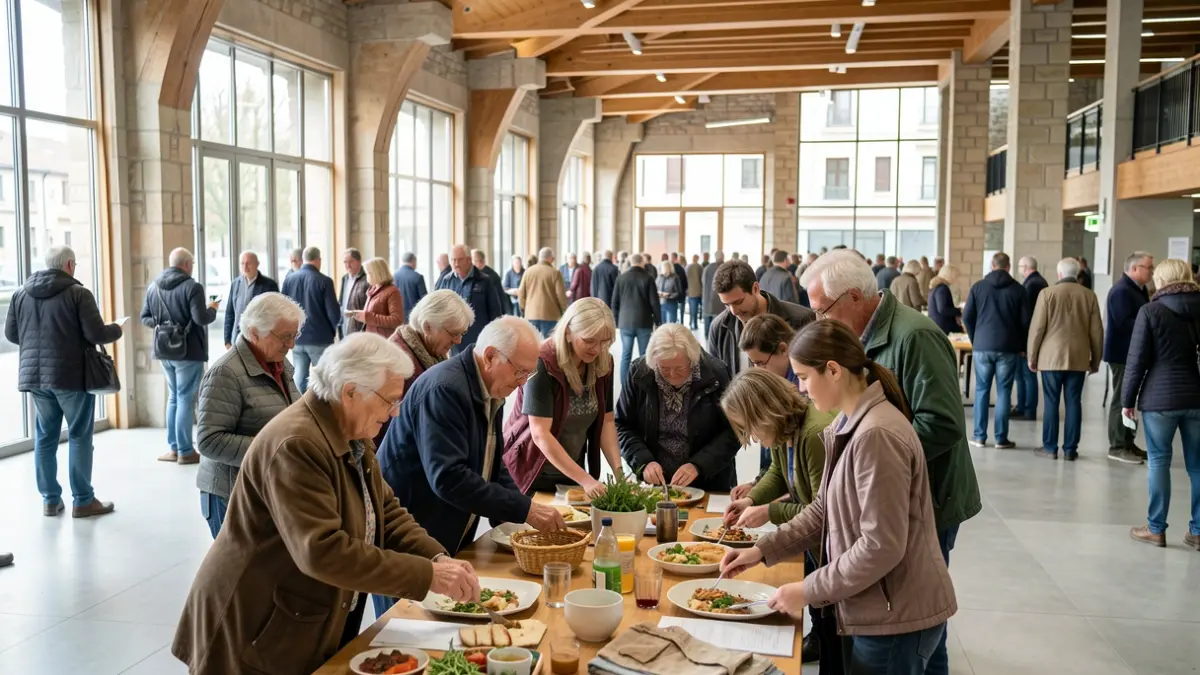
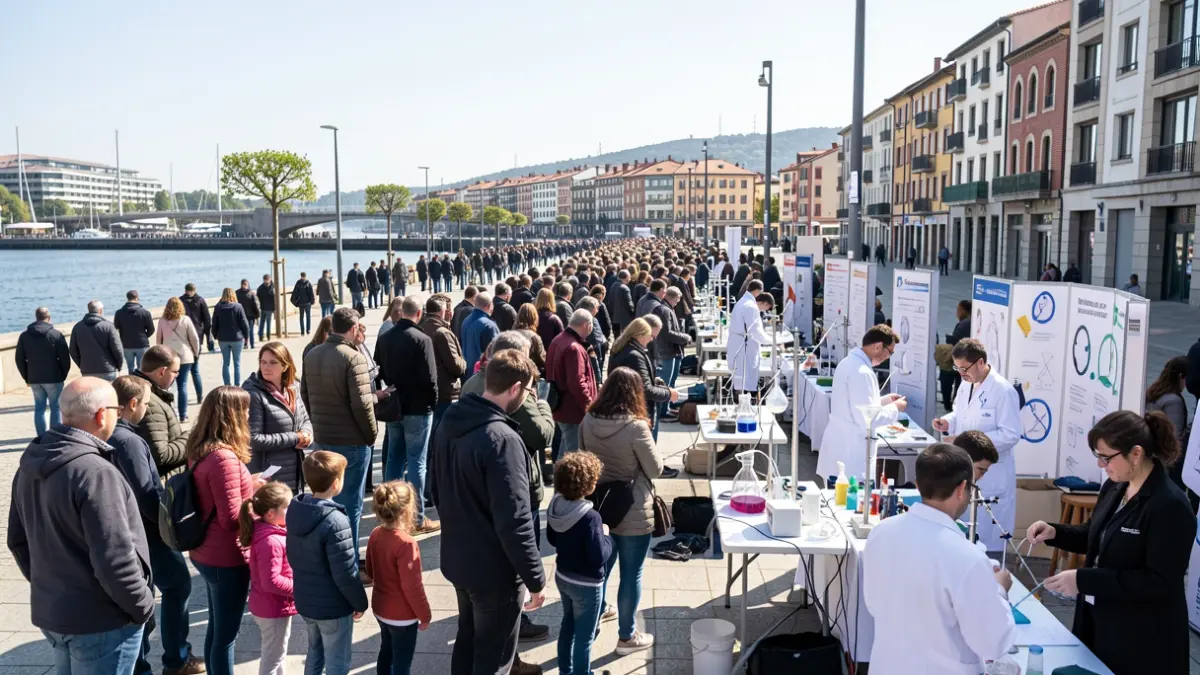
The Arenal promenade in Bilbao welcomed a large number of people, especially families with children, to discover the University's research in a close and participatory manner. Throughout the afternoon, 245 researchers shared their work with the public at 38 science stands, featuring experiments, demonstrations, workshops, and games.
The European Researchers' Night, organized by the University of the Basque Country (UPV/EHU), brought together around 7,600 people in Bilbao on September 25th, establishing itself as a major scientific outreach event in the city.
In addition to the EHU, institutions such as CIC bioGUNE, CIC energiGUNE, BCMaterials, and the Biofisika Institute participated with their own stands. This joint effort aims to showcase the diversity and strength of research conducted in the Basque Country, foster inter-institutional synergies, and present a shared, collaborative image of science to society.
The program offered insights into research across various fields, from health and the fight against cancer to sustainability, new technologies, and artificial intelligence. Among the most engaging proposals was the Emergencias Osakidetza stand, where the public could learn practical skills in recognizing cardiac arrest and performing basic cardiopulmonary resuscitation (CPR) maneuvers.
The event also featured the #SheMentoring space, dedicated to highlighting women in science and providing female scientific role models. Furthermore, there was a European MSCA stand, featuring Marie Skłodowska-Curie researchers.
A novelty this year was the Scientific Story Corner, an initiative specifically aimed at children. Here, 11 researchers temporarily swapped their lab coats for storytelling, using narrative to spark scientific curiosity among the younger generation.
Science extended beyond the Arenal with an astronomical observation event organized by the EHU's Planetary Sciences Group at Bizkaia Aretoa. This activity allowed the public to remotely follow an observation conducted with a professional telescope from the Calar Alto Observatory (Almería), controlled from Bilbao.
Favorable observation conditions enabled a journey through the universe, featuring celestial objects such as the open cluster NGC 457, the globular cluster M15, the planetary nebula M27 (known as Dumbbell), and M32, a satellite galaxy of Andromeda. The activity was highly successful, providing attendees the chance to learn, guided by EHU astrophysicists, about professional astronomical observation techniques.
The EHU organizes the European Researchers' Night as part of the new European project G9EU4RESEARCH, promoted by the Group of Nine Universities (G9). The project aims to bring research and its protagonists closer to society, focusing on areas like gender balance, diversity and inclusion in science, open science, the European Green Deal, the European Cancer Plan, and the Sustainable Development Goals.
G9EU4RESEARCH is funded by the European Union under the Horizon Europe program, through the Marie Skłodowska-Curie (MSCA) Actions, enabling the G9 universities to jointly develop activities to bring science and research closer to the public.