A Latin inscription found on a rock along a path between Loiu and Gatika identifies the vecunians as the builders of that road; they were the ones who erected the first documented public works in the history of Euskal Herria. It is believed they lived in a Romanized indigenous settlement 2,000 years ago, upon which the Basílica de Begoña was built over the centuries; however, it is suspected that an even earlier one may lie beneath. This would be the first settlement in what we now know as Bilbao.
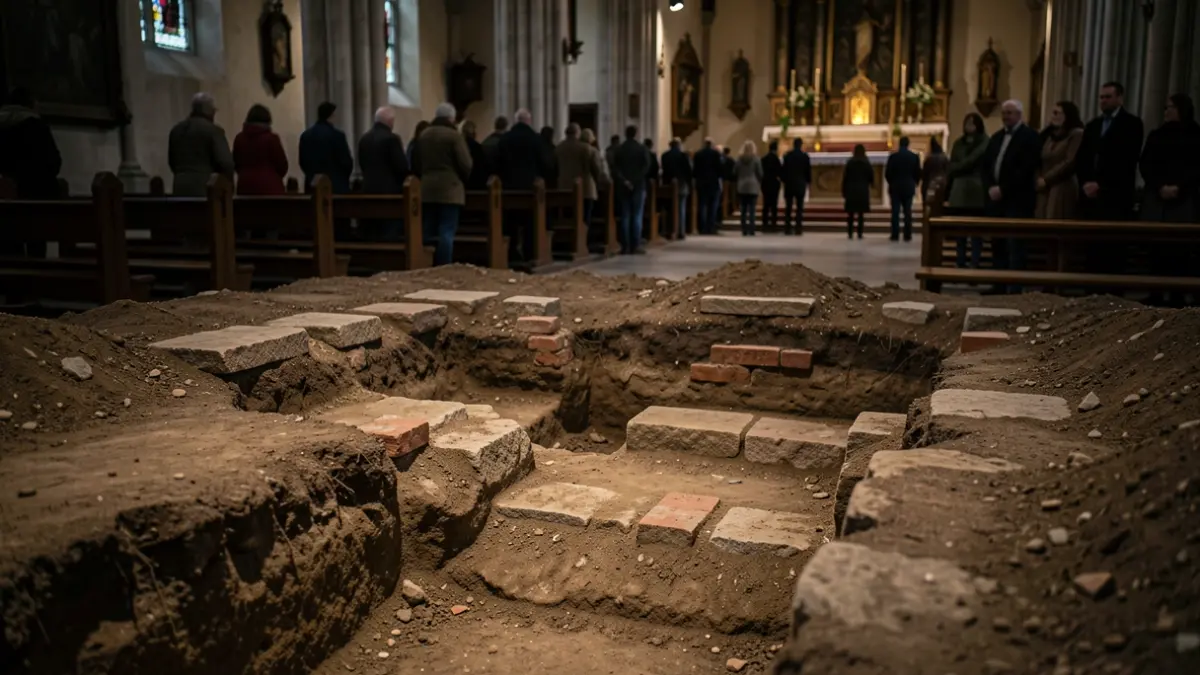
Following geological surveys conducted in 2024, archaeological excavations will commence in the temple after the summer to search for remains. These works will last for a year and will be carried out in phases to minimize disruption to worship. Anticipation is high regarding what the subsoil of the Bilbao basilica may hide: during the surveys, which reached six meters underground, human remains such as bone fragments, red bricks, and pieces of wood have been found at depths ranging from 40 to 120 centimeters.
Archaeologists suspect that beneath the pavement there may be a large cemetery approximately 500 years old; deeper still, a humble church, likely Romanesque and predating the founding of Bilbao, which stood for nearly five centuries, and another pre-Romanesque one over a thousand years old. From there, they will delve into unknown territory, although they are confident in finding the remains of that Vecunia, a Romanized indigenous settlement that learned to speak Latin 2,000 years ago.
To achieve this, the basilica's subsoil will need to be excavated over an area of approximately 700 square meters. The work will be conducted in four phases, one for each zone of the temple: the south nave, the north nave, the head of the central nave, and the foot of the central nave. Each sector will be addressed sequentially from start to finish; it is estimated that each phase will require a three-month period. In addition to protecting elements that cannot be removed – such as altarpieces or paintings – architectural elements like floors, pavements, the baptismal font, or even the altar will also need to be dismantled.
In each phase, the pews will be removed, and the sector will be isolated from the rest of the temple to prevent dust and noise from interfering with the parish's ordinary activities. “It will be crucial to properly seal the joints and edges to prevent the spread of dust and noise,” emphasize the Foral Deputation of Bizkaia, which is promoting the research alongside the Diocese of Bilbao. Plaster and plasterboard panels will be used, covered with a screen-printed canvas depicting the hidden parts, so that visitors to the basilica do not lose the building's perspective. Furthermore, research personnel will access the site through a different door than that used by parishioners and other visitors. At the end of each phase, the affected surface will be cleaned, and a general cleaning of the entire church will be carried out before its reopening.
The archaeological excavation itself will be carried out using a mixed technique, both mechanical and manual, to identify all deposits formed during the different stages of occupation of this area of the Artagan hill. Upon completion of each phase, the excavated area will also be opened to the public. In fact, visits to the excavation will be organized to show the work to the public and publicize the findings. The project, in any case, does not contemplate musealizing the church: structures, trenches, or pits found beneath the subsoil will be protected and covered with a floating slab, creating an underground crypt that researchers can access if needed.
In the unlikely event of finding visually attractive and spectacular findings, the crypt could be adapted for visits, turning it into a cultural resource without interfering with the temple's functions and activities.