With the goal of implementing strategies that foster more sustainable urban mobility in Barakaldo, reducing energy consumption and emissions, and simultaneously ensuring a better quality of life for citizens, the City Council has been working for months on a Sustainable Urban Mobility Plan (PMUS). This document, which received initial approval from the municipal plenary last year, highlights the activation of a low-emission zone as one of its main actions, with initial trials expected by mid-current academic year.
This tool, described by the Consistory as “key to advancing towards more livable, resilient, and competitive cities,” will be valid for five years (2026-2031) and will involve the implementation of 23 measures. Many of these have been formulated to further promote bicycle use, both within the municipality itself and to facilitate connections with nearby towns. In this regard, the City Council aims to improve links with both Trapagaran and Alonsotegi through a cycle path.
According to a study conducted for the drafting of the PMUS, “the absence of safe routes” to these two neighboring municipalities has been identified, “despite strong existing labor, commercial, and service ties.” It also notes that currently, “the only safe interurban connection” is the L4 Ezkerraldea-Meatzaldea-Enkarterri line, which is part of Bizkaia's Sectoral Territorial Plan (PTS) for Cycle Routes. The objective is to create a network linking Barakaldo with Trapagaran and Alonsotegi, with sections that can be included in this PTS.
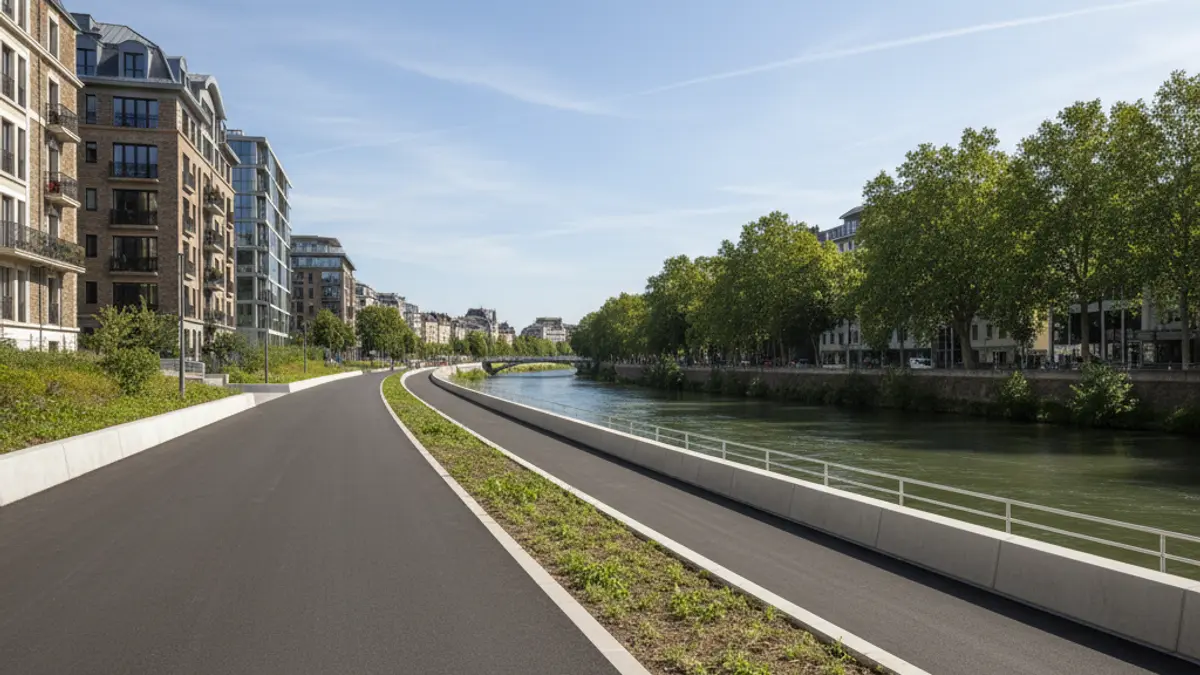
All of this considers several criteria, such as the infrastructure being segregated from motorized traffic and differentiated from pedestrian space, with a minimum width of 2.5 meters per direction and an accessible parallel sidewalk. For the connection with Alonsotegi, the adaptation of a path parallel to the Cadagua river is proposed, from the Kastrexana neighborhood to the Enkarterri municipality.
At the other end of the locality, two priority axes are identified for the connection with Trapagaran. One is in the Aparkabisa area, where the creation of a pedestrian and cyclist walkway is planned to cross the BI-744 road. This bridge aims to connect the existing industrial area at this point with Barakaldo's urban network and the Megapark commercial zone. Additionally, a connection with the Mining Zone is prioritized through the recovery of part of the old Franco-Belga railway line. This would involve creating branches towards the Ibarzaharra industrial estate, shared by Trapagaran and Sestao, and towards the center of Barakaldo. The Consistory has emphasized that this measure will require “supramunicipal coordination” for its execution.
Currently, the municipality boasts 22 kilometers of cycle paths and a network of “friendly lanes,” streets where shared use by vehicles and bicycles is encouraged, and where greater visibility is given to the latter mode of transport, which is expected to expand from 2.5 to 5.5 kilometers in the coming days. Furthermore, it is the municipality with the most stations, 33, for Bizkaibizi, the provincial network of electric bicycles that covers the Left Bank, the Right Bank, and Bilbao.