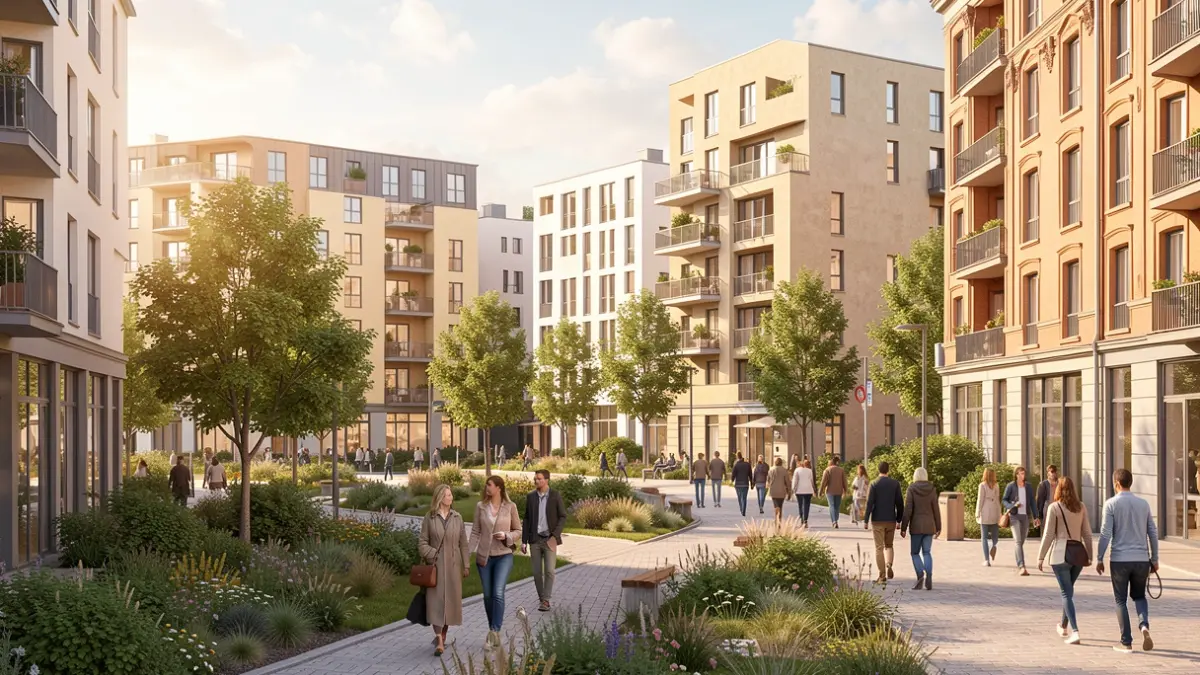
Bilbao - Denis Itxaso, Minister of Housing and Urban Agenda of the Basque Government, has called to overcome resistance to the implementation of affordable housing in the immediate surroundings and move towards a culture of urban solidarity that expands opportunities for access to a home. At the institutional opening of the XXIV edition of the EuskalHiria Kongresua 2026, held at the Bizkaia Aretoa in Bilbao, Itxaso identified the NIMBY (Not In My Backyard) phenomenon among the main cultural and political challenges cities must face to respond to the housing emergency.
Under the slogan ‘Re-crecer’ (Re-grow), the event addresses the need to combine the construction of new homes with the rehabilitation, urban regeneration, and transformation of existing buildings. Itxaso explained that "there is a very broad social consensus on the need to build more housing, especially affordable housing. But that consensus begins to crack when a specific development is planned near our homes." The minister warned that this contradiction can end up creating "invisible barriers" that protect those who already have a home and hinder access for those who have not yet acquired one.
Faced with this attitude, Itxaso advocated for shared responsibility among cities, municipalities, and neighborhoods. "We cannot ask for the housing problem to be solved by always sending it to the next neighborhood over," he stated. In this regard, he appealed to recognize that the residential crisis is not solely a real estate issue, but also "a problem of social cohesion and the functioning of our cities," especially when those who work and contribute to a municipality's prosperity cannot afford to live in it.
Tomorrow, Tuesday, the congress will feature participation from Sonja Trauss, one of the promoters of the YIMBY (Yes In My Backyard) movement in San Francisco, who will discuss the role of citizens in advocating for a greater supply of affordable housing and in people's ability to remain in their neighborhoods.
The minister emphasized that neighborhood participation is indispensable and that administrations have the obligation to listen, explain, negotiate, and correct projects when necessary. He acknowledged residents' right to demand information, architectural quality, sufficient services, dignified public spaces, and guarantees against disturbances arising from construction work. "Not all neighborhood objections are NIMBY. But we also cannot allow any particular interest to become a veto right over a collective need," he highlighted. In his opinion, urban debates must also incorporate the perspective of those who do not yet live in those neighborhoods because they cannot access housing: young people still living with their parents, families forced to move away, or people who work in a city but have to reside increasingly further away.
Therefore, Itxaso defended the need to promote a "new urban pedagogy" that explains both the importance of expanding affordable housing and the improvements that a well-planned transformation can bring to the entire community. "Urban solidarity cannot be demanded without offering guarantees. But guarantees also cannot be used as an excuse to renounce solidarity," he maintained.
Under the slogan ‘Re-crecer. La ciudad entre los retos de la vivienda y la sostenibilidad’ (Re-grow. The city between the challenges of housing and sustainability), EuskalHiria addresses how to combine the construction of new homes with the rehabilitation, reuse, and transformation of existing buildings and urban spaces. Itxaso acknowledged that Euskadi needs to continue building new affordable housing in much larger quantities than in recent years, but warned that it would be "a strategic error" to rely exclusively on new urban expansion operations.
With limited territory, dense and consolidated cities, and a residential stock with an average age of nearly fifty years, the minister advocated for the need to "learn to grow inwards as well." This implies rehabilitating, regenerating, transforming, completing, adapting, and densifying urban environments, making better use of a scarce resource like land.
In this regard, he expressed that urban regeneration must cease to be a complementary policy and become a central part of the response to the housing crisis. To illustrate this, he reviewed various actions promoted or studied by the Department to give new residential uses to buildings that have exhausted their original function.
These include the 48 endowed apartments in the former convent of Las Esclavas in Azpeitia, the twelve apartments for young people in the former Casa de Sindicatos in Arrasate, and the study to recover the old La Merced school in the same municipality. These projects are joined by the 19 apartments planned in the former courthouses of Eibar and another 40 in the AIBE factory in Txonta, the fourteen apartments that could be enabled in the current health center of Elgoibar, and the transformation of the former Telefónica offices on Cortes street in Bilbao into new endowed apartments.
"A convent, courthouses, a factory, a school, an office building. Buildings that have exhausted one function, but have not exhausted their utility for society," stated Itxaso, who argued that the city should be understood as "a living heritage, susceptible to being reinterpreted, adapted, and put back into service for collective needs."
The minister also highlighted the possibilities of densifying consolidated urban environments. In Miribilla, one of six pilot projects for adding floors to public rental housing buildings is being studied, through which the Department plans to generate up to 189 new apartments by expanding existing buildings and using industrialized construction techniques. Likewise, the possibilities of transforming disused commercial premises into housing are being explored, provided they meet the necessary conditions of habitability, lighting, and ventilation. "Densifying does not mean overcrowding. It means making better use of the city, without sacrificing its quality," he specified.
Itxaso also focused on intergenerational endowed apartments, a formula that seeks to simultaneously address the emancipation needs of the young population and those of autonomous elderly people who wish to change their habitual residence for one that is more accessible and adapted to their circumstances.
The proposal includes that these elderly people can move to endowed apartments and voluntarily make their previous home available to Alokabide, through the Bizigune program, to incorporate it into the public protected rental stock, while retaining ownership at all times. In this way, a single initiative can offer a more suitable residential alternative to an elderly person, facilitate the emancipation of young people, and allow a family to access a larger home. "We are talking about making better use of the homes that already exist, adapting our residential heritage to the evolution of households, and promoting new forms of intergenerational solidarity," explained the minister.
Currently, Euskadi has 992 occupied endowed apartments. If those under construction, in project, or under study are included, the figure reaches 2,210. The Department estimates that, if new assignments and expansion possibilities on public buildings mature, the stock could exceed 5,100 apartments. The strategy is complemented by neighborhood rehabilitation and regeneration initiatives such as Opengela, which works in 25 neighborhoods facilitating these processes, and proposals like Care Blanket, the winner of Europan 18 for Bustaldea, in Vitoria-Gasteiz, which aims to improve housing, accessibility, and common spaces.
The minister defended that all these actions respond to the same conviction. "A good housing policy is not just about producing new homes. It is also about preventing people from being expelled from their neighborhoods and ensuring that our cities remain socially diverse," he stated.
Organized by the Department of Housing and Urban Agenda of the Basque Government with the support of ONU-Habitat, the XXIV EuskalHiria Kongresua brings together today and tomorrow in Bilbao international experiences and specialists from cities such as Montreal, San Francisco, Rotterdam, Turin, or London. It is the edition with the greatest international projection to date, with a program that will address issues such as land and planning, circular architecture, building reuse, climate adaptation, public space, housing affordability, and the right to remain in neighborhoods.
The institutional opening was attended by the mayor of Bilbao, Juan Mari Aburto; the Minister of Housing and Urban Agenda, Denis Itxaso; and the Head of Planning and Finance at UN-Habitat, Shubhagato Dasgupta.