The Department of Linguistic Policy and Culture of the Basque Government has decided to initiate the procedure to declare the Elizalde complex in Usurbil (Gipuzkoa) as a protected monumental complex of medium protection. This decision, announced through the Official Gazette of Gipuzkoa, considers the area's heritage interest and the proposal presented by the Technical Services of the Basque Cultural Heritage Centre.
The resolution by Andoni Iturbe Amorebieta, Deputy Minister of Culture of the Basque Government, establishes an immediate and provisional protection regime, along with the general and specific protection measures for assets of medium protection as outlined in Law 6/2019 on Basque Cultural Heritage. This entails suspending licenses for parceling, construction, or demolition in the protected area, and requiring prior authorization from the Provincial Council of Gipuzkoa for any works.
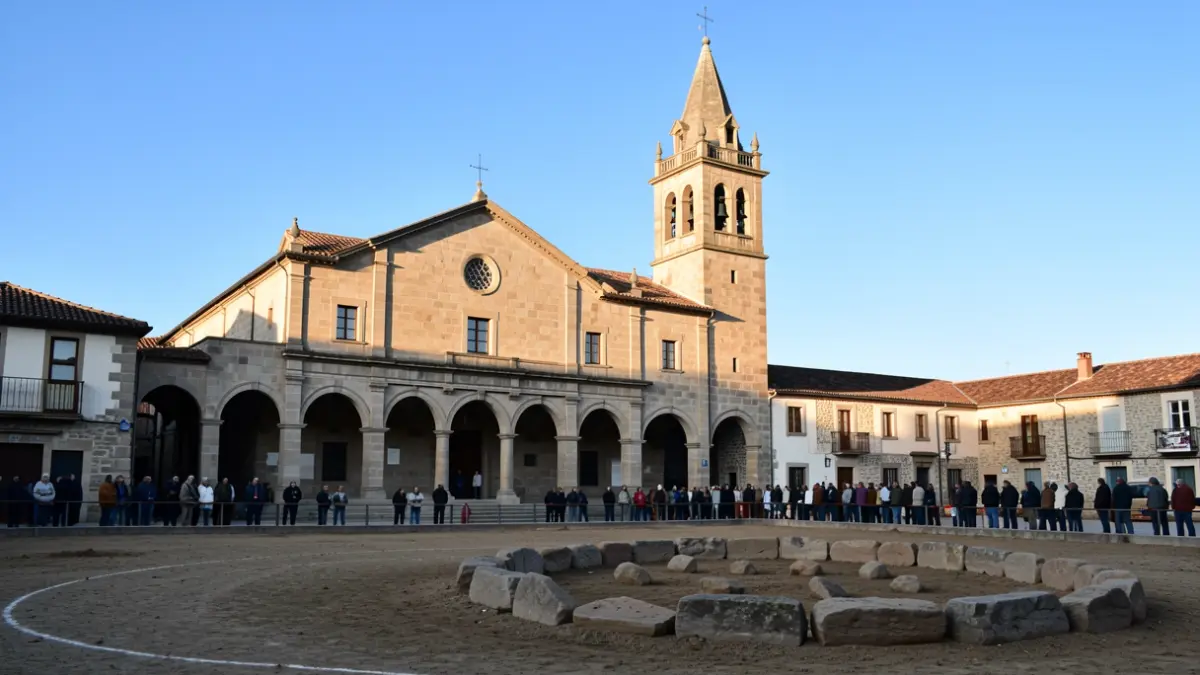
The area to be protected encompasses the mentioned built elements, including the San Salvador church, the probalekua (stone-dragging area), and the fronton (pelota court), as well as the entire plaza space connecting them and associated pedestrian areas. The boundaries define the pelota court and its pedestrian zone to the north, the probalekua in the center, and the urban frontage reaching Calle Mayor to the south.
The Government has argued for the protection of the "cultural, spatial, and functional values" of this space, deeming it an "identity space linked to the social and cultural life of the Community." It also highlights its "continuity of public space, visual and functional connection between elements," and its contribution to forming "one of the most representative and distinctive spaces of the urban landscape."
From an artistic and architectural perspective, the integration of diverse typologies (religious, sports, and public) within a single area is valued. The San Salvador church features elements such as a bell tower, dome, lantern, and arcades with Flamboyant tracery, reflecting construction phases from the 15th to 20th centuries. The excellent preservation of the pavement and the Romantic-Symphonic organ are also highlighted. The Dema plaza (probalekua) exemplifies functional architecture linked to rural sports, and the fronton represents the traditional typology of sports architecture, adorned with ceramic murals.
Conservation criteria have also been established, such as ensuring the primary use of "religion-game-sport." For the church, the organ built by Charles Mutin and the family necropolis beneath the temple are to be protected. The probalekua and fronton are to remain open spaces with public vocation, allowing only small, temporary, and reversible mobile installations that respect traditional materials and forms.