The streets of Donostia-San Sebastián once again hosted the Holy Week procession this Good Friday, more than half a century later. The event, held outside the Cathedral of the Good Shepherd, gathered several thousand people, where silence prevailed despite the high anticipation and notable participation.
At 8:00 PM, the rattle of the Cathedral of the Good Shepherd began to sound, replacing the ringing of bells and announcing the imminent departure. Three warnings, spaced fifteen minutes apart, were enough to gather a crowd of Donostia residents and visitors around the temple. Punctually, at 8:30 PM, the procession began after the conclusion of religious services.
The Guide Cross and the banner of the Brotherhood of Jesus of Nazareth led a sober parade, as anticipated by the organizers. The Bishop of Donostia, Fernando Prado, was also present. Following them, children dressed in Hebrew attire and the txistulari band gave way to the first rows of Nazarenes, in purple tunics and hoods, who advanced in order preceding the float of the Nazarene and the image of Veronica.
The procession maintained a constant rhythm along its route through the city center, passing through Urdaneta, Hondarribia, San Martín, and Avenida de la Libertad, where the public accompanied in silence. After the first block, a second group of Nazarenes, drums, and children carrying symbols of the Passion—crowns of thorns or nails—introduced the float of the Recumbent Christ, one of the most solemn moments of the night.
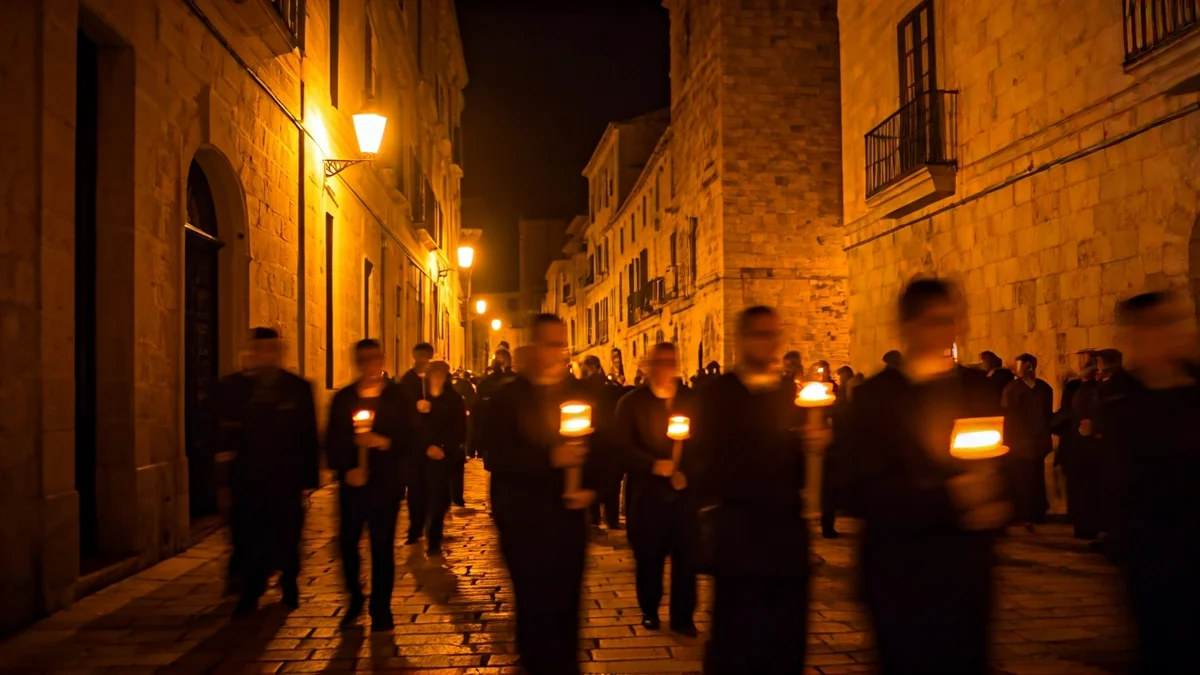
The procession reached Gipuzkoa Square, where the planned prayer station was held, before returning along the same streets. In the final stretch, the Three Marys and the Virgin of Solitude advanced among candles, followed by the raised cross, the clergy, and the music band. Behind them, numerous faithful, many dressed in street clothes and holding candles, joined the procession, maintaining the tone of respect requested by the organization.
The return of the procession, driven by the revival of the historic brotherhood founded in 1929, ultimately gathered several hundred participants and brought back a tradition absent from the Gipuzkoan capital for 59 years. The massive public response confirmed the interest the initiative had generated since its announcement and left an unusual image in the city, with the center enveloped in an atmosphere of reverence that accompanied the entire route until the return to the temple.