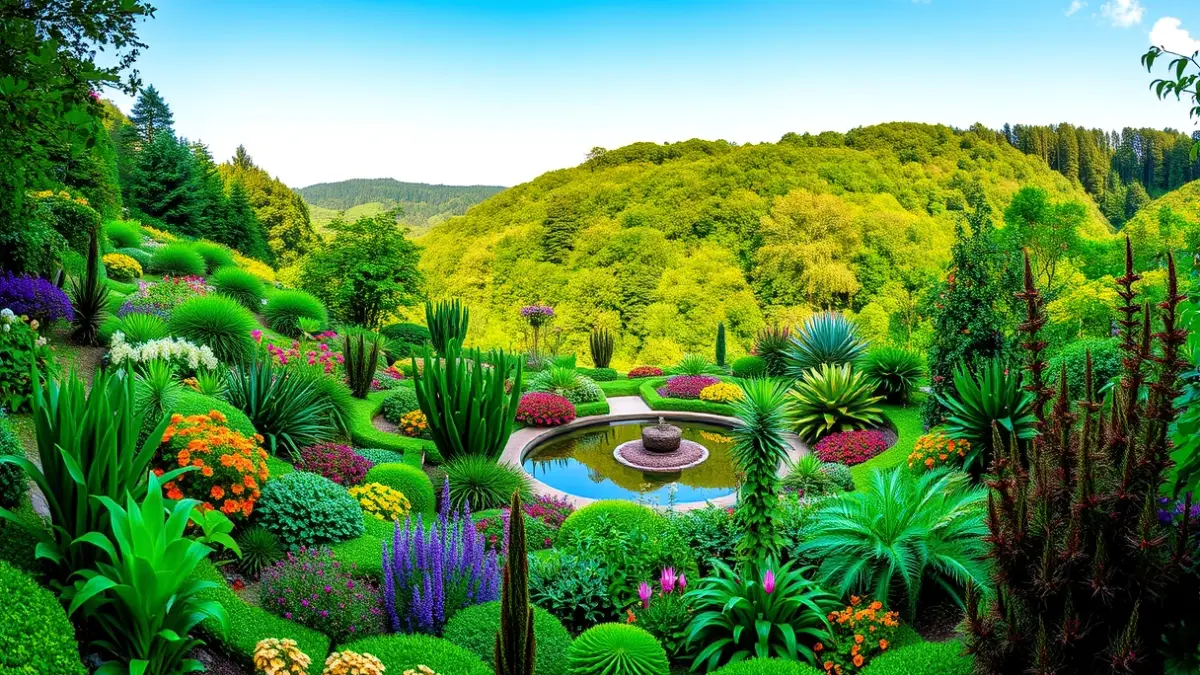
One does not need to travel far to visit other continents. Hidden in a small valley in Oiartzun, Lur Garden is a botanical garden composed of different types of gardens capable of evoking diverse and exotic landscapes. From wild scenes, similar to those found in a tropical destination, to oriental-inspired corners surrounded by bamboo, rocks and vegetation combine to create compositions full of color and texture. This 20,000 square meter space is an ode to nature and life.
This small Eden in Gipuzkoa invites visitors to stroll among more than 300 different botanical species, cultivated over more than ten years and distributed in 16 thematic gardens. The first, and one of the most colorful, is the Red Garden, a color that is “difficult to integrate into the landscape”. Although initially there was reluctance to work with red, it was later realized that the maroon and reddish tones of this pathway formed a triumphant entrance to the garden, leading to what is undoubtedly its crown jewel: the Mirror Garden.
“"It is an area where yellows, oranges, whites... are combined. It is the most emblematic place."
The 25-meter-long circular pond is the central axis of Lur Garden. Its simplicity seems to clash with the chaos of color and the different plant species surrounding it, but when the wind is calm, the water reflects everything around it. The next stop on the journey is the Yellow Garden, “the most vibrant of all”, where the spring effervescence of the green, red, and yellow tones of maples and dogwoods stands out.
Passing through the Garden of Extravagance, composed of “strident and striking combinations of curious plants”, one arrives at the next space. It is one of the landscaper's ‘whims’, as “the theme of large leaves has always fascinated me”. Hence its name. In this corner there are no flowers, but rather “contrasts of foliage, banana trees, different types of bamboos, elephant ear leaves...”. The optimal time for these species is September, so “what are now ‘sticks’ buried in the ground can reach six meters in height in a few months”.
The route also includes aquatic species, so between gardens, different species of water lilies, lotuses, or water irises can be found. And at the back of the central meadow, there is also a corner dedicated to the Jurassic, inspired by prehistoric vegetation, or to the oriental, with a Moss Garden that recreates the compositions of Japanese temples, leading to a bamboo forest that emerged almost “by chance. It is very difficult to control where they sprout, because bamboo growth is abysmal, very fast. They can reach 15 meters in height in a month”.
However, for coincidences, the Hydrangea Labyrinth is highlighted, reaching its peak splendor in August – like the rest of the garden – and literally enveloping the visitor in colorful flowers of immense density. “This labyrinth was not the initial objective, but it turned out even better. That’s why nature must be allowed to flow,” insists the garden manager, reminding that anyone wishing to stroll through the garden, either freely or with a guided tour, must book their ticket in advance on its website.
An ahuehuete specimen can also be found in Oiartzun. Its trunk is almost 15 meters in diameter. More than 30 people with intertwined hands were needed to encompass it, and about 200 people could shelter under its shade. This is the Tree of Tule, the tree with the largest trunk diameter in the world, located in Oaxaca, Mexico. But it can also be found in Gipuzkoa. Although it does not reach such tremendous dimensions, the Lur Garden botanical garden has a specimen of this tree species – an ahuehuete – growing inside. The Mexican specimen has been growing for an estimated 2,000 years; the Gipuzkoan one for only 19, but it is also “the first tree we planted”. “We brought a small branch and, without realizing it, the rest of the garden was built around it.”