
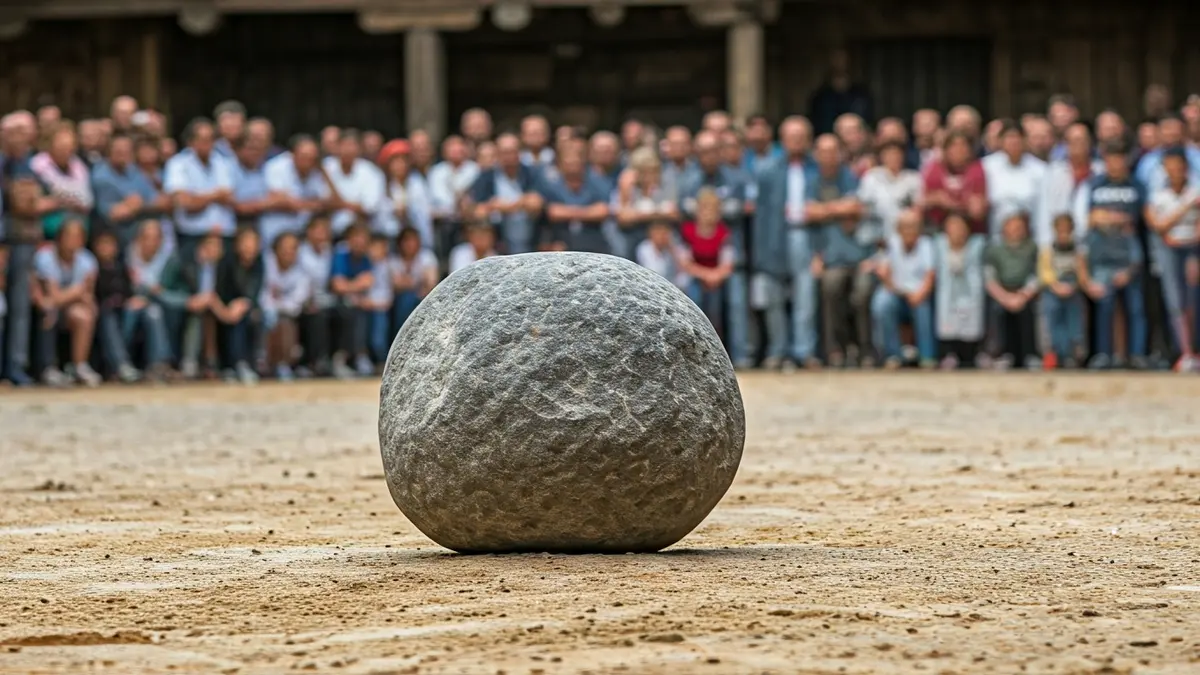
The world of Basque rural sports and its betting culture is rich in anecdotes. Today, we recall a notable case that occurred during an ox-pulling competition held in Astigarraga eighty years ago. The headline of the article published by EL DIARIO VASCO on April 17, 1946, read: «In an ox-pulling test, in Astigarraga, they smeared the stone with tallow and then set it on fire with gasoline».
“"The city man often, with unforgivable lightness, denounces the 'cashero' because he bets on ox-pulling tests, in 'aizkolari' contests, in ram fights. As if the vice of those who bet on games of chance, in clandestine poker, baccarat, and auction tute games, were not less justified."
The event took place in Astigarraga, when it was a district of Donostia (it was annexed from 1941 to 1987). A man named Ramón Goicoechea claimed that a single ox of his property, a magnificent specimen weighing 600 kilograms —comparable to the bulls of Manolete and Arruza—, would complete 53 'plazas' in 50 minutes, dragging a 1,500-kilogram stone.
The challenge mobilized the entire region, drawing a considerable crowd to the Astigarraga square. Admission cost 6.25 pesetas, and numerous bets had been placed. However, on Sunday, April 14, 1946, spectators discovered that the stone had been heavily smeared with tallow on its underside. This trick, presumably to make the stone slide more easily, caused a major scandal.
To resolve the incident, it was decided that the best way to clean the stone was to douse it with gasoline and set it on fire to completely remove the tallow. The stone was moved several times and subjected to fire for a long period. Once the test began, the ox was pulling the stone at a good pace, but upon reaching the 27th 'plaza', the stone broke into two pieces. It is likely that the movements for cleaning and the fire had weakened it. The competition was thus interrupted.
The bettors found it difficult to accept the suspension. At that time, in 1946, the Guipuzcoan Athletic Federation oversaw these events, as there was no specific federation for herri kirolak. The federation decided to declare all bets void and not refund the ticket prices. This incident, without a doubt, added 'flavor' to the situation, culminating with a 1,500-kilogram stone, blackened and broken.