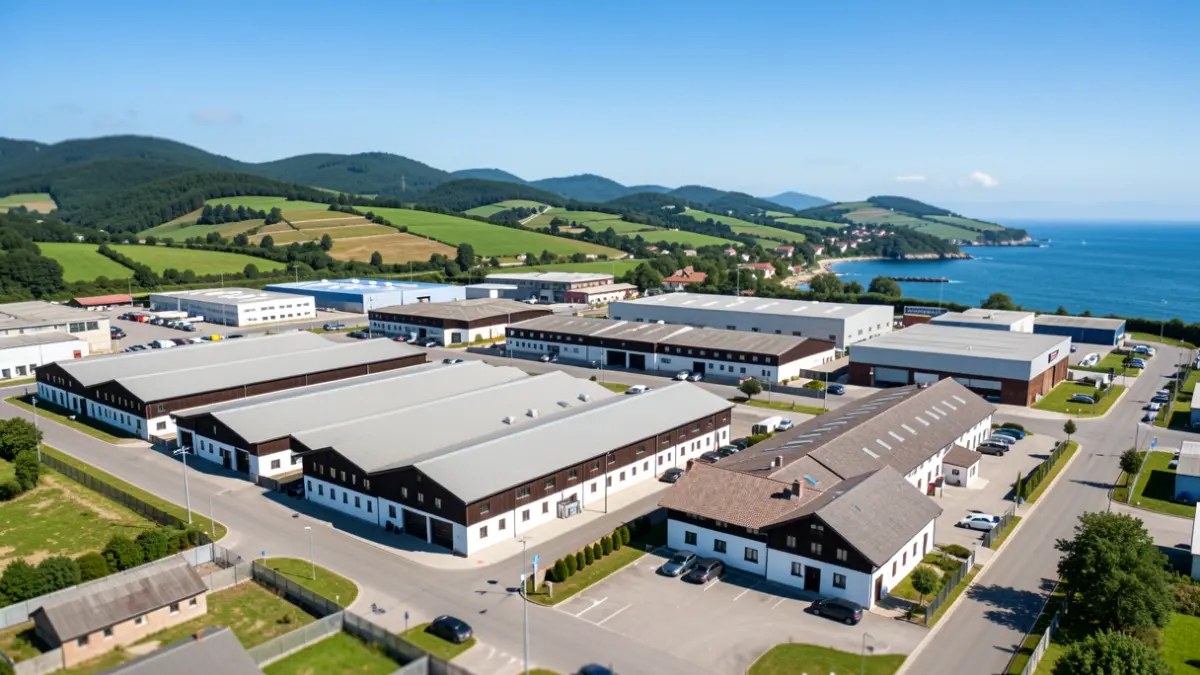
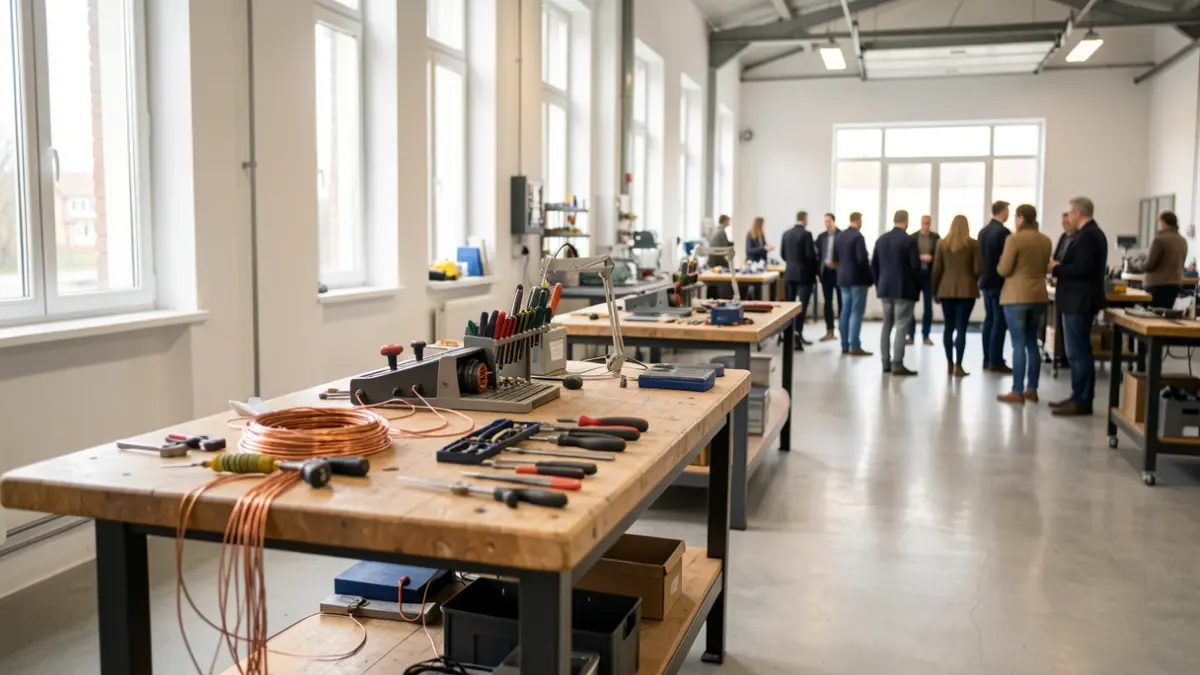
Lantegi Batuak, located in the Txaporta industrial park in Gernika-Lumo, has completed a 2.2 million euro investment in a comprehensive renovation of its facilities. This organization, a benchmark in Bizkaia's social economy, integrates 147 individuals into its human ecosystem. The true value of this investment is measured not in the renewal of thermal systems or polished floors, but in the stories of overcoming challenges presented by its daily attendees.
María Zabala, the center's receptionist, welcomes visitors and explains that by 8 AM, she has everything prepared for her daily tasks, including her role as a radio announcer for the company's internal radio, which informs all employees.
Beneath the rhythmic sound of pneumatic cutters and the hiss of compressed air, a deeper mechanism beats: that of human development and socio-labor inclusion. Maintaining the demanding delivery standards for multinational electrical sector companies like Ormazabal, MESA, Plastibor, and Arruti Group, while simultaneously restructuring the building, required meticulous coordination. To commemorate this milestone, a main wall now features a moving mural-tribute, engraved with the names of all current staff members, intertwined with those of the twenty-one pioneers who opened the historic Aixerrota workshop in 1977. 'It's a recognition of having endured and worked together, without stopping the machines,' explains plant manager Igor Ibarguengoitia.
The building is now divided into two perfectly connected realities that feed each other. If the ground floor is the realm of electromechanical precision, the upper floor has been transformed into an ecosystem dedicated to the personal well-being and emotional growth of the 36 users attached to the occupational service. Here, the remodeled spaces house activity rooms, changing rooms, and a dining area where identity development continues. Throughout the week, workshops on easy reading, body expression, art therapy, and music therapy fill the classrooms. As Ibarguengoitia details, through these musical and artistic disciplines, the aim is to foster 'the personal, affective, and social development of the group, equipping them with indispensable tools for their daily lives'.
The week's highlight occurs on Fridays in the cooking workshop, and today's chosen menu is rice pudding. Mikel Colina, the activity's manager and facilitator, moves among the stoves, calmly coordinating the weighing of portions. 'This workshop gives us the opportunity to work on many different things, fundamentally daily and personal autonomy,' explains Colina, looking at the students. Groups rotate fortnightly in small teams to ensure individualized support, and they themselves choose the recipe. 'Last week we made Russian salad... and then we eat it all!', they comment with laughter.
Descending to the manufacturing area, the noise intensifies, revealing an impeccable organizational system divided into four productive sections and a large central warehouse. Lantegi Batuak's socio-labor strategy shines here with its cognitive and physical accessibility engineering. Ibarguengoitia explains that the secret lies in the fragmentation of processes: 'a complex order, such as the technical assembly of a large electrical distribution board, is broken down into small consecutive sub-tasks'.
On the first row of tables, automatic machines perform the cutting and stripping of cable hoses; on the next, connections are identified and welded; subsequently, the crimping and terminal attachment is carried out, leading to the final assembly. In this way, any person, regardless of their degree of intellectual or physical disability, becomes an efficient, productive, and competitive link. At one of these tables, we find Edurne Torrealdai. A lifelong resident of Gernika, Edurne embodies the success of labor stability within the territory's social economy. She has been working at the center for fourteen years, specializing in the meticulous placement of terminals on copper wires. 'I am very well here, very happy and very calm with my daily work,' she confesses.
Furthermore, it should be highlighted that one of the center's objectives is the promotion and transition to employment through programs like the alternation program, through which Paul Legarreta, a 23-year-old young man from Gernika, works. After three years in the occupational service, 'now I work in alternating training,' he recounts from one of the center's most dynamic lines.
Oda El Badaui, 24 years old with three years of experience in the organization, shares her satisfaction while operating in a section for differentiated assemblies using specific die-cutting machines. Over this time, she has moved consecutively through various areas of the plant and emphasizes the social value of the center: 'I have been in different sections, I have learned new things this year,' which qualifies her to work in any position on the production line.
This immense insertion network generated an Integrated Social Value of 3.48 million euros in Gernika-Lumo last year, an indicator demonstrating how every euro invested multiplies family well-being, energizes administrations, and restores social dignity to a group demanding its rightful place in the Bizkaian labor fabric.
At the end of each workday, the lights of Txaporta turn off, but the echo of a workshop where electrical circuits are assembled with the thread of the human ecosystem remains in the air.