
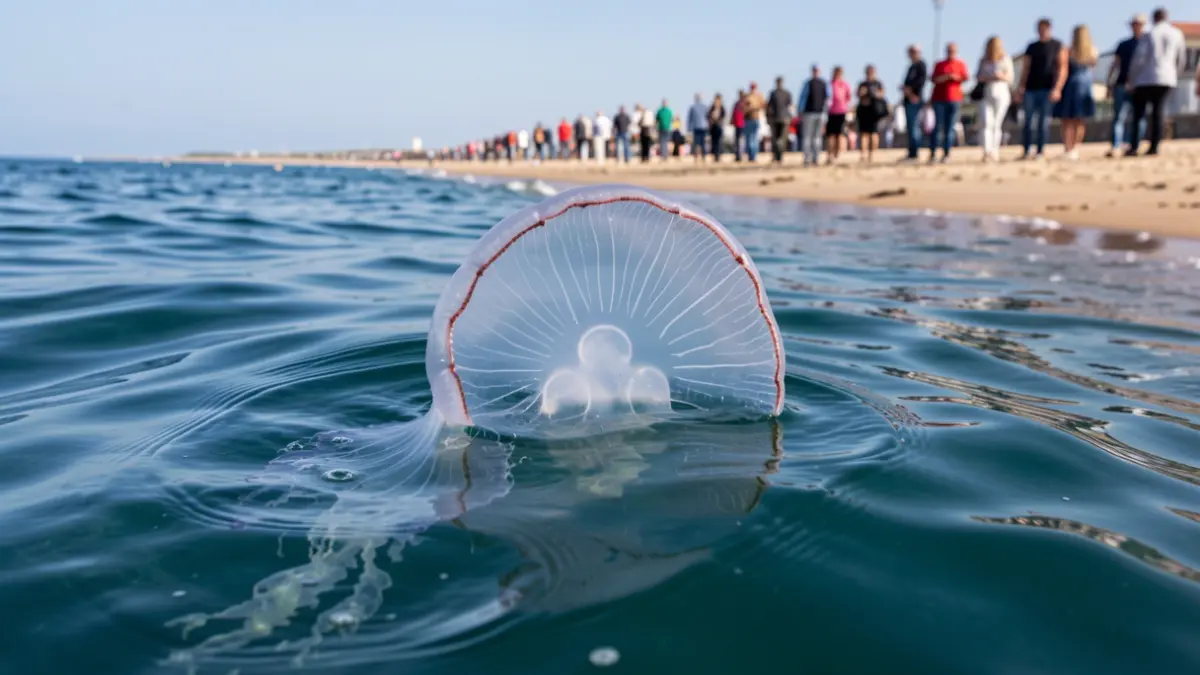
Portuguese man o' war, venomous colonial organisms, appeared this Friday on Laga beach, just before the start of the summer season. Throughout the day, a yellow flag was raised to alert bathers to their presence in the waters. According to the protocol from the Basque Government's Department of Health, it is recommended to avoid swimming and touching them, even if they are on the sand.
Last summer, these organisms were sighted not only in Laga but also on the beaches of La Arena (Muskiz), Barinatxe (Getxo), Arriatera-Atxabiribil (Sopela), and Isuntza (Lekeitio). This would mark the fourth consecutive year that Portuguese man o' war have appeared in Bizkaia's summer landscape, much to the dismay of many who suffer their stinging bites or see their large numbers force beach closures.
When a swimmer is stung by a Portuguese man o' war, the recommendation is to go to a lifeguard station as soon as possible. If there are no lifeguards, the instruction is to clean the affected area with seawater. Fresh water has the opposite effect, causing the organism's cells stuck to the skin to release more venom, leading to greater itching.
These 'false jellyfish' – actually a type of organism called a siphonophore – are known for their stinging bite, which causes burning, itching, and, in allergic individuals, fever or vomiting. They navigate from the North Atlantic, propelled by their characteristic 'sail', allowing them to travel up to 500 km per month, reaching the Cantabrian Sea or the Canary Islands depending on their 'right' or 'left' orientation. Although they usually wash ashore and die, their presence in Bizkaia is common, especially in July, with this being the third consecutive summer they have been detected. In 2010, up to 3,500 specimens reached the beaches of Bizkaia.