
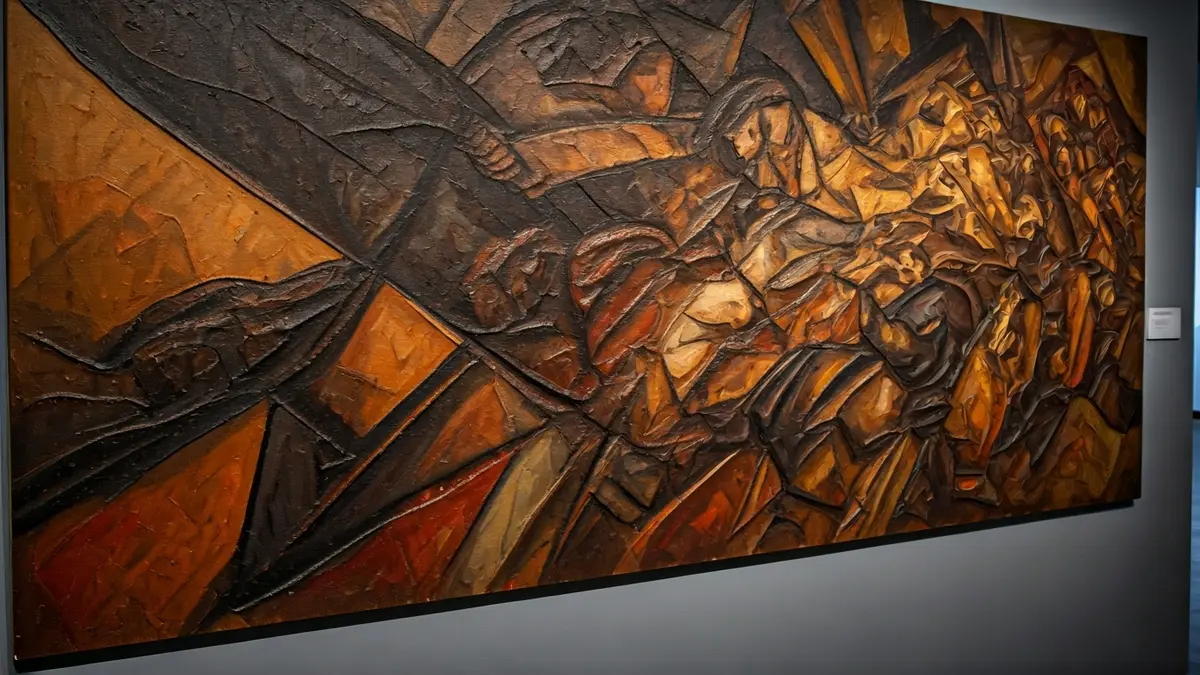
The PNV maintains that the political will of the Spanish State is the key to facilitating the Basque Government's request for the temporary transfer of Pablo Picasso's Guernica to Euskadi, aligning with the 90th anniversary of the Gernika bombing. The Basque nationalist party questions the Ministry of Culture's refusal to move the painting from the Reina Sofía Museum (Madrid) and believes the Spanish Government is using technical reports as a shield to avoid fulfilling the wishes of Imanol Pradales's Executive.
Maribel Vaquero, spokesperson for the PNV in the Congress of Deputies, called this Wednesday for the Guernica to undergo an “in-depth” study by international experts “to see if the painting truly cannot be moved” from the Reina Sofía for its temporary transfer to Euskadi. In an interview on Onda Vasca, Vaquero noted that the PNV is proposing this study because the painting “has traveled across half the Western world, through eleven countries, many cities, to Copenhagen, Paris, London, New York, San Paulo; that is, it has traversed Europe and America, until it ended up in Madrid in 1992 and has not traveled since.”
“"It's curious, since the 80s, with the Basque Government, after the dictatorship, we have been demanding that this painting come to Euskadi permanently or temporarily, and it traveled all over the world until '92, but from the 80s onwards it has not been able to reach Euskadi. That's the curious thing about the case."
The Basque deputy emphasized that in the nineties, the Spanish Government cited technical difficulties for the transfer of the cubist painting, which depicts the horror of the Gernika bombing during the Spanish Civil War. Against those who argue that the transfer would deteriorate the oil-on-canvas painting, Vaquero contends that there might now be “more advanced” restoration and art transfer techniques. Therefore, they request “an in-depth study with international technicians from different fields to see if that painting truly cannot be moved.” “We have seen more impossible things,” she concluded. She also highlighted that the Sánchez Government “often says something cannot be done, and after a while, it can be done. We believe that political will is also a plus when making decisions,” she insisted.
Vaquero does not question the technical reports from the Reina Sofía, explaining that they only seek “more technical reports.” “We believe that on the 90th anniversary of the Gernika bombing, it would be an undeniable demonstration of great importance for the Basque people if this work could be seen here,” she added.
This new clash follows Aitor Esteban's, president of the PNV, demand for the painting's transfer to Euskadi for exhibition, initially at the Guggenheim Museum Bilbao for several months. Subsequently, Lehendakari Imanol Pradales joined the demand, ironically exclaiming during his Aberri Eguna speech to thousands of supporters: “how is it possible to have exhumed the remains of dictator Francisco Franco from the Valle de los Caídos and not be able to move a painting from Madrid to Bilbao.” These statements were met with a response from the president of the Community of Madrid, Isabel Díaz Ayuso, who called the Basque nationalists “hicks” and provincials.
The matter then fell to the Spanish Government, and after days of hesitation, Minister Urtasun delivered the State's position, stating that the Guernica is one of the “most fragile works of the 20th century,” which cannot be “subjected to more stress,” and that the best tribute to the victims of Gernika is to care for this symbol so that “it can last another 90 years.”
The minister adheres to the technicians' firm advice against the transfer due to strictly technical criteria, citing the risk of inevitable vibrations during any movement. “We are talking about a work that already shows deformations, craquelure from previous roll-ups, small repaired tears, and accumulated deterioration after decades of international transfers,” he stated last Tuesday in the Senate. In the same plenary session in the Upper House, PNV Senator Igotz López Torre lamented that the Guernica has undergone “more than forty transfers” in its 89-year history and has “never once” landed in Gernika or any other Basque town. He also indicated that “technical advances could make” a safe movement possible.