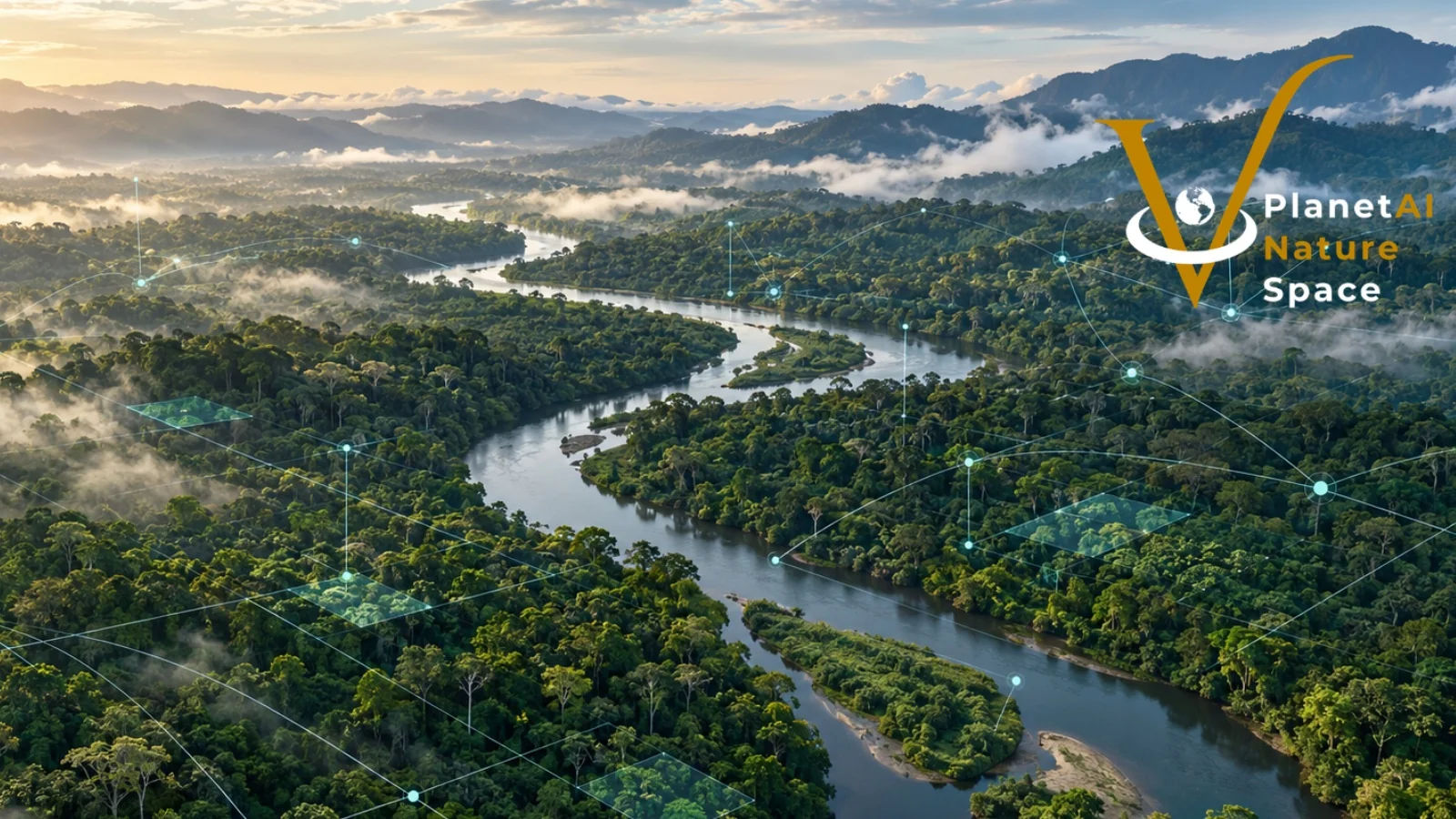
PlanetAI Nature Space (PNS) was born in Barcelona in 2023 with the aim of strengthening the traceability, scientific rigor, and technological accuracy of the voluntary carbon market. The organization, registered as a non-profit entity, develops its own standard for quantifying, verifying, and certifying greenhouse gas reductions or captures.
The platform combines historical and multispectral satellite images with artificial intelligence algorithms inspired by quantum physics. According to PNS, these tools allow for the estimation of carbon reserves, monitoring of ecosystem conservation status, and generation of current and "vintage" credits linked to captures from previous years.
Its catalog includes methodologies for forest carbon, blue carbon, sustainable palm cultivation, and methane mitigation, as well as a seal of natural origin and non-deforestation. The entity assures that projects undergo external review by specialists before being certified.
According to the organization itself, by May 2025 its platform had certified and issued over 133 million verified natural carbon units. With this figure, PNS presents itself as the European Union standard with the highest volume of credits issued; both the figure and the ranking come from the entity's corporate communication.
The most notable project is Flor de Inírida, in the Colombian department of Guainia. The project covers 3,408,186 hectares, involves eleven indigenous reserves with 12,000 indigenous people, and resulted in the issuance of over 133 million carbon credits at its inception. The entity describes it as the largest conservation project in the world.
Credits are registered through the platform owned by Karbonoa, a platform developed by XM within its environmental line EcoClic. The alliance incorporates blockchain to record the issuance, transfer, cancellation, and retirement of each unit independently of the certification.
As a differential value, PNS finances the issuance of carbon credits to facilitate project implementation for developers and ensure integrity and transparency with blockchain technology. Furthermore, it works directly with indigenous communities, training indigenous leaders in artificial intelligence and earth observation while understanding the ancestral knowledge of the communities, aiming for technology to fully respect their traditions.
PNS finances the issuance of carbon credits to facilitate project implementation for developers and ensure integrity and transparency with blockchain technology
PNS is also part of the UpLink innovator community, the open innovation platform of the World Economic Forum. In April 2025, it was selected as one of the ten winners of the Quantum for Society Challenge thanks to Quantum Aqua, a technology combining quantum machine learning and satellite data to detect underground water reserves. This recognition earned it the Top Innovator distinction and facilitated its participation in the Annual Meeting of the New Champions, known as Summer Davos, in 2025 and 2026.
In parallel, the Climate Technology Centre and Network (CTCN), linked to United Nations climate action, incorporated PNS into its network in October 2025, recognizing its capabilities in satellite monitoring, AI, and emissions and capture measurement. The challenge for the young Catalan entity will be to translate this technological foundation into verifiable trust within a market demanding greater transparency.
Technology enhances the traceability of carbon credits and the integrity of the market, which relies on independent verifications and clear public data.
Projects are peer-reviewed by an external team of doctors expert in various scientific fields "biology, anthropology, mathematics, physics, astronomy, economics, etc.." with the aim of gaining diverse perspectives on the project and its impact on communities and the environment.