Artist Jesus Jauregi has presented for the first time in Bilbao one of his most ambitious proposals, titled Anthropos. This large-format exhibition, which brings together years of work, can be visited in the Chillida room of the Bizkaia Aretoa of the UPV/EHU. The exhibition, consisting of a dozen large paintings, will be open until May 7, from Monday to Friday from 08:00 to 20:00.
“"The university is the soul of a city."
This academic context holds special significance for the artist, who considers the university to be the soul of a city. Therefore, he has emphasized that exhibiting in this space is a source of great pride and satisfaction. Under the title Anthropos, the exhibition focuses on the “uncertain nature of the body” and addresses profound questions about human existence. In the artist's words, it is an “attempt to express the enigmas of existence,” delving into mystery rather than offering answers.
According to Jauregi, in contrast to the predominance of current conceptual discourses, he advocates for a different path, which is why his proposal notably deviates from the dominant trends in contemporary art. Arguing that art must arise from an intimate and visceral need, he places intuition, instinct, and poetry at the center, above idea and discourse. His creative process is intuitive and not pre-planned, and the works are large-format, resulting from an evolution.
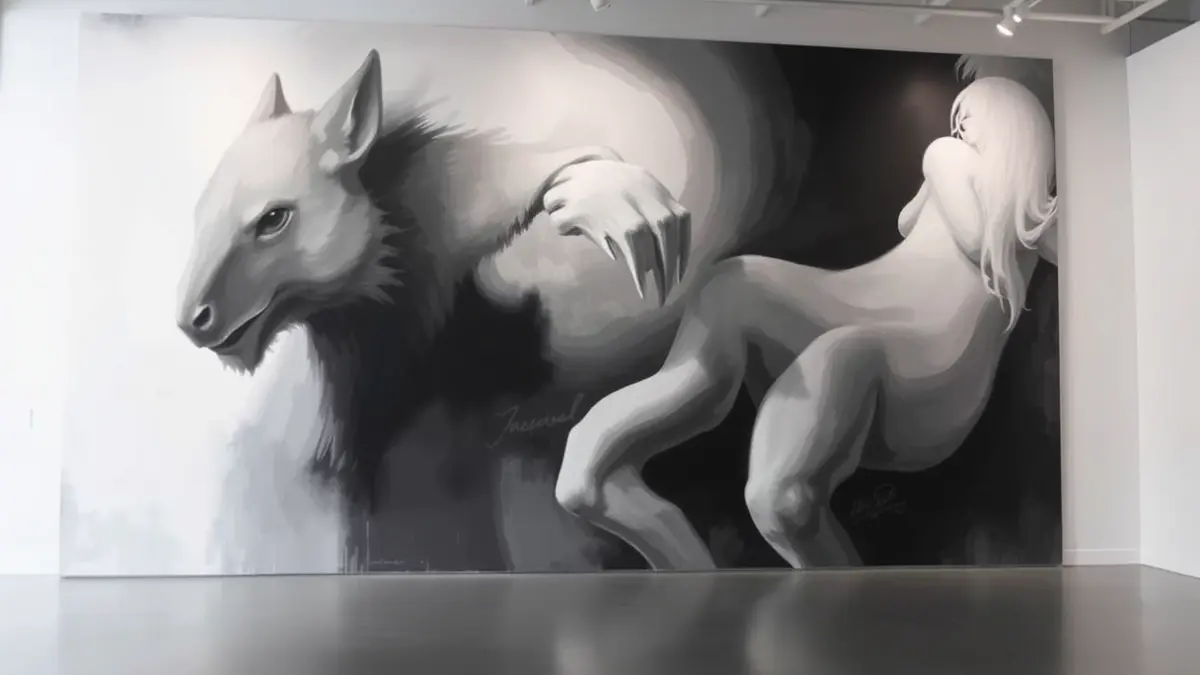
The images in the exhibition are generally solitary and nude, with great expressive force, and often feature animal characteristics, seeking to capture that animal side of the human being. According to Jauregi, each work composing the exhibition is not an isolated image, but part of a journey, forming a kind of chain. The pieces have a mutual connection that proposes a continuous reading for the viewer, but the artist does not seek to guide the interpretation, but rather for each viewer to create their own experience.
Regarding the formal aspect, his works are based on a limited color palette, with grays, whites, and blacks predominating. Light and shadow are fundamental elements for creating atmospheres and enhancing suggestion. From a technical point of view, Jauregi's process is never completely closed, as sometimes a drawing or a stain initiates the work, and from there he develops it. This open and intuitive creative process allows for unexpected evolutions.
The artist's career has been significantly influenced by Basque constructivism, and particularly by his relationships with Nestor Basterretxea and Jorge Oteiza. Furthermore, he lived for 25 years in Mexico, which has had a profound impact on his work, where he discovered the magic of art. His knowledge of new figuration, Mexican expressionism, and indigenous art provided him with a more open perspective, freeing him from Western rigidity.
The Anthropos exhibition is not a space for explanations, but an experience. The artist's intention is clear: for the viewer to feel something, to be moved from within, and not to leave the same way they entered. In that intensity, he places the true meaning of his work.