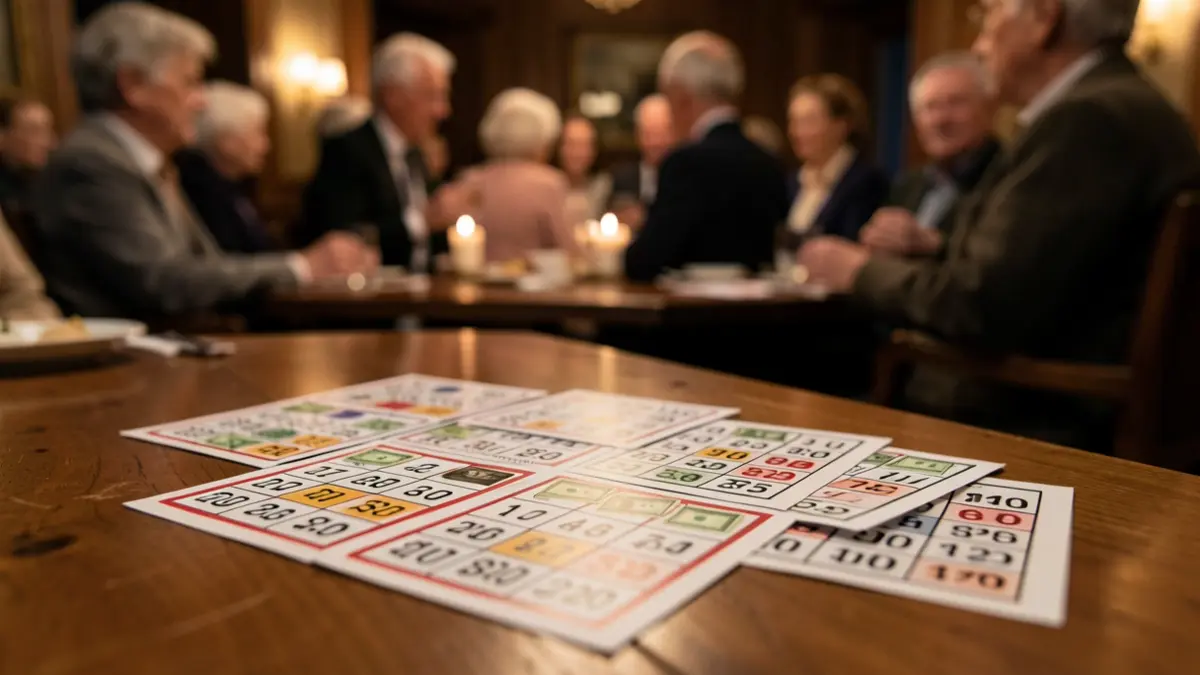
The controversy over whether bingo with symbolic amounts of money should be permitted in senior centers has reached the Basque Parliament after Ertzaintza officers intervened in a retirement home in the Santutxu neighborhood of Bilbao last March to prohibit games with 20-cent bingo cards. The intervention, prompted by a complaint from a nearby gaming hall, was accompanied by a warning of potential fines up to 60,000 euros for an infraction considered serious under the current Basque Gaming Law.
Following this incident, the Basque PP, with the support of the PNV, PSE, and Vox, has pushed for legislative reform to regulate these practices. As the process moves forward, the Basque Chamber has hosted appearances from the involved parties, who present contrasting views on a deeply rooted social activity that finds itself at a legal crossroads.
“"Unfair competition."
The spokesperson for the Association of Bingos of Euskadi, Pedro Jiménez, has denounced that allowing gambling with money in senior centers, however symbolic, constitutes "unfair competition." He explained that the regulated bingo sector has seen a drastic reduction in recent years, from 30 to 14 halls in Euskadi, currently employing between 300 and 400 people. The problem, he states, is that they share the same target audience: the elderly. "We have the same and only clientele; young people don't like bingo," he noted.
Jiménez insisted that they are not opposed to bingo as a social activity, as long as no money is involved. "What difference does it make to me whether I mark with 20 cents or without 20 cents? That's what we don't understand," he stated, suggesting that prizes could be "a snack or a sandwich." The association maintains that gambling with money should remain in the "professional" sphere, which complies with all safety regulations, and warns of the risk, if the law is relaxed, of extending the practice to other groups such as "sports clubs." "Opening that can of worms will bring us problems," he concluded.
“"We need that spark."
The senior association Las Cuatro Torres offers a completely different perspective. For them, that small amount of money is precisely what adds excitement to the games. They argue that bingo is a fundamental social activity in the centers, and the symbolic 20 cents are the "spark" that maintains interest and camaraderie. "We need those 20 cents that you've messed up for me; we need that spark, that's how we are," argued Carlos Matías, their representative.
They recall that in retirement homes, "everyone is family" and they know each other, keeping a record of games and being the first to address any issues. They believe they can self-manage and that the amount played is too small to pose a real risk. The president of the Santutxu center, Iluminada Rosa Raimundo, warned parliamentarians, reminding them that they too will age, that it would be "a mistake to prohibit" bingo. "A fine of 60,000 euros for 20 cents? Where do we have that money? I am astonished."
A study by the Basque Observatory of Gaming, commissioned by the Basque Government, reveals the phenomenon's magnitude. Before the Santutxu incident, six out of ten Basque retirement centers (there are 168) "practiced bingo," but now it's about half. "13% have stopped playing due to fear of sanctions, an impact that has been greater in Bizkaia," explains Iraide Fernández. Social bingo is particularly widespread in Gipuzkoa, where 71% of senior associations practice it, compared to 42% in Bizkaia and 25% in Álava.
The economic component is a determining factor. According to the same study, 71% of senior centers play bingo with money, on average once a week with a pot of 5 euros for the winner. The survey is clear: if playing with money were prohibited, three out of four associations would stop doing so. Faced with this situation, many associations are asking for "clarity" to know where they stand.
Finally, the Gizakia Foundation, dedicated to addiction care in Bizkaia, has provided its recommendations for the reform. They believe regulation can be positive if properly defined, as the benefits of socialization outweigh the risks of gambling addiction in this population. They propose that the activity be limited to non-profit entities with a social purpose, to avoid "scheming," that prizes be symbolic, and that games be occasional to avoid continuously activating the "brain reward" system. These are recommendations that parliamentary groups are already studying for their amendments to the future law.