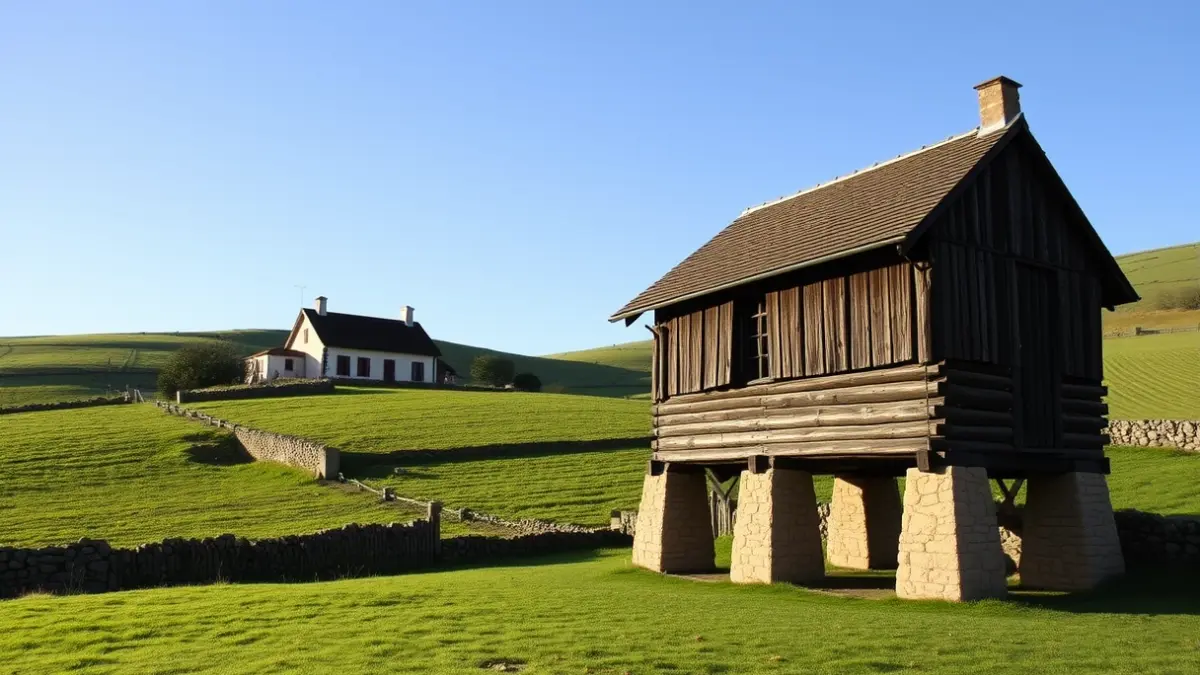
In the Gaztañatza neighborhood of Iurreta, Bizkaia, lies a treasure that often goes unnoticed: a 500-year-old hórreo. This structure, known as the Ertzile hórreo, is highly valued by the Provincial Council of Bizkaia as one of the most spectacular in the region due to its age and state of preservation.
During the 16th century, hórreos were common in the farmhouses of the Bizkaian valleys, especially in the Duranguesado. However, from the 17th century onwards, their numbers began to decline, and by the 18th century, their presence was almost negligible. The Ertzile hórreo is one of the few examples that still stand throughout Euskal Herria.
“"Hórreos were granaries located next to the farmhouse, used to store seeds, grain, apples, chestnuts, and other harvest fruits. These products were kept out of reach of rodents, which is why the stone staircase leading to them is missing its last step."
In addition to storing agricultural products, these granaries also served to represent the family's social prestige. A well-built and well-preserved hórreo was a visible sign of the farmhouse's prosperity. Each of the three compartments of the Ertzile hórreo has its own door and lock, allowing for the separation of products and, when necessary, the management of spaces for different families or tenants.
The disappearance of hórreos was not due to abandonment but to replacement. With the arrival of American corn to Basque farmhouses from the 17th century, the volume of harvests soared. Wealthier families began to integrate storage space within the stone constructions of new farmhouses. The separate granary lost its purpose. In Bizkaia, this process was so rapid and complete that by the 19th century, hardly any examples remained standing.
The Ertzile hórreo also suffered this decline: in the early 19th century, the granary fell into disuse and began to deteriorate. Its history could have ended there, but in 1987, it was reconstructed respecting its original appearance. The reconstruction allowed for the preservation of its most unique constructive features: it is made entirely of oak wood, elevated on four sandstone pillars, and its pieces fit together without a single metal nail. Although privately owned, the Ertzile hórreo remains open for free visits.