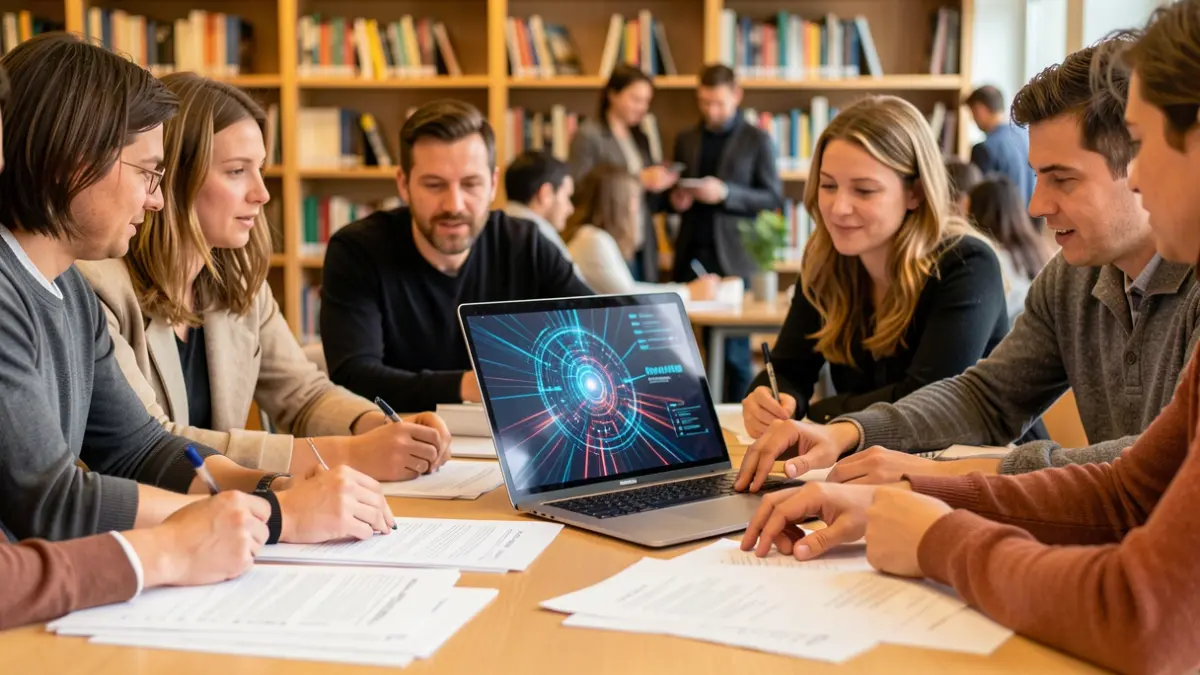
The gathering, themed Tejiendo puentes (Weaving Bridges), brought together over 260 participants, including more than 60 young scientists from master's to postdoctoral researchers, focusing on the results of joint projects and the human relationships that make them possible.
The Human Shelters LTC brings together specialists in paleoanthropology and human evolution from both universities, with a team of 17 researchers from Bordeaux and 19 from the EHU. Their work explores how rock shelters can serve as archives of human history.
The project is driven by, among others, Christine Couture, a professor of paleoanthropology at the University of Bordeaux, and Asier Gómez-Olivencia, an EHU researcher. Gómez-Olivencia explains that the collaboration began over ten years ago with the study of human fossils found in southwestern France, and has progressively grown through publications and co-supervision of theses.
“"Ha sido un camino largo, provechoso y natural. Ha fluido de una manera natural."
Looking towards the future, Gómez-Olivencia emphasizes the importance of continuing to broaden perspectives and train new generations, enabling them to understand the ecosystem on the other side of the Pyrenees. The goal is for knowledge gained from French sites to be applied to those being studied in the Basque Country.
“"Jaso dugun bermearekin eta laguntza ekonomikoekin hori posible izan da, eta, gainera, haratago joan gara, taldea handituz eta jende gehiago erlazioan jartzen. Eta, horregatik, oso-oso aprobetxagarria izan da, eta, dudarik gabe, erabakiorra, gero LTC-a lortzeko."
Christine Couture recalls that the LTC Incubator phase allowed them to structure themselves for two years, providing an administrative framework and solid organization. She highlights that, despite different cultures, languages, and ways of working, the ability to pool them together was crucial for achieving laboratory recognition.
“"Le LTC Incubateur nous a permis pendant deux années de nous structurer."
“"On a des cultures différentes, on a des langues différentes, on a des façons de travailler différentes et je pense que le LTC Incubateur nous a appris à mettre en commun."
Looking ahead, Human Shelters aims to strengthen its academic dimension, explore new connections with the educational sector, and develop joint training programs, initially at the master's level. Transmitting knowledge to new generations will be one of their priorities.
The presentation of Human Shelters is part of a broader cooperation trajectory between Euskadi and Nouvelle-Aquitaine. During the event, Juan Ignacio Pérez Iglesias, the Basque Government's Minister of Science, Universities, and Innovation, emphasized the connection of these laboratories with the Euskadi 2030 Science, Technology, and Innovation Plan.
The event also touched upon historical and personal dimensions. Ricardo Díez Muiño, director of the Donostia International Physics Center (DIPC), evoked memories of those who crossed the border in 1939. Joxerramon Bengoetxea, rector of the EHU, recalled the curiosity sparked by French radio and television. Dean Lewis, president of the University of Bordeaux, stated that what they build together opens possibilities no single institution could offer.
The Euskampus Bordeaux Eguna 2026 program has highlighted the diverse areas of cooperation, presenting initiatives in education, employability, research, innovation, internationalization, and territorial commitment, including collaborations with the ENLIGHT alliance, joint master's degrees, educational robotics, social economy, and neuroscience, as well as the Bizi On program for cancer patients.
The decade of meetings celebrated at Euskampus Bordeaux Eguna 2026 demonstrates that cross-border cooperation is built with time, trust, and shared work, with Human Shelters serving as a clear example of this trajectory.