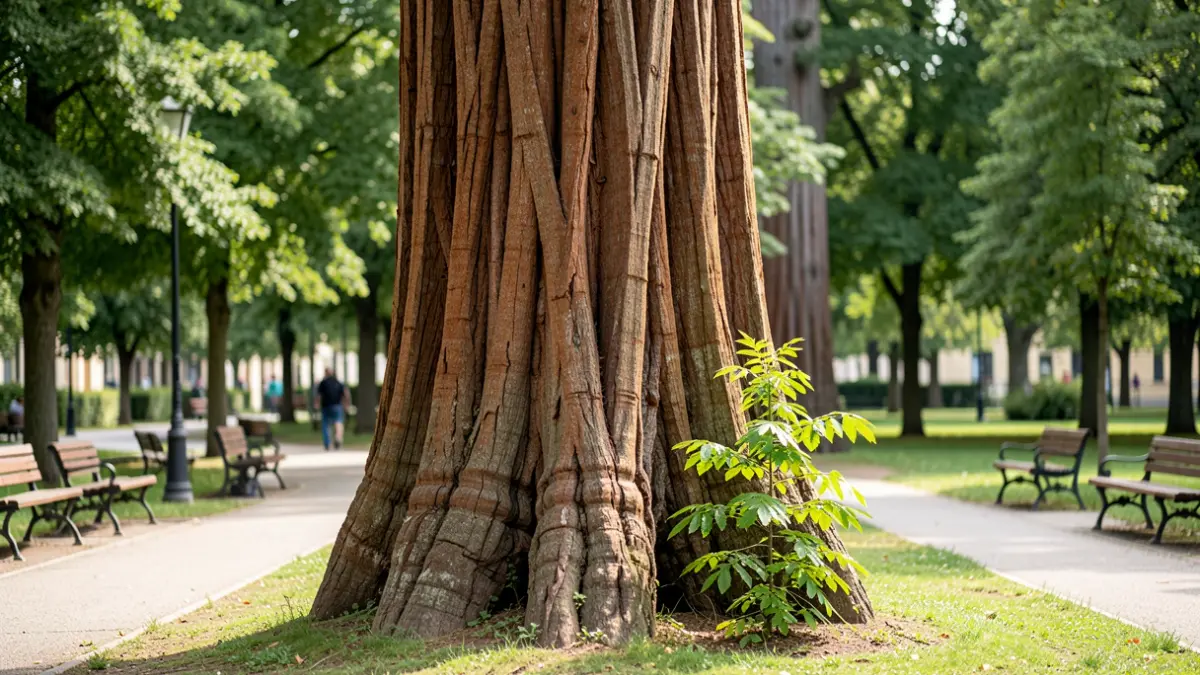
Behind one of the busiest streets in Vitoria-Gasteiz lies one of its great natural symbols: a giant sequoia that, even though it is no longer alive, continues to attract attention. Planted around 1860 by Juan Ibarrondo, who brought it from Brussels, it reached about 40-42 meters in height and over 8 meters in trunk circumference. In 1995, the Basque Government declared it a singular tree.
The problem arose in 2014, when a report confirmed the specimen was dead due to a fungus, Armillaria mellea, which attacked its roots. Despite its condition, the City Council decided not to cut it down. Its enormous dry trunk remained standing for its symbolic and monumental value, becoming part of the city's visual and emotional identity.
After the pandemic, in 2020, the former 'Parque de la Secuoya' was renamed Sempervirens Parkea, the "Evergreen Park". The Basque Government and the City Council remodeled the space to turn it into a memorial dedicated to the victims of COVID-19. The old dry sequoia represents memory, while a new young sequoia planted beside it symbolizes life and continuity.
Vitoria-Gasteiz also preserves other examples of artistic interventions on dead trees. In the Etxanobe gardens, next to the Camino de Santiago, stands the sculpture "Peregrin@". A lightning strike killed a centenary sequoia planted around 1860, and its trunk was worked on by sculptor Santiago González, transforming it into a figure about five meters high, inaugurated in 2010.
In Álava, similar stories surround singular trees like the 'Roble de Estarrona', also known as the "Fat Oak of Estarrona". This common oak of extraordinary dimensions witnessed the 'Battle of Vitoria' in 1813. Despite its popularity and historical value, it received no institutional protection. Finally, in 1921, it was destroyed by a bonfire, but part of its wood was reused to make a large table for the Provincial Council of Álava and an information panel exhibited at the Ibero-American Exposition in Seville (1929-1930).