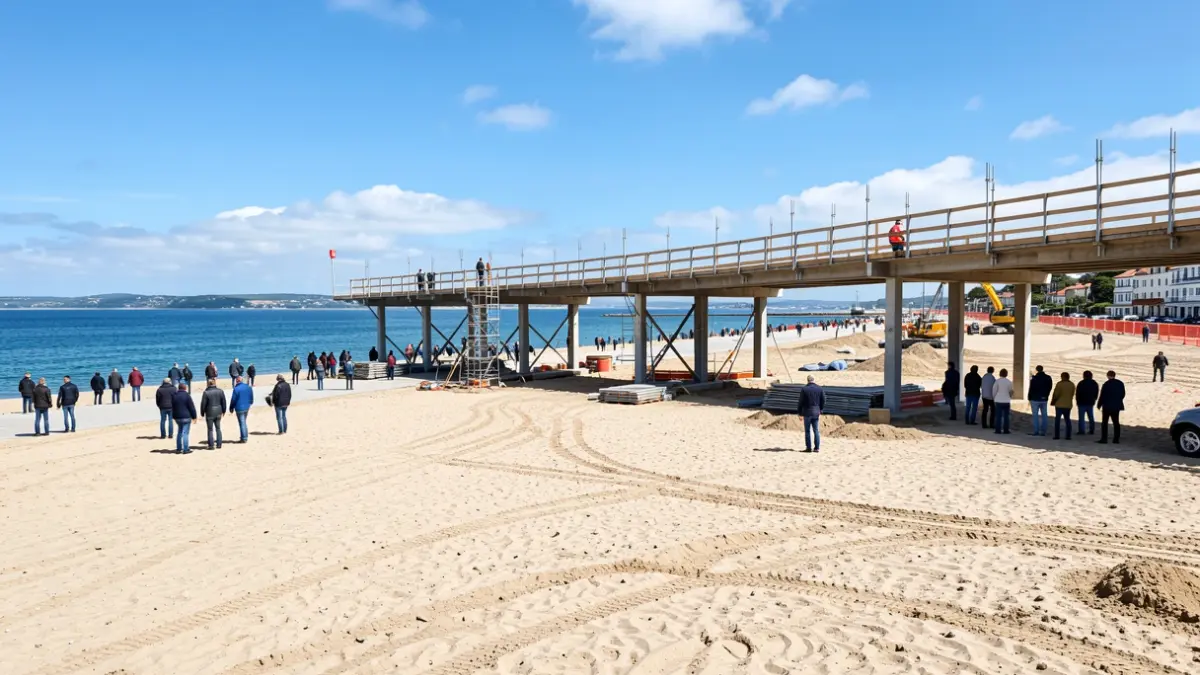
The works for the LIFE IP Urban Klima 2050 project have begun on the promenade in Zarautz. This initiative, funded by the European Union and coordinated by the Basque Government's Public Environmental Management Company, Ihobe, is the largest climate action project in Euskadi, involving over twenty entities.
The first phase involves remodeling the western access points to the beach, starting with the demolition of stairs leading to the sea near Munoa Square and the existing cantilever. Additionally, the promenade's elevation will be raised to improve safety and accessibility, and to prevent flooding and structural damage.
Mayor Xabier Txurruka (EAJ-PNV) stated that the Zarautz City Council has maintained constant contact with local residents and business owners to agree on the project's details.
Preliminary work began in 2020 with the Zarautz City Council's 'Diagnostic and Alternatives Assessment Report'. Subsequently, in May 2024, the 'Preliminary Project' was developed, outlining actions to mitigate climate change effects. The Narros-Munoa area remodeling is considered a priority within the LIFE program's funding limits.
Continuing the initiative, in 2025 the Zarautz City Council tendered the project's drafting and construction management. In 2026, the works were tendered and awarded to Construcciones Mariezcurrena S.L. for 1,244,955.75 euros (VAT included), with an approximate execution period of 7 months. The European Union will contribute 696,231 euros, the Basque Government 380,000 euros, and the Zarautz City Council the remainder.
The mayor explained that the works are not commencing earlier due to winter weather conditions and heavy surf.
Zarautz beach, the longest in the Basque coast at 2,100 meters, faces significant challenges from rising sea levels and increased wave intensity. The 2014 storm caused severe damage to the promenade. Projections indicate a potential loss of 30% of its surface area by 2050 and between 65% and 90% by 2100. This poses economic risks and, more importantly, leaves coastal structures more vulnerable.