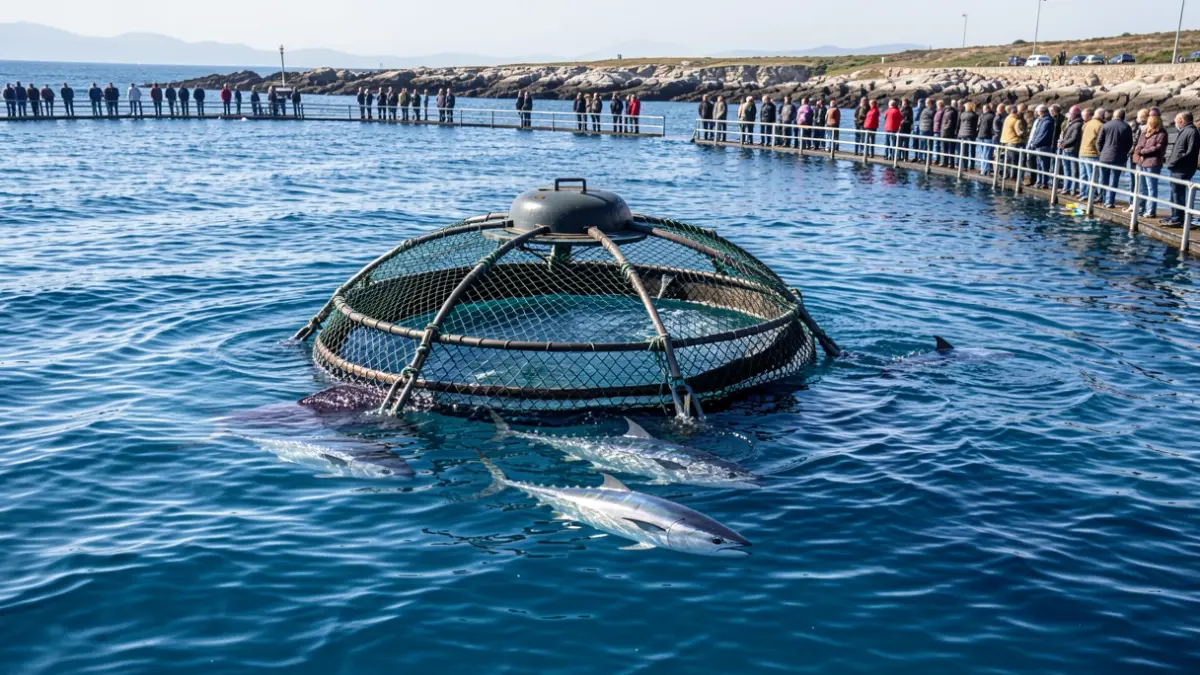
The bluefin tuna farming project in the waters off Getaria, led by ItsasBalfegó (a collaboration between the firm Balfegó and the technological center Azti), confronts a significant challenge: how to transition from catching 80 tuna off the coast of Gipuzkoa to achieving 1,500. Their promoters view this as a «long-term» objective, supported by a recent request to the Basque Government for permission to continue this farming activity for the next 50 years.
Pilot tests conducted in 2025 have demonstrated that farming bluefin tuna in submersible cages «is technically possible and lays the groundwork for its economic viability in the Cantabrian Sea». ItsasBalfegó successfully completed its first farming cycle with 80 specimens caught 48 kilometers off the coast of Gipuzkoa, an activity monitored by the Secretary of Fisheries and the International Commission for the Conservation of Atlantic Tunas (ICCAT).
«We have proven that farming bluefin tuna in the Cantabrian Sea is possible. Now, we must ensure it is viable, safe, and sustainable on a large scale. Therefore, 2026 is a year for consolidating the foundations», states Juan José Navarro, deputy director of ItsasBalfegó. In the 2025 campaign, locating a school of tuna weighing over 100 kilos using a purse seine net required nearly two weeks of navigation, an effort that «would not be sustainable» for an industrial operation.
To enhance the efficiency of resource location, Azti and the Basque fishing sector will conduct the first comprehensive bluefin tuna prospecting campaign in the Cantabrian Sea between June and July. This initiative will identify and characterize schools of the species to create a distribution map that will facilitate future capture operations. The goal is to develop a plan to access the tuna that will be farmed in the two submersible pools located 3.7 miles from the port of Getaria.
Scaling up from 80 specimens to industrial volumes of 1,500 tuna weighing over 100 kilos «requires highly qualified diving personnel within the farms themselves», they note. The operations of capturing, towing, and transferring live tuna between pools are technically complex and demand specific training for both occupational safety and animal welfare reasons.
The 2025 pilot campaign was carried out under a temporary authorization from the Ministry, as purse seine fishing is generally not permitted within twelve miles in the Cantabrian Sea. Consequently, the industrial development of the project now requires permanent authorizations from ICCAT, the General Secretariat of Fisheries, and the Basque Government. ItsasBalfegó has chosen not to commit to a large-volume campaign until a solid and stable regulatory framework is in place.
«We don't want a project for one year, but for decades. That requires firm legal foundations, and we are working on that with all administrations», says Navarro. ItsasBalfegó confirms ongoing discussions with the Basque fishing sector for its formal incorporation as a partner. This adhesion would strengthen the project's collective nature and help align the interests of various stakeholders in the bluefin tuna value chain in Euskadi. The initiative allows for the utilization of Euskadi's allocated bluefin tuna fishing quota, preventing its transfer, promotes the creation of skilled employment on the Basque coast, and «aims to supply the region's renowned high-end restaurant sector with top-quality bluefin tuna».
The company explains that the project respects artisanal fishing zones and quotas at all times, keeping them unchanged, and is conceived as a complementary activity that diversifies the offering without competing with traditional fishing. All phases of the activity are carried out under the supervision and authorization of the Basque Government, the General Secretariat of Fisheries, ICCAT, Maritime Captaincy, the Provincial Coastal Service, and the municipalities of Getaria and Zarautz, incorporating continuous environmental monitoring systems via sensors and cameras.